
Essays · Photography
Bernd Becher and Hilla Becher. Water Towers.
Keep everything the same, and difference appears.
Tate · Tate
Nine water towers on one wall
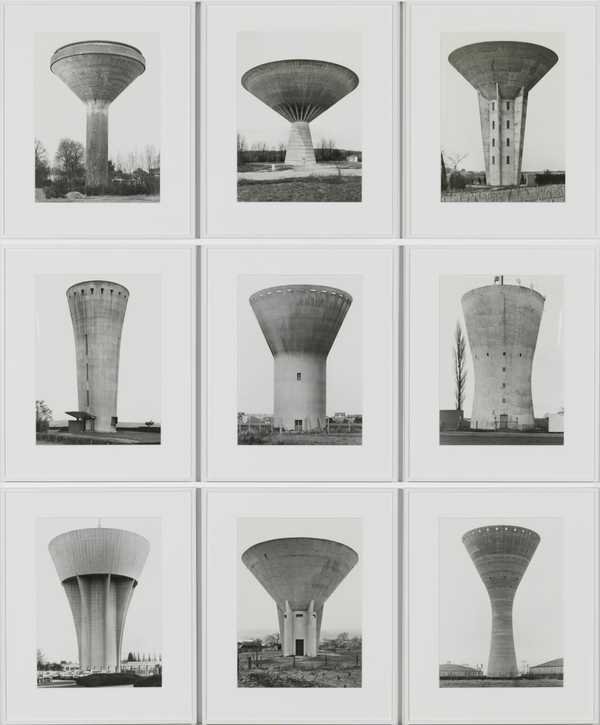
Water Towers in the Tate collection is made of nine black and white gelatin silver prints hung as a grid. Each shows a single water tower. Tate dates the work 1972 to 2009, a span of almost forty years.
Over the years the Bechers photographed water towers in many regions, built at different times for different industrial sites and towns. Water towers come in many kinds: steel or concrete, round tanks or flared ones, a single column or many legs.
In the photographs, though, they are treated alike. Each tower sits in the middle of the frame, shot straight on, against an even grey sky. No people, no dramatic clouds. Nothing pulls the eye away from the form.
When the nine stand side by side, the eye starts comparing on its own. A tank larger or smaller. Legs slender or thick. A ladder outside or hidden inside. These differences only appear because everything else has been held constant.
A method, not a style
Bernd Becher was born in 1931, Hilla Becher in 1934. They began working together at the end of the 1950s and did so for nearly fifty years, until Bernd died in 2007. Hilla went on printing and completing the series afterwards, which may explain the 2009 in this work's date.
They used a large format camera and fine grained black and white film so that every detail of a structure would read clearly. They chose overcast days, when light is even and shadows are soft. They shot frontally, from a slightly raised viewpoint.
Then they grouped the pictures by the function of the structure: water towers with water towers, blast furnaces with blast furnaces, cooling towers with cooling towers. This is called typology, sorting by type. It borrows from natural science, where botanists press leaves and zoologists lay out specimens side by side.
Anonymous sculpture
In 1970 the Bechers published a book titled Anonyme Skulpturen, Anonymous Sculptures. The name says how they saw these structures. Nobody thinks of a water tower as art. It was built by engineers, not artists. Yet its form, placed beside others of its kind, carries the weight of sculpture.
In 1990, at the Venice Biennale, the Bechers received the Golden Lion, and it was awarded for sculpture rather than photography. That detail says a lot: their pictures were read as a way of holding form in space.
They also taught at the Düsseldorf Art Academy. Many of their students became major photographers, among them Thomas Struth, Andreas Gursky and Thomas Ruff. Each went his own way, but all carried their teachers' calm, distant, unexclaiming gaze.
An archive before disappearance
Many of the structures the Bechers photographed have since been demolished. Water towers, mine heads and blast furnaces belong to an industrial era that was closing in Europe and North America. When the function ends, the building ends too.
So Water Towers gains another layer over time. When it was made, it was a study of form. Today it is also an archive. Some towers survive only in these prints.
The Bechers never speak of regret. Their pictures are not sad or nostalgic. They simply record, precisely and evenly. That calm is what makes the viewer realise: a material world once stood there, and someone took the trouble to look at it one piece at a time.
Photography