
Essays · Photography
Ralph Eugene Meatyard. The Family Album of Lucybelle Crater.
The face is hidden, yet the family is still there.
Fraenkel Gallery · Fraenkel Gallery
A weekend photographer
Ralph Eugene Meatyard was an optician in Lexington, Kentucky. He photographed mostly on weekends, around the town where he lived, with his wife, children, friends and neighbours as models. He did not make his living from photography. Yet what he left makes him one of the most singular voices in mid century American photography.
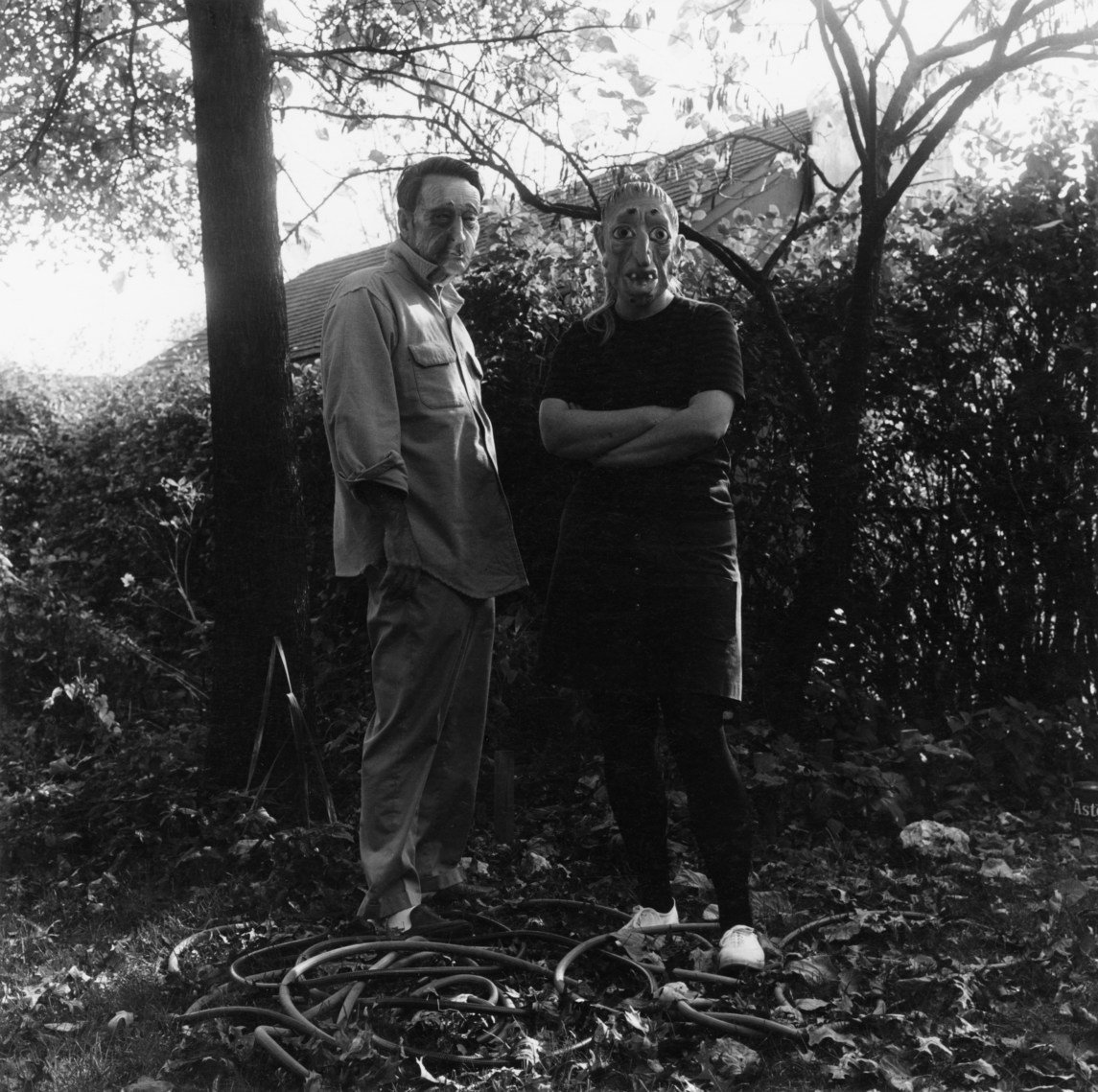
An optician's trade is a trade of seeing. On weekdays he helped people see more clearly. On weekends he did the opposite: he placed a cover over the most familiar things so we would have to look again. In this series the cover is a very cheap mask, enough to turn a family scene into something hard to name.
Meatyard read widely. He was drawn to Ambrose Bierce's definition of romance: fiction that owes no allegiance to things as they are. For him, photography did not have to be faithful to reality. It could build another one.
Two people, one name
The Family Album of Lucybelle Crater is the series Meatyard made in his last years, roughly 1970 to 1972. At its centre is his wife, Madelyn, wearing a dime store hag's mask of the kind sold for Halloween. In each picture she stands beside someone else: a relative, a friend, a child. That person wears a hard, transparent plastic mask.
The name Lucybelle Crater was adapted from a character in Flannery O'Connor's story The Life You Save May Be Your Own, published in 1953. Meatyard altered it slightly and gave it to everyone.
The strangeness lives in the titles. Each follows the same pattern: Lucybelle Crater and someone who is also named Lucybelle Crater. Lucybelle Crater and her forty year old husband Lucybelle Crater. Lucybelle Crater and her sixteen year old son's quiet, demure girlfriend Lucybelle Crater.
The captions spell out the relationship. The name wipes out the difference. We know who is husband, friend or child, but not who is who.
An album of a faceless family
A family album has a clear task: to keep the faces of relatives as they grow, age, leave. Meatyard turns that task over. He uses the album's form, pairs of people before a house, in a garden, on a porch, but removes the very thing albums exist to hold.
The result is both comic and unsettling. The wrinkled, rigid hag's mask repeats in every frame. The clear masks are worse: they show real features but blur and bend them, like a face seen through fogged glass. Identity does not vanish. It is held in between.
Meatyard died in 1972, at forty six. The book was published by the Jargon Society in 1974, after his death, with sixty four pictures. It became his best known work.
Read today, the album reminds us that every family photograph has masks we no longer notice. The smile on the count of three. The best clothes. The arranged pose. Meatyard only made the mask into an object we can see.
Photography