
Essays · Photography
Lewis Baltz. The New Industrial Parks near Irvine, California.
A blank wall is also a testimony.
MOCA Los Angeles · MOCA Los Angeles
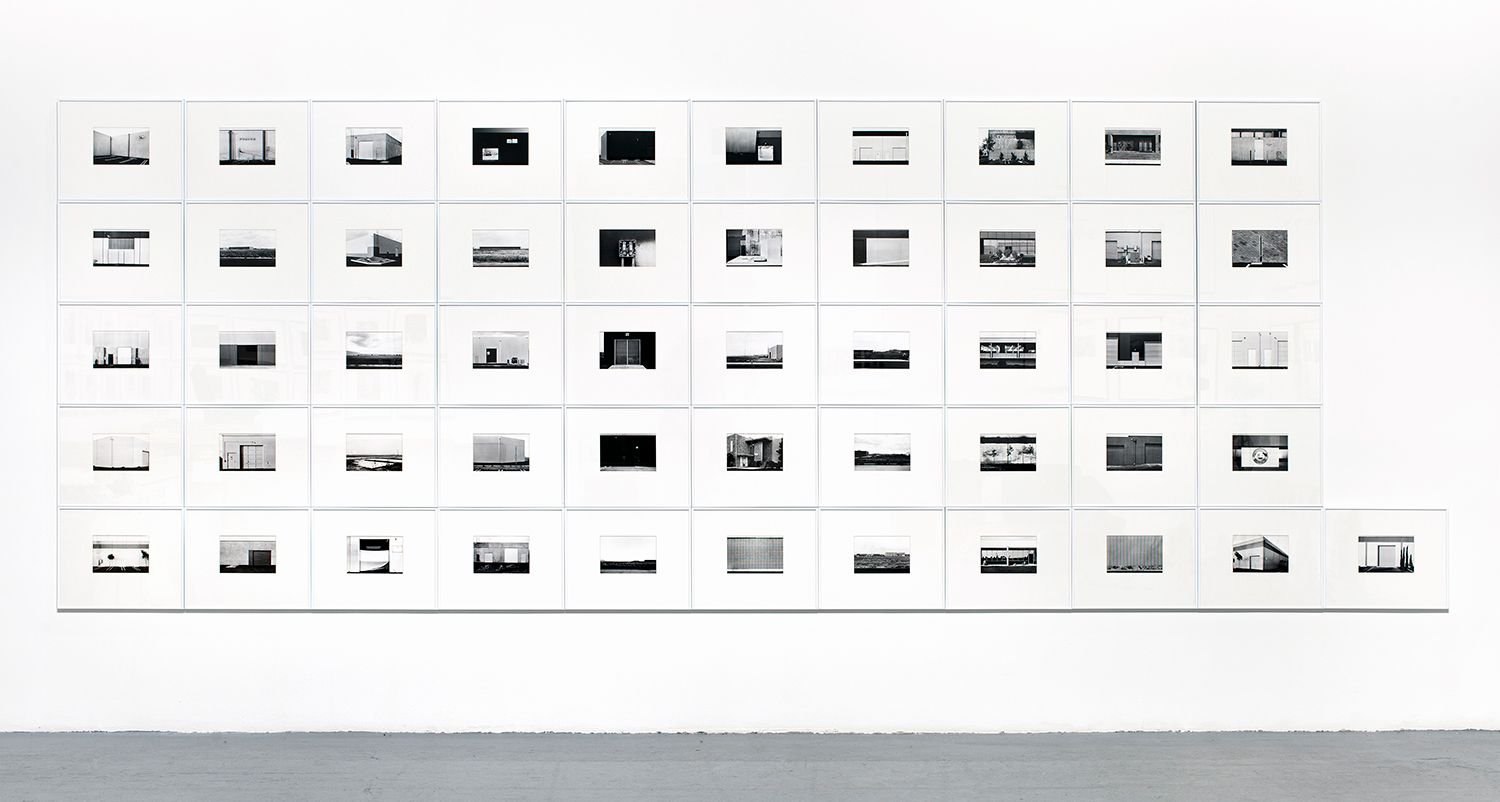
Fifty one small prints
The New Industrial Parks near Irvine, California is a set of 51 black and white gelatin silver prints made in 1974. Each is only 20.3 by 25.4 centimetres, the size of a small sheet of paper. The Museum of Contemporary Art, Los Angeles holds the complete set, a gift of Mr. and Mrs. Timothy A. Eaton.
Irvine lies in Orange County, south of Los Angeles. In the early 1970s new industrial parks were rising around it: low sheds, single storey offices, parking lots, roads without trees. They were built quickly, to a template, for companies no one needed to remember.
Baltz photographed exactly that. A wall. A closed roller door. A corner with a drainpipe. A patch of empty ground before a building. One print follows another, barely different, until the viewer's eye begins to find the differences on its own.
No people, no feeling
MOCA describes the series as a conceptual and critical approach to the urban environment. The pictures are straight, flat, evenly lit. No dramatic sky, no odd angle.
Most obvious is the absence of people. The museum reads this as an attempt to remove even the photographer's presence from the image. The camera stands there like a measuring device, without attitude. We cannot tell whether Baltz liked or disliked these buildings.
Yet there is detail. The museum points to piles of dirt and markings on partly painted walls. These are traces of construction: land just turned into an industrial park, and the turning not yet finished. The prints catch the in between moment, when a building stands but is not yet really in use.
New Topographics
Lewis Baltz was born in 1945 in Newport Beach, California, not far from Irvine, and died in 2014. He grew up as Southern California's suburbs spread, and this series is the view of someone watching home change shape.
In 1975 his work appeared in New Topographics: Photographs of a Man Altered Landscape at George Eastman House in Rochester, with Robert Adams, Bernd and Hilla Becher, Stephen Shore and others. MOCA writes that Baltz's stark, objective approach is what aligned him with that movement.
The title states the aim: landscape altered by people. These photographers turned from idealised scenery to the built environment. Within the group, Baltz perhaps pushed coolness furthest. Adams still saw light and mountains. Baltz saw walls.
Why a wall is worth looking at
At first glance the series might pass for a property developer's documentation. But it sells nothing. No best angle, no sunset glow. The buildings appear as they are: generic, anonymous, replaceable.
That anonymity is the subject. Such parks are everywhere, and so alike that we pass them without seeing. Baltz makes the viewer stop before what the eye always slides over.
Fifty years later the scene has spread across the world: warehouses, distribution centres, office parks along highways. Baltz's small prints read like a quiet, exact forecast. They do not call it good or bad. They say only: this is what we built, look at it.

Photography