
Essays · Photography
Josef Koudelka. Exiles.
No home. Only the road.
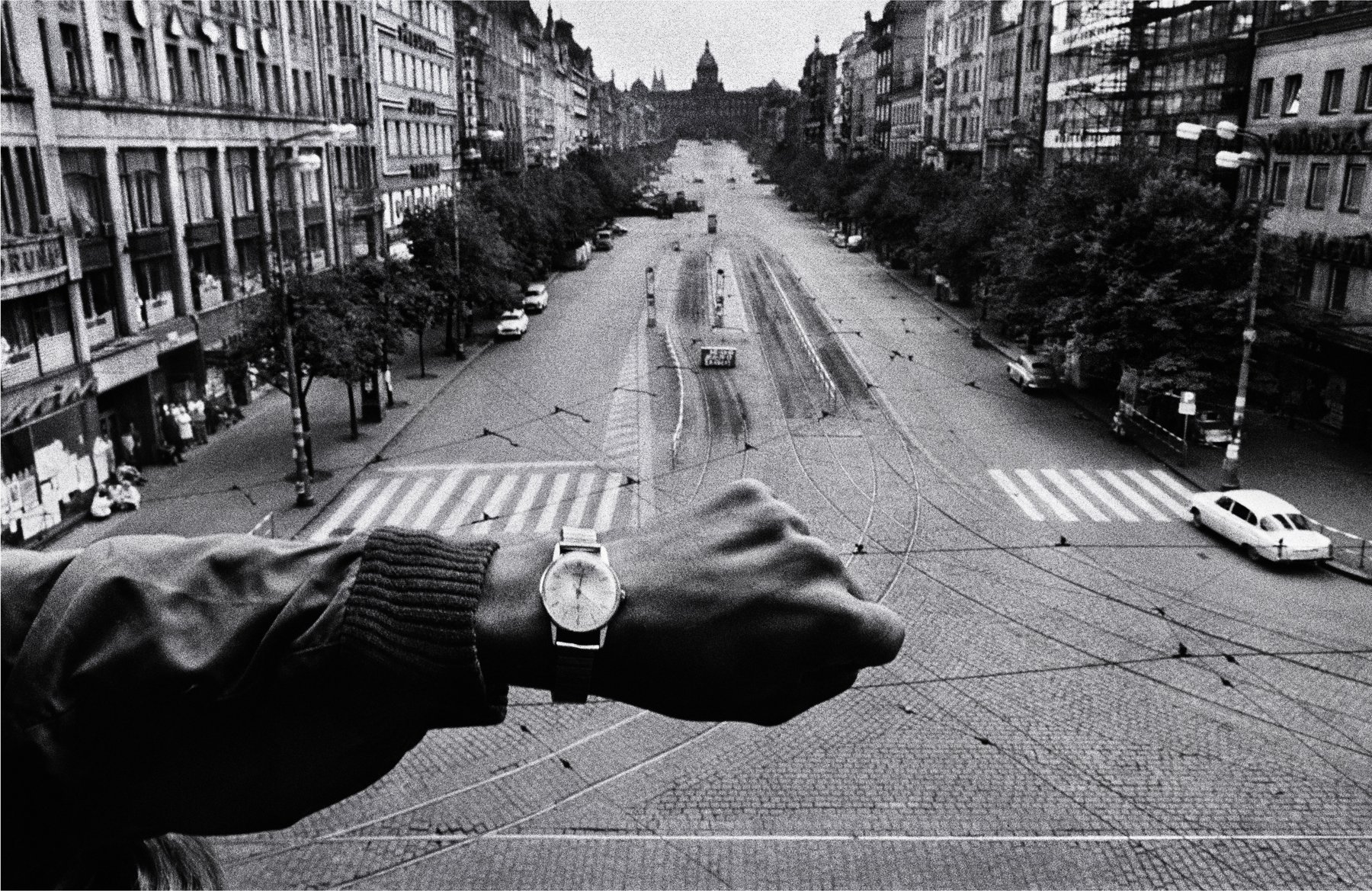
© Josef Koudelka · Magnum Photos
Leaving Prague
In August 1968, Warsaw Pact troops entered Czechoslovakia. Josef Koudelka, then a young engineer who had not been photographing for long, was on the streets of Prague. He photographed tanks, crowds, people standing in front of gun barrels.
The pictures were smuggled abroad and published around the world without the photographer's name. In 1969 the anonymous photographer was awarded the Robert Capa Gold Medal by the Overseas Press Club. He could not accept it under his own name without endangering himself and his family.
In 1970 Koudelka left Czechoslovakia and sought political asylum. Soon after, he joined Magnum Photos. He remained stateless until 1987, when he became a French citizen and held a passport again.
A sleeping bag and fifteen years
For about fifteen years Koudelka lived with almost nothing. One sleeping bag. One pair of shoes. Two pairs of socks. A pair of trousers a year. One jacket. Two shirts, which lasted three years. He bought no house and rented no flat. Many nights he slept outside.
He took no assignments and did not photograph for money. He photographed for himself. He kept moving, seeking out festivals and places where people gathered, and never stayed anywhere longer than three months.
He travelled from Ireland to Spain, from England to Switzerland, from his native Czechoslovakia to France, which later became his second home. He worked in 35mm black and white. The contact sheets he kept run into the tens of thousands.
What is in the frame
The pictures in Exiles rarely report an event. They are small scenes: a dog on snow, a man by the roadside, a station platform, a field, an empty street corner. Many hold few people, and those there tend to turn away or stand far off.
The frames are often tight, with broad areas of black and hard light. The photographer seems always to stand at an edge: of a crowd, a town, a ceremony. There are self portraits too, rare ones, in which the exile steps into his own frame.
No picture speaks directly of homesickness. But together they show a man looking at the world as a place he does not belong to. And because he does not belong, he looks very closely.
These were years before mobile phones and email. An exile then was truly cut off from the place he had left. Letters were slow; going back was impossible. Every picture in Exiles was made by someone who knew there was no way home, at least not for a very long time.
The book and its returns
Exiles was first published as a book in 1988 by Robert Delpire in Paris, with an English edition from Aperture in New York. It carries texts by the poet Czesław Miłosz, himself an exile, along with Robert Delpire and Stuart Alexander. Later editions added ten new images and new commentary.
In February 2017 the Centre Pompidou in Paris opened an Exiles exhibition of photographs from 1968 to the early 1980s, including unpublished images and self portraits. The accompanying book was titled La Fabrique d'Exils.
Read beside Brian Goeltzenleuchter's Scents of Exile, a work that uses smell to speak about exile, two roads lead to the same question. What does a person who leaves carry with them? Goeltzenleuchter looks for the answer in scent. Koudelka looks for it in light, and in roads that do not lead home.
Exiles does not retell a life. It keeps what one man saw in the years when there was nowhere to return to.
Photography