
Essays · Photography
Robert Adams. The New West.
The landscape was never empty of us.
Philadelphia Museum of Art · Philadelphia Museum of Art
A book from 1974
The New West: Landscapes Along the Colorado Front Range appeared in 1974 from Colorado Associated University Press in Boulder, with a foreword by John Szarkowski, then MoMA's director of photography. A slim book, black and white, small in format.
The Front Range is the eastern edge of the Rockies, where plain meets mountain. In the early 1970s the area around Denver and Colorado Springs was growing fast. Grassland was divided into lots. Prefabricated houses went up in rows. Shopping centres, parking lots and highways joined up.
Adams arranged the book in five parts, following the land from low to high: prairie, tracts and mobile homes, the city, foothills, and the mountains. The reader takes a familiar Western journey, from plain to peak. But along the way what they meet are roofs and billboards.
Photographing what others passed over
For nearly a century, photography of the American West was photography of grandeur. Deep valleys, cliffs, clouds, rivers. The camera carefully avoided roads and houses to keep the picture of a land no one had touched.
Adams did the opposite. He set up in the middle of new housing and photographed a stucco wall in noon sun, a woman behind a window, a freshly graded road of bare earth. His prints are bright, close to overexposed, because high plains sunlight is harsh. The sky is often white.
There is no sneer in these pictures. Adams did not photograph the suburb to mock it. He photographed it as landscape, with the same attention earlier photographers gave to canyons. So the viewer begins to see things too familiar to notice: the shadow of an eave, the mountain skyline behind a fence.
An exhibition in Philadelphia
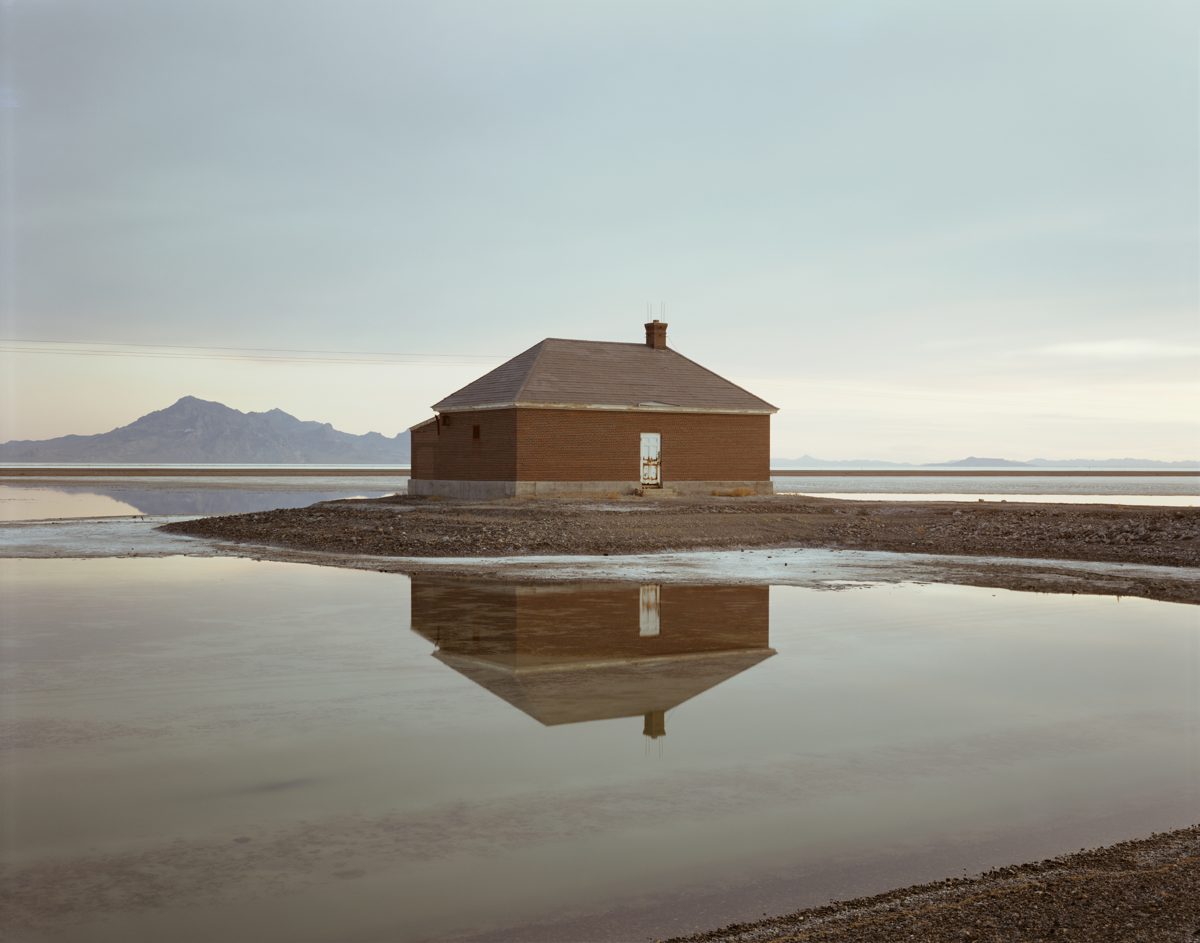
From 25 April to 12 July 1981, the Philadelphia Museum of Art showed The New West: Photographs by Robert Adams, curated by Michael E. Hoffman and Martha Chahroudi. Its core came from the portfolio From the Missouri West, reaching beyond Colorado into Nebraska, Wyoming, Arizona, California, Oregon and Utah.
The museum listed what Adams photographed: roads bulldozed for new housing, man made lakes, winding highways, roadside commercial buildings. It also recalled his view: he rejected the idea that what is not wild is not natural.
In the museum's words, his pictures suggest the possibility of reconciling human presence with the natural world. Not choosing one over the other. People are here. The mountains are here too.
Landscape after New Topographics
Robert Adams was born in 1937 and taught English literature before turning fully to photography. In 1975 his pictures appeared in New Topographics, a group show in Rochester, alongside Lewis Baltz, Bernd and Hilla Becher, Stephen Shore and others. The show's title later became the name for a whole new way of seeing landscape.
Within that group, Adams had his own voice. Baltz's pictures are cool and flat. Adams's still carry worry, and care. He wrote a great deal, and his writing shows grief at land being carved up, without giving up on the light that falls on it.
Fifty years on, The New West reads like a book about now. Every growing city has such an edge: empty lots, show homes, new roads, and something of the old view in the distance. Adams teaches a way of looking at that edge. No lament, no gloss. Just looking.
Photography