
Essays · Photography
Masahisa Fukase. Family.
Each group portrait, the album loses someone.
© Masahisa Fukase Archives; courtesy Michael Hoppen Gallery, London · Aperture
A photo studio in a small town
The Fukase family ran a photography studio in Bifuka, a small town in northern Hokkaido. It was the kind of studio every Japanese town had then: where people came for wedding pictures, graduation pictures, portraits for important occasions. Masahisa Fukase grew up inside it, among darkroom chemicals and painted backdrops.
He did not take over the business. He went to Tokyo, studied photography, and became one of the most daring photographers of his generation. But from 1971 he began returning to the family studio whenever the family gathered, and photographing everyone.
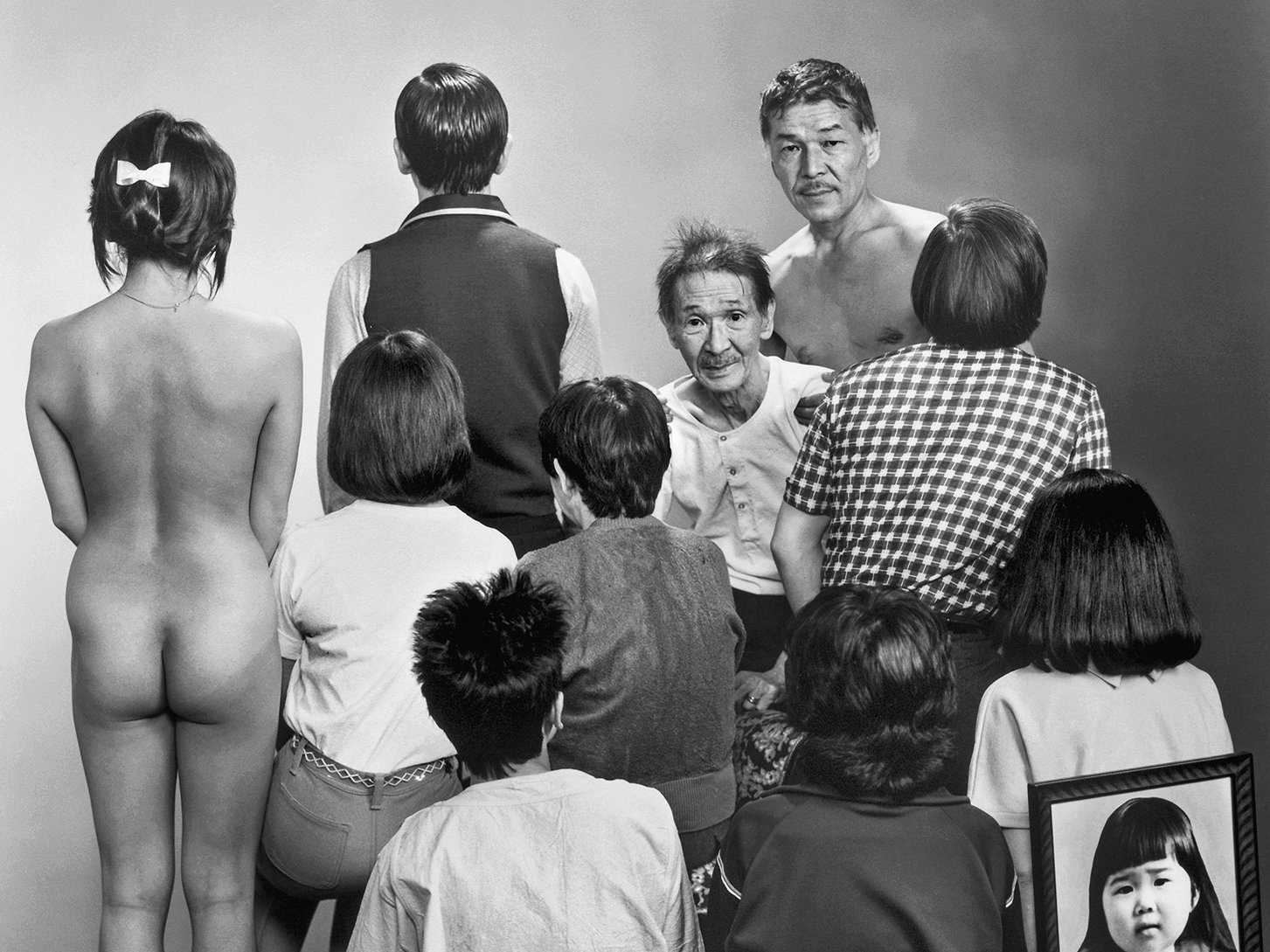
He photographed them exactly the way the studio photographed its customers: lined up before a backdrop, facing the lens, properly dressed. A commemorative portrait. Then the next year, another. The series ran until 1989 and is called Family, in Japanese Kazoku.
Strangers in the family picture
At a glance the pictures look entirely ordinary. The father, Sukezo; the mother, Mitsue; siblings, relatives. Look closer and something is off.
In many of the pictures from the 1970s, among the relatives stand nude or seminude women. They are not family. They have nothing to do with the family at all. Fukase put them in the frame as a joke, a deliberate misalignment.
Their presence breaks the rules of the genre. A family portrait is a serious thing, to hang in the living room, to send to relatives. With a naked stranger in the middle, the viewer has to ask: what is a family picture, who is allowed in it, and what exactly is this commemorative photograph commemorating?
In the same years Fukase was making Karasu, his ravens in the snow of Hokkaido. Two series from the same home ground and the same period: one a game played in a lit studio, the other darkness outdoors.
The funeral photograph
In 1987 the father, Sukezo, died of pneumonia. During the funeral, Fukase gathered the family once more, some still in mourning clothes, and took a group portrait as always.
With one difference. Where the father would have stood, Fukase placed a portrait of him taken in 1974. The dead man appears in his own funeral picture, as a photograph.
This is the moment when the whole series shows what it was. From the start these commemorative portraits had been a kind of memento mori, a reminder of death. To photograph once a year is to count once a year. The family ages, leaves, dies. The album records it all without a word of commentary.
When the studio closed
By 1989 the family had scattered. His brother divorced. The sister moved away. The mother went into a care home. The family studio, open for some eighty years, closed. There was no one left to stand before the backdrop, and no backdrop either.
The series ends there. In 1991 two books were published: Family, and a separate volume about his father, Memories of Father.
Looking back, Family is a work about photography itself. A small town studio that had photographed so many other families over eighty years ends by recording the dissolution of its own. The commemorative portrait, made to preserve, ends up recording loss with great clarity.
Not long after, an accident in 1992 left Fukase unable ever to work again. Family is thus almost his farewell to the craft, and to the house where he first learned to look through a lens.
Photography