
Essays · Olfactory Art
Francis Kurkdjian. Parfum, sculpture de l'invisible.
A smell has no shape, yet it takes up space.
Palais de Tokyo · Palais de Tokyo
A perfume house in a museum
From 29 October to 23 November 2025, the Palais de Tokyo in Paris hosted an exhibition called Parfum, sculpture de l'invisible. Perfume, sculpture of the invisible. It sat on an intermediate level of the building, in a space called the Saut du Loup.
The name on it was Francis Kurkdjian, the French perfumer and creative director of Maison Francis Kurkdjian, the house he founded in 2009 with Marc Chaya. The house itself organised the show, to mark thirty years of his work. Visitors had to book through the brand's own website.
That detail matters. The Palais de Tokyo is one of the major contemporary art centres in Paris. This time, though, the storyteller was not an independent curator. It was a brand telling its own story in the language of a museum.
This does not make the show less worth looking at. It only changes how one looks. Visitors moved through rooms that were part exhibition, part memoir of a man who makes smells.
The people in conversation
The exhibition was built as a series of conversations. Kurkdjian worked with people from many trades: the artist Sophie Calle, the artist Yann Toma, the theatre director Cyril Teste, the photographer Christelle Boulé, the conductor and cellist Klaus Mäkelä. The French press also mentions the designer Felipe Ribon and the chef Anne-Sophie Pic.
Sophie Calle, who once turned the belongings of hotel guests into art in The Hotel, heads the list. According to reports on the show, the two met in 1999, when Calle asked Kurkdjian to turn the smell of money into a perfume. He has called that meeting a turning point. It was the first time an artist asked him not for a pleasant smell but for an idea.
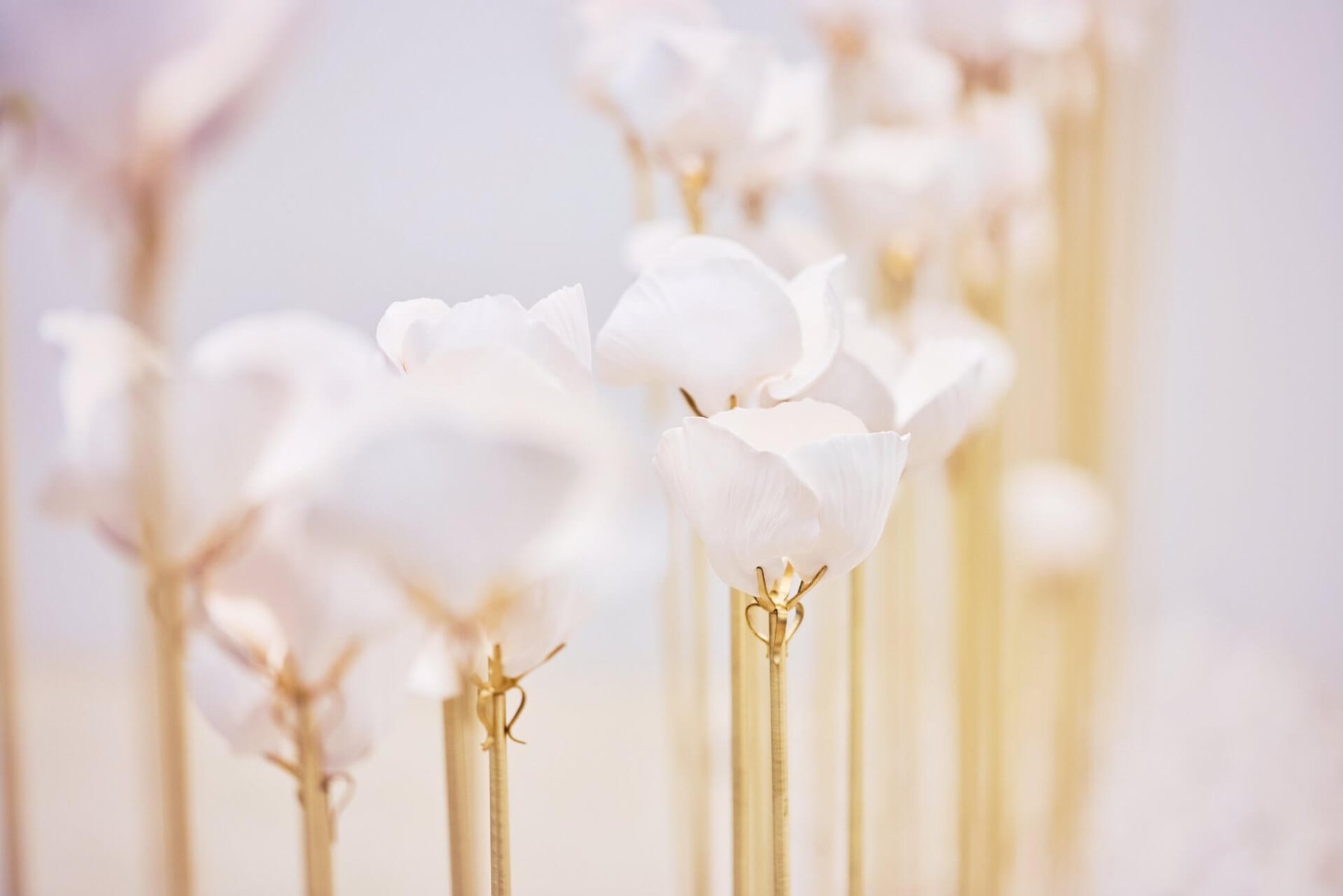
With Yann Toma he made L'Or bleu, a perfume you can drink. In the show it ran from a small fountain. In another corridor stood porcelain roses fired by artisans of the Manufacture de Sèvres, and the porcelain petals themselves gave off scent.
Each object is a way of taking smell out of the bottle. Into water to drink, into porcelain to look at, into music, into photographs. The show called them heritage works, olfactory installations and scented objects.
A room around a bottle
The newest work was L'Alchimie des sens, the alchemy of the senses. An immersive installation built around Baccarat Rouge 540, the best known scent of the house.
Here the idea of sculpture goes furthest. A smell that normally lives in a bottle, sold in a shop, sprayed on a wrist, is spread out into a whole room. The visitor does not pick the smell up. They walk into it.
Here too the show is most torn. A room built around a best selling product is a work and a presentation at once. Visitors are free to sense both. There is no need to choose.
Is smell a sculpture?
The question in the title is much older than the show. Since the early twentieth century, artists have tried to bring smell into galleries. But perfumers have rarely been invited into museums as authors. They usually stand behind the bottle, behind the brand, behind the face in the advertisement.
Kurkdjian claims another position. He describes perfume as a material that is breathed, the way stone or bronze is a material that is seen and touched. Sculpture has volume, weight, shadow. Smell has reach, persistence, a region of air it occupies.
Accept that idea and the perfumer becomes a kind of sculptor working in air. Every scented room becomes a form whose outline no one can draw.
The show does not settle the question. It lets visitors walk through those forms of air, from porcelain flowers to fountain, from one room to the next, and decide for themselves whether they have stood before a sculpture or simply caught a smell.
Olfactory Art