
Essays · Contemporary Art
John Akomfrah. Vertigo Sea.
The sea keeps what people would rather forget.
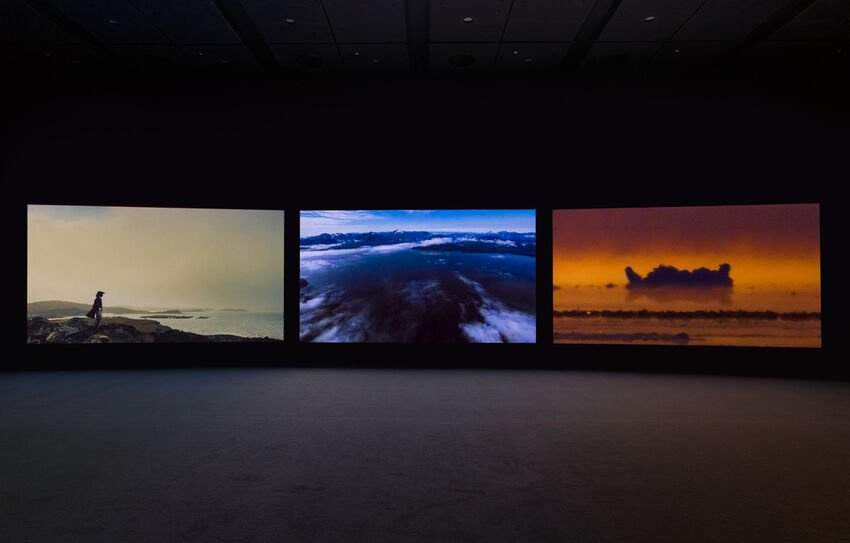
© John Akomfrah · SFMOMA
Three screens, one body of water
Vertigo Sea is a three-channel video installation John Akomfrah completed in 2015. Three screens stand side by side and 7.1 surround sound fills the room. It runs 48 minutes and 30 seconds, close to the length of a short feature.
The work premiered at the Venice Biennale in 2015. In 2018 it was acquired jointly by three museums: SFMOMA in San Francisco, the Museum of Contemporary Art Chicago and the Solomon R. Guggenheim Museum in New York. A work about the sea, shared among three cities thousands of kilometres apart.
Viewers do not watch a single frame. They must choose where to look. Sometimes the three screens show three different scenes. Sometimes one scene stretches across all three. Sometimes two stand still while the third moves. The eye never holds the whole at once.
Nature footage and fragments of history
Much of the sea imagery in Vertigo Sea comes from the BBC natural history archive. It is footage television audiences know well: shimmering shoals, waves breaking on rock, drifting polar ice. Akomfrah sets it beside other material: whaling, industrial fishing, boats carrying migrants.
Between the archive clips are scenes he shot himself. A figure in eighteenth century dress stands still on a shore, facing the water. A few objects lie scattered on the rocks, as if washed up. These scenes tell no story. They stand like witnesses.
Under the images runs a voice reading from texts about the sea, among them Herman Melville's Moby-Dick and Heathcote Williams's long poem Whale Nation. His gallery describes the work as an exploration of what Ralph Waldo Emerson called the sublime seas. Sublime here carries both meanings: overwhelmingly beautiful and overwhelmingly frightening.
The title says the same. Vertigo is the dizziness of standing before something too large.
A filmmaker of diaspora memory
Akomfrah was born in Accra, Ghana, and grew up in Britain. In 1982 he co-founded the Black Audio Film Collective in London, a group making films about Black life in Britain. His first film, Handsworth Songs of 1986, looked back at the 1985 riots in Birmingham and London. Later he worked with David Lawson and Ashitey Akomfrah as Smoking Dogs Films.
What he has pursued for four decades fits into a few words: memory, the postcolonial, time, and the lives of migrant communities. He often works with archives, assembling existing images so that they say something other than what they first said.
In Vertigo Sea the ocean becomes the place where these histories meet. Ships carrying enslaved people across the Atlantic. Boats carrying people away from home toward another shore. Whaling ships. All moving on the same surface. Akomfrah does not rank one grief above another. He places them side by side and lets viewers find the joins.
Why it stays with you
Vertigo Sea is hard to watch. It is long, it is beautiful, and then it unsettles you in the middle of the beauty. A whale diving into the deep can make you hold your breath. The next shot can be blood spreading on the water.
That discomfort is what the work wants to keep. It reminds us that the most soothing nature images float on the same water as stories no one wants to tell. The sea does not separate them. Only the way people choose to look does.
It is far from the still seascapes of Hiroshi Sugimoto, where water and sky reduce to one horizon. In Akomfrah the surface always holds people, ships, blood. Years later, Vertigo Sea is still named when people talk about large scale video installation. Not because it offers answers. Because it puts so many heavy things into one room and lets them breathe.
Contemporary Art