
Essays · Olfactory Art
Karola Braga. Sfumato.
An old road redrawn in smoke.
Images: Lance Gerber · Karola Braga (official site)
A desert on the Incense Route
AlUla lies in the northwest of the Arabian Peninsula, on land that was once a stop on the Incense Route. For centuries caravans carried frankincense and myrrh from the south of the peninsula to the north, linking East and West. The most precious goods on that road were never visible for long. They were burned, became smoke, and were gone.
In 2024 Desert X AlUla invited artists to work with this desert. The exhibition ran from 9 February to 23 March, commissioned by the Royal Commission for AlUla. Karola Braga, a Brazilian artist who works mainly with smell, brought a piece called Sfumato.
Braga chose not to retell history in images. She chose to tell it with the smell that made that history: frankincense and myrrh, the two resins that were the road's main cargo.
Eleven thousand cones
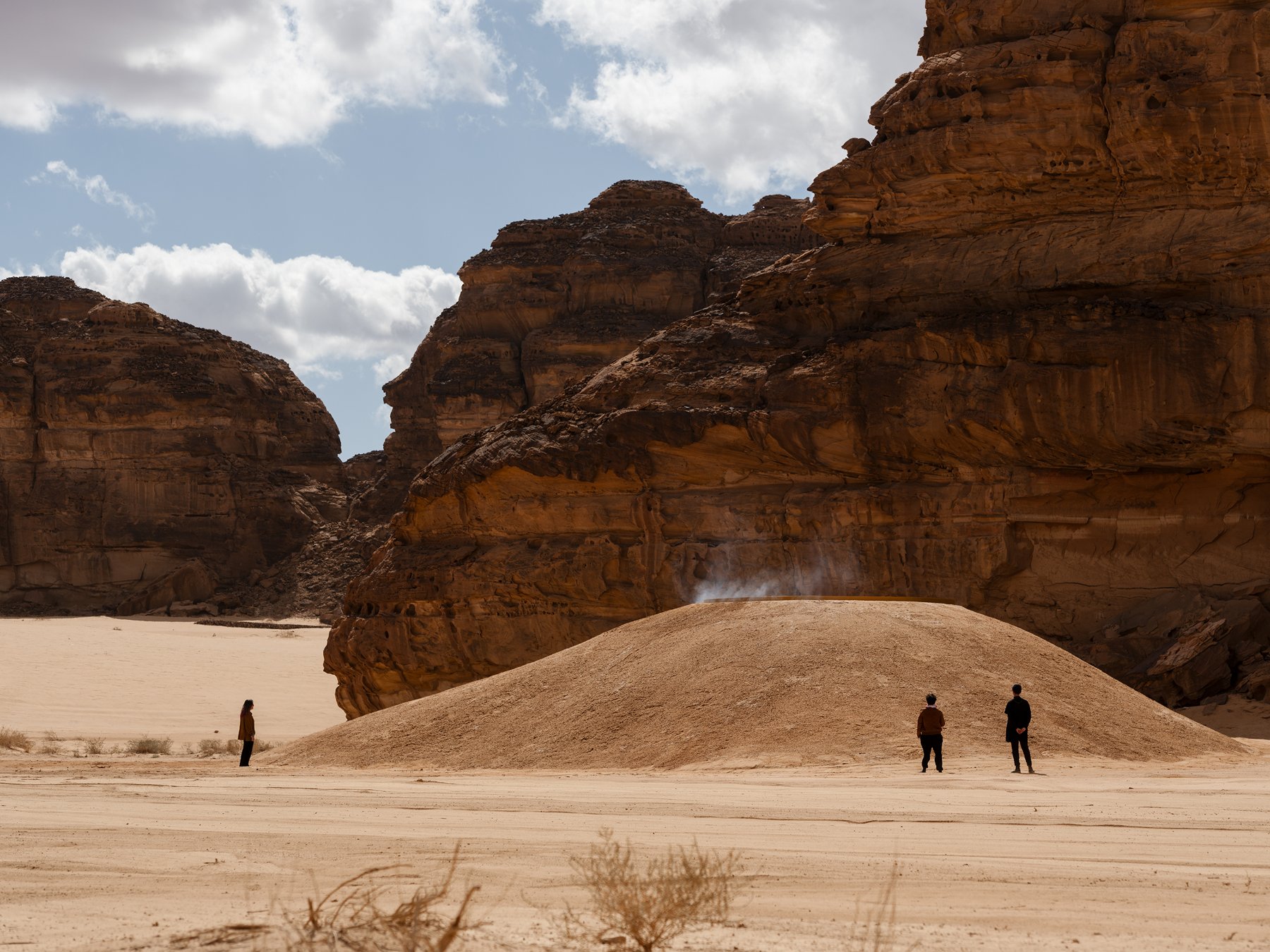
The work is a temporary sand structure set in the desert. Inside is an incense room with a metal door and roof. Its fuel is more than eleven thousand hand rolled incense cones made from natural ingredients, chiefly frankincense and myrrh.
The incense was not chosen at random. According to the artist, the team spent months of research so that it would burn slowly and evenly, without polluting substances, because the desert ecosystem is fragile. A duct system carries the smoke outward. Negative pressure inside makes it leave in visible streams.
Several times a day the structure is activated. Smoke rises, and from that moment the work is no longer in the artist's hands. The wind decides. A strong wind stretches the scented trail. A shift in wind sends it elsewhere. Visitors follow the smell, or stand and wait for it to arrive.
The sand form recalls a giant censer placed under the sky. But unlike a censer indoors, it has no walls to hold the smoke. The whole desert is the room.
The name of a way of painting
Sfumato is an Italian painting term for very soft transitions of tone, without outlines, so that forms melt into the ground as if through haze. The word comes from fumo, smoke.
Braga takes the literal meaning back. Instead of painting smoke, she uses smoke to blur the horizon and soften the line between structure and landscape. The work has no fixed shape to photograph. Each hour, each gust, it draws a different contour.
This is a rare kind of land art. Most land art leaves marks on the ground: a trench, a ring of stones, a spiral. Sfumato leaves its marks in the air, where nothing stays for long.
Leaving nothing
According to the artist, over the whole season the cones perfumed the desert without leaving any permanent trace. The sand structure is temporary. The ash sinks into sand. The smoke dissolves into sky.
That matches the road the work recalls. The Incense Route has left few material traces. Its goods were made to vanish, in temples, in homes, in rites. The value of frankincense lies in the moment it stops being itself.
Sfumato repeats that moment eleven thousand times, then withdraws. Braga has made other works with smell as the main material, such as Lágrimas, Terra e Crisântemo. But in AlUla her work had a collaborator no one could direct: the desert wind.
Olfactory Art