
Essays · Olfactory Art
Sean Raspet at Various Small Fires.
A forest smell, from moss that people rewrote.
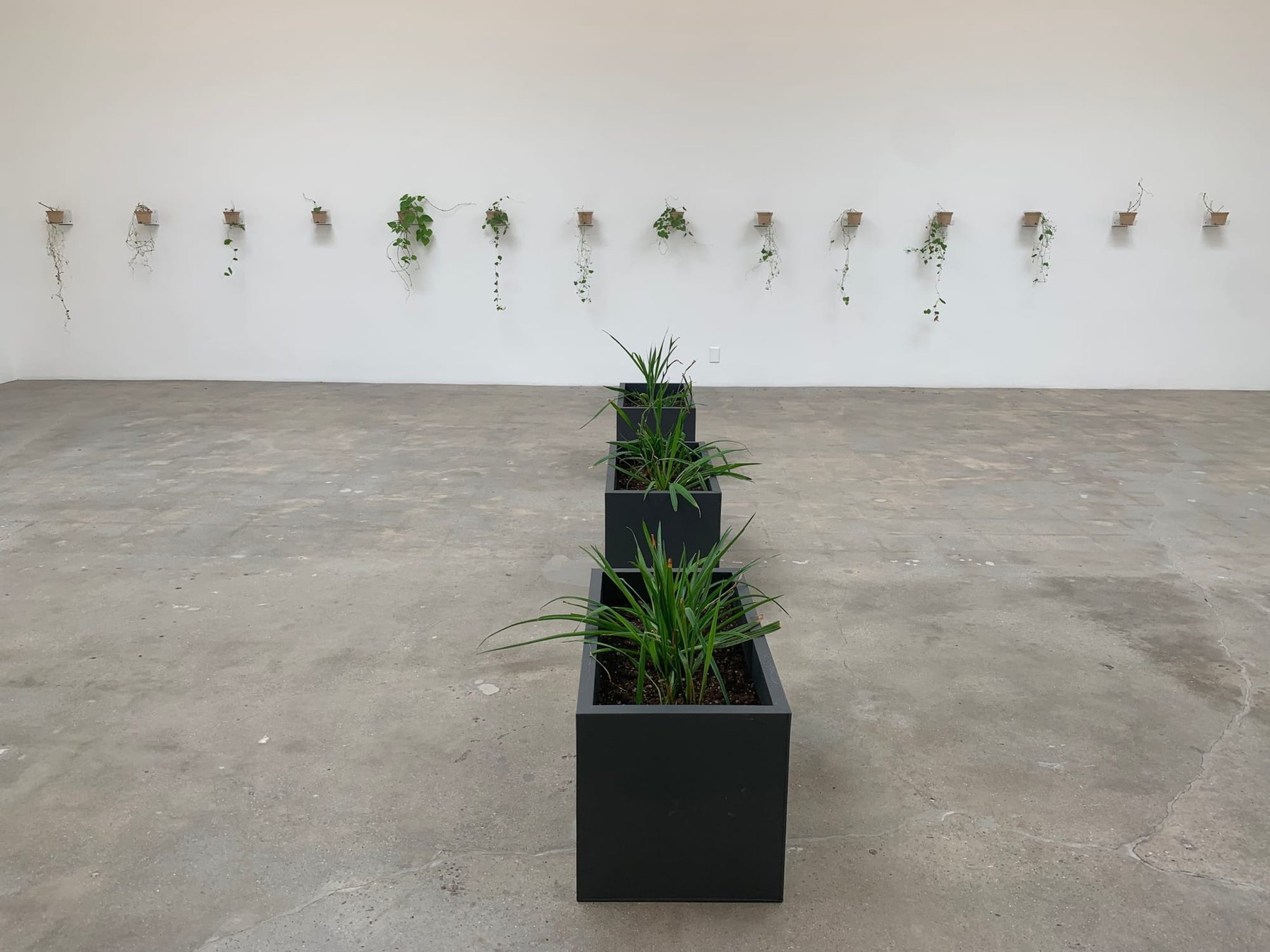
Photo for Hyperallergic · Hyperallergic
A garden in rows
In 2021 Sean Raspet had his first solo exhibition in Los Angeles, at Various Small Fires on North Highland Avenue in Hollywood. It ran until 11 September that year.
Visitors entered through the courtyard. There, morning glory vines climbed three rectangular trellises set side by side. The critic Caroline Ellen Liou, writing in Hyperallergic, likened them to a minimalist triptych. Some of the works carry the title Orange Noah Morning Glory.
Inside, potted plants hung in neat rows at even intervals. One room held a canister of carbon dioxide. At the back, a moss panel released a faint whiff of patchouli now and then.
Everything was arranged cleanly, almost sterile. No spilled soil, no fallen leaves. Nature appeared as a laboratory specimen, and that was the point.
Three projects, one material
According to Various Small Fires, the exhibition brought together three related projects whose shared material was carbon: increased, circulated and captured.
The first was a set of plants exposed to radiation and chemical mutagens to produce random genetic mutations. The press release described these as experiments by the artist, looking for changes that might help plants adapt to a shifting climate.
The second was a metric ton of CO2 removed from the atmosphere by direct air capture. In the gallery it was just a canister. But it stood for an enormous volume of air that had been filtered.
The third was the moss. It is a biological air filtration system made of moss genetically engineered with genes from patchouli and other flowering plants. The moss continually produces the molecules patchoulol and linalool, giving an earthy, slightly floral smell that recalls a forest floor.
Each project draws carbon out of the air at a different scale and pace. Plants slowly, machines quickly, the moss filtering and scenting at once.
What does it mean to exhibit nature
That question is the title of the Hyperallergic review, and it is the question the exhibition leaves behind. We tend to think of civilisation and nature as opposite sides. Raspet puts them in one room without letting us tell which side is which.
Raspet has long worked with scent molecules. In earlier projects, such as Residuals, he sampled the air of the gallery itself for seven days and concentrated that background smell onto the walls. Air, which we treat as empty, turned out to have a smell and could be captured. At Various Small Fires he returns to air, this time through living things. The moss is no longer only moss. It is a biochemical device programmed to give off a particular smell.
That may unsettle visitors, or intrigue them, or both. The patchouli smell is pleasant. Knowing its origin, we have to ask: is the forest smell we love still a forest smell if people wrote it?
The critic observes that the show embeds pressing political questions in the very air we breathe. Carbon, climate, genetics: large subjects, here appearing as a faint smell at the back of a room. The exhibition stays in mind because it does not raise its voice. It lets the air speak.
Olfactory Art