
Essays · Olfactory Art
Sylvie Fleury. Aura Soma.
Oil and water sit side by side and never become one.
Museum Tinguely, Basel · Museum Tinguely
A wall of coloured bottles
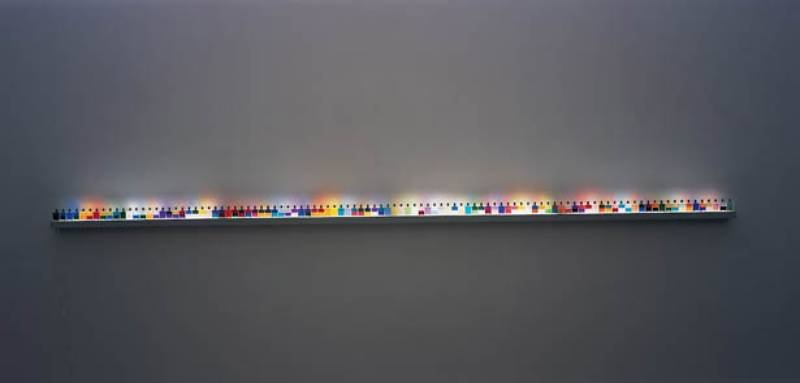
Aura Soma is a 2002 work by Sylvie Fleury, a Swiss artist born in Geneva. It consists of 102 small bottles of 50 ml each, set in rows, with four light boxes.
Each bottle holds oil and water. The two do not mix, so each bottle divides itself into two bands of colour, one above, one below. The bottles differ in colour and also in scent.
From a distance the work looks like a shelf in a cosmetics shop. Up close it looks like a painter's palette, except the colours are bottled instead of squeezed from tubes. The light boxes make the liquids glow, as if each bottle had its own light inside.
The work belongs to the Mercedes-Benz Art Collection. In 2015 it was shown at Museum Tinguely in Basel, in the exhibition Belle Haleine, The Scent of Art.
A name borrowed from a trend
Aura-Soma is the name of a real commercial system. Within it, a consultant decides which bottle of oil and water suits the personality of each customer. Each pairing of colour and scent is thus treated as an individual portrait of a person.
Fleury took that name for her work. According to Museum Tinguely, the work deals with fashionable phenomena around esotericism and with trends that use scent in search of inner balance. By the early 2000s those trends had become a large market, with its own shops, products and language.
Fleury does not report on that market. She does something else: she takes its objects, places them in a gallery, and lets viewers see what they look like without the consultation that usually comes with them.
With no one to read the colours for you, the bottles are only bottles. Beautiful, bright, many coloured. And silent about meaning.
Between shop shelf and museum
Fleury is known for bringing consumer goods into art: shopping bags, cosmetics, fashion, things tied to the desire to buy and to look a certain way. Aura Soma belongs to that line. But it also speaks to art history.
The regular block of bottles recalls the wall pieces of Donald Judd, the American minimalist who liked identical units in repetition. The Mercedes-Benz collection also reads the work as a three dimensional colour chart in the tradition of concrete and constructive art, where colour is studied as a material in itself.
So the same wall of bottles can be read two ways. As a shop display for a spiritual trend. Or as a minimal work about colour. Fleury does not make the viewer choose. She lets both readings exist at once, like the oil and water in each bottle: side by side, never mixed.
Her interest in the esoteric does not stop here. Pendulums, meditation imagery and coloured lamps also appear in her work. She uses them the way she uses a designer shopping bag: as objects society has loaded with extra meaning.
Scent in a work made to be seen
Aura Soma is first of all a work to look at. Colour, light, the rhythm of repeated bottles. But because the bottles carry different scents, it also belongs to olfactory art. At Belle Haleine it stood among works on smell by more than forty artists, across more than 1,200 square metres.
There it raised a question of its own: what does scent say when it comes with colour? In cosmetics, the colour of a liquid is often chosen to suggest a smell before we smell it. Pink for flowers, blue for freshness, yellow for citrus. The eye guesses before the nose.
Fleury's work exposes that habit. Faced with 102 coloured bottles, a viewer cannot help guessing. And the guessing shows how much advertising has taught us about what a smell should look like.
Olfactory Art