
Essays · Modern Art
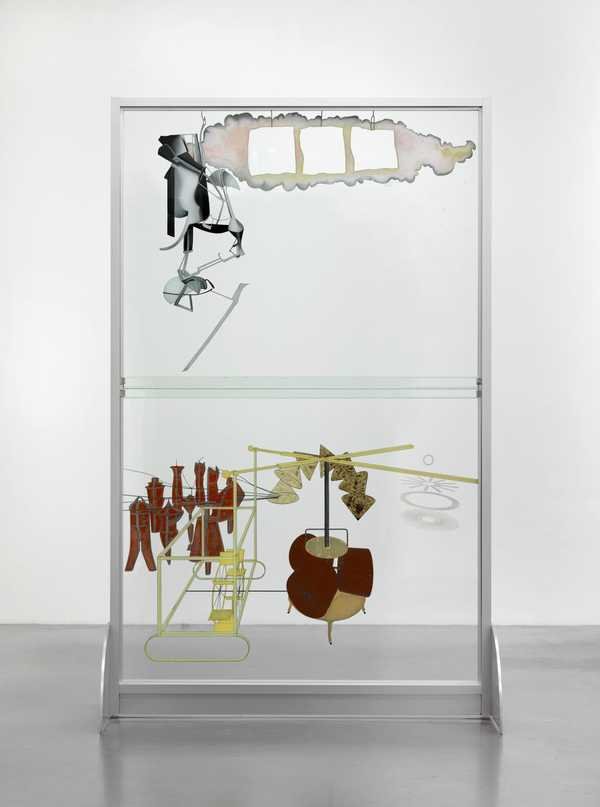
Marcel Duchamp, Richard Hamilton. The Bride Stripped Bare by Her Bachelors, Even (The Large Glass).
A work can be remade from its notes.
Tate · Tate
A love machine on two panes of glass
The full title is La Mariée mise à nu par ses célibataires, même: The Bride Stripped Bare by Her Bachelors, Even. It is usually called The Large Glass.
The work is divided horizontally. The upper half is the Bride's Domain. The lower half is the Bachelor Apparatus. Tate describes it as the diagram of an ironic love making machine of extraordinary complexity, in which the male and female parts communicate only through two circulatory systems and never touch.
Below stand the Nine Malic Moulds, nine hollow forms in a row, each a uniform: cuirassier, gendarme, flunkey, department store delivery boy, bus boy, priest, undertaker, station master, policeman. Beside them are the Chocolate Grinder, the Water Mill, the Sieves, and on the right the Oculist Witnesses, drawn in silvering scraped away to leave only the lines. Above are the Bride, the Draft Pistons, a Milky Way, and nine drilled holes marking the Shots.
Duchamp wanted to avoid all contact with traditional painting. He did not paint on canvas. He used glass, lead wire bent to the drawing, lead foil, oil paint, varnish, and dust.
Eight years and a crack
Duchamp began the glass in New York in September 1915 and worked on it at intervals until February 1923, when he left for Europe and declared it definitively unfinished. From mid 1912, much of his work had already been studies for its parts.
Walter Arensberg bought it in 1918. When he moved to Los Angeles in 1921 he sold it to Katherine S. Dreier so it could stay in New York and Duchamp could keep working.
In 1926, returning from its first exhibition at the Brooklyn Museum, the glass shattered. The damage was found only years later when the crate was opened. In 1936 Duchamp repaired it himself, clamping the pieces between two heavier sheets of glass in a metal frame. The cracks stayed in the work. After Dreier's death in 1952 it went to the Philadelphia Museum of Art, where it remains.
In 1934 Duchamp issued The Green Box, a flat case of 94 loose documents in random order: photographs, drawings, handwritten notes. In 1967 another 79 notes followed in The White Box. These scraps are the key to reading the glass.
Rebuilt from a box of paper
In 1966 the Arts Council asked Richard Hamilton to organise a major Duchamp exhibition at the Tate Gallery. The original was too fragile to lend. Photographs were not enough. Hamilton decided to remake the glass at full scale.
A copy already existed, made by Ulf Linde in 1961 for the Moderna Museet in Stockholm, but Linde had worked from photographs without seeing the original, and it was wrong in places. Hamilton took another route. He did not work from photographs. He followed The Green Box, retracing the stages Duchamp had gone through to arrive at the glass. The work was done in the Fine Art Department of the University of Newcastle upon Tyne, where he taught.
The first step was a full size perspective drawing of the lower half, built from the measurements in the notes. Hamilton made dozens of perspective studies, stretching threads to the vanishing points. He repeated two of Duchamp's glass studies to learn the medium, then made two that Duchamp had never needed: one of the Sieves, to try the dust raising process described in the notes, and one of the Oculist Witnesses.
The upper half is freer, so its outlines came from photographs. The nine Shots were plotted from notes and measurements of the Philadelphia glass. Duchamp had located them by firing paint dipped matches from a toy cannon.
A copy true to the intention
Hamilton deliberately avoided copying the original's present state, with its cracks and deterioration. He made the glass as it was conceived, accepting that it too would change with time. One thing is different: the new glass is toughened plate, so it will never crack.
The reconstruction took exactly a year. The collector William N. Copley, a friend of both men, paid for the materials and, at Hamilton's suggestion, paid Duchamp an equal sum as a fee. When Duchamp came to London for the opening, he signed the back with a French phrase: pour copie conforme, for a faithful copy.
The glass was shown in The Almost Complete Works of Marcel Duchamp at the Tate in June and July 1966. Copley gave it to Tate in 1975. According to Tate's record, the lower panel was remade in 1985.
In the same years Duchamp also allowed his lost readymades to be remade, Fountain among them. He seemed to care less about the unique object than about the idea staying visible. The Large Glass at Tate is the clearest case: a work that survived through its own notes.
Modern Art