
Essays · Modern Art
Pablo Picasso. Guernica.
A painting that knew how to wait.
Museo Reina Sofía · Museo Reina Sofía
A painting for a pavilion
In 1937 the government of the Spanish Republic asked Picasso for a large work for the Spanish Pavilion at the International Exposition in Paris. The country was at civil war. Picasso was then living and working in Paris.
Then the news arrived. The Basque town of Guernica had been bombed from the air at the end of April 1937 by the Condor Legion, the Nazi German air unit fighting against the Republic. Picasso saw the photographs in French newspapers. He began to paint.
According to the Museo Reina Sofía in Madrid, the work was made in Paris between 1 May and 4 June 1937. Just over a month for an oil on canvas 349.3 centimetres high and 776.6 long. No one can take it in at a single glance. You step back, walk along it, as along a wall.
Black, white and grey
Picasso set colour aside. The whole painting is in shades of grey, a technique known as grisaille. The museum suggests that the landscape format and the absence of colour refer to cinema and press photography, the media through which Europeans of the time learned about war.
The composition is a pyramid, a familiar structure in history painting. Picasso borrows from Rubens, Delacroix, David and Goya. He borrows from himself too: several elements appear already in his 1935 etching Minotauromachy.
The art historian Anthony Blunt divided the figures into two groups. First, three animals: the bull, the wounded horse, and a winged bird barely visible in the dark on the left. Second, the humans: a dead soldier on the ground, a woman leaning from a window at upper right holding a lamp, a mother on the left wailing over her dead child, a woman rushing in from the right, and one raising her arms to the sky while the house behind her burns.
Nothing in the painting or its studies points directly to Guernica. No place names, no aeroplanes, no dates. The town lives only in the title. The rest is a general protest against the cruelty of war anywhere.
Four decades away from home
The Republic acquired the painting from Picasso in 1937. Two years later the Republic had lost the war, and then the Second World War began. Picasso placed Guernica in the care of the Museum of Modern Art in New York until the fighting ended.
The fighting ended, but Spain remained a dictatorship. In 1958 Picasso extended the loan indefinitely, on one condition: the painting would go to Spain only when democracy was restored. He died in 1973, before that happened.
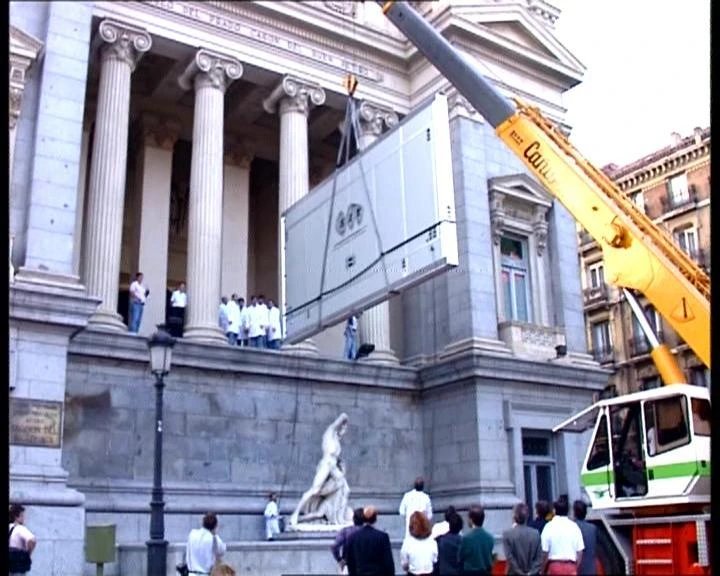
In 1981 Guernica arrived in Spain and hung at the Casón del Buen Retiro, part of the Prado. In 1992 it moved to the Reina Sofía. For that short journey a crate was built so the canvas would not roll, a vehicle was adapted and a lift was constructed to bring it into the room. The filmmaker Tino Calabuig recorded the move from the street.
The room where it hangs
The Reina Sofía tells a detail few visitors know. During the civil war, the room where Guernica now hangs was where survivors of the Condor Legion's air raids were cared for. The building was then a hospital.
So the painting does not only speak of a distant tragedy. Here it stands in a room that saw the same kind of wounds, in Madrid itself. Wall and canvas share a memory.
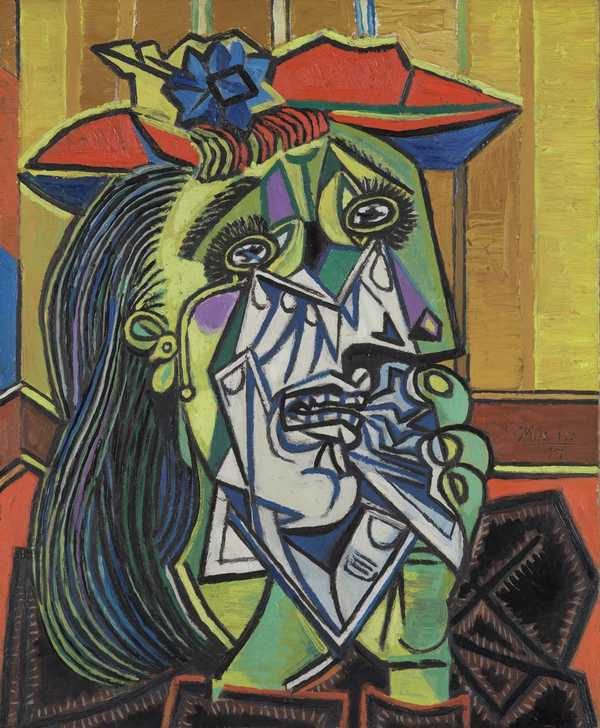
Picasso made many studies and later works around Guernica, among them the Weeping Woman paintings. That face seems to step out of the great canvas and go on living, this time in colour.
Guernica is now read as the anti war image of the twentieth century. But standing before it, what one feels first is not a symbol. It is the size. The silence of the grey. The sense that everything is happening at once and there is nowhere to hide.
Modern Art