
Essays · Modern Art
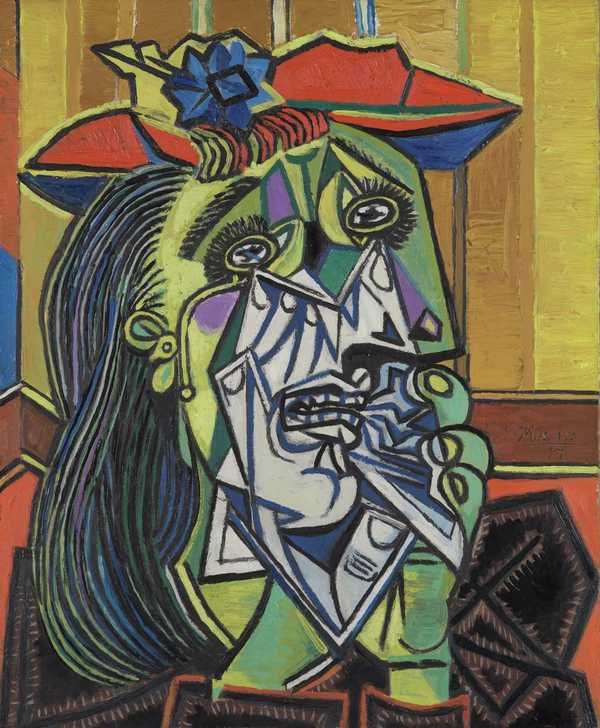
Pablo Picasso. Femme en pleurs.
Grief is not grey. It glares like broken glass.
Tate · Tate
A broken face
Weeping Woman, Femme en pleurs in the original French, is a small oil painting on canvas made by Picasso in 1937. It is in the collection of Tate in London.
It shows a woman from the waist up. She wears a hat trimmed with a blue flower, her hair dark. Both hands grip a handkerchief pressed to her mouth. The face is cut into planes. The eyes look at us from the front and from the side at once, as Picasso had painted since his Cubist years.
The strangest part is the centre of the face. The area around the mouth, nose and handkerchief is almost white and pale blue, edged in sharp black. It looks like broken glass, or skin gone transparent. The tears do not fall as round drops. They fall as shards.
The rest of the picture is full of colour: red and yellow ground, green patches on the face, a hat of red and blue. None of it softens to suit the sorrow.
The year of Guernica
In April 1937 the Basque town of Guernica was bombed by German and Italian aircraft during the Spanish Civil War. Picasso, living in Paris, began the huge mural named after the town for the Spanish pavilion at the Paris World's Fair.
Guernica is only black, white and grey. In it a mother throws back her head and cries, holding her dead child. The image of the weeping woman stayed with Picasso. Over the following months he returned to it again and again in drawings, prints and paintings. The Tate canvas is one of the most complete and colourful versions.
Side by side, the two works speak of one thing in two ways. Guernica is the cry of a whole town, wide, dark, crowded. Weeping Woman is one face, close, bright, alone. Shared grief narrows into private grief.
Dora Maar
The model was Dora Maar, photographer and painter, Picasso's companion in those years. She photographed the stages of Guernica as it was painted in the studio, making an important record of how the picture came to be.
Picasso is reported to have said that for him Dora Maar was always a weeping woman. The remark is repeated in many books about the two, and it gives the painting more weight. It is not only a portrait of a sitter. It is how a man saw the woman beside him in a year of war.
Dora Maar was no passive figure. She had her own career, her own surrealist photographs. But in this painting her face became the place where Picasso put the grief of an entire period.
Why the colours are bright
Many people are surprised the first time they stand before Weeping Woman. A painting about tears, as vivid as a poster.
One way to read it: grief does not arrive on a gloomy day prepared in advance. It arrives in the middle of ordinary life, when someone is wearing a good hat and bright clothes. Picasso kept every colour and broke only the face. The contrast makes the shock sharper.
That is also why it is hard to look away. A dark painting lets us step back. A bright one draws us close, and only then shows the crack in the middle.
The painting offers no comfort. It does not explain where the grief comes from. It shows a woman who, for a moment, can no longer hold her own face together.

Modern Art