
Essays · Photography
Martin Parr. The Last Resort.
A holiday that isn't pretty is still a holiday.
© Martin Parr / Magnum Photos · Magnum Photos
A beach near Liverpool
New Brighton is a seaside resort near Liverpool, in the north west of England. There was a time when city people crowded there every weekend for the sea air. By the early 1980s it had aged a great deal. Buildings were decaying, litter was piling up, visitors had less money.
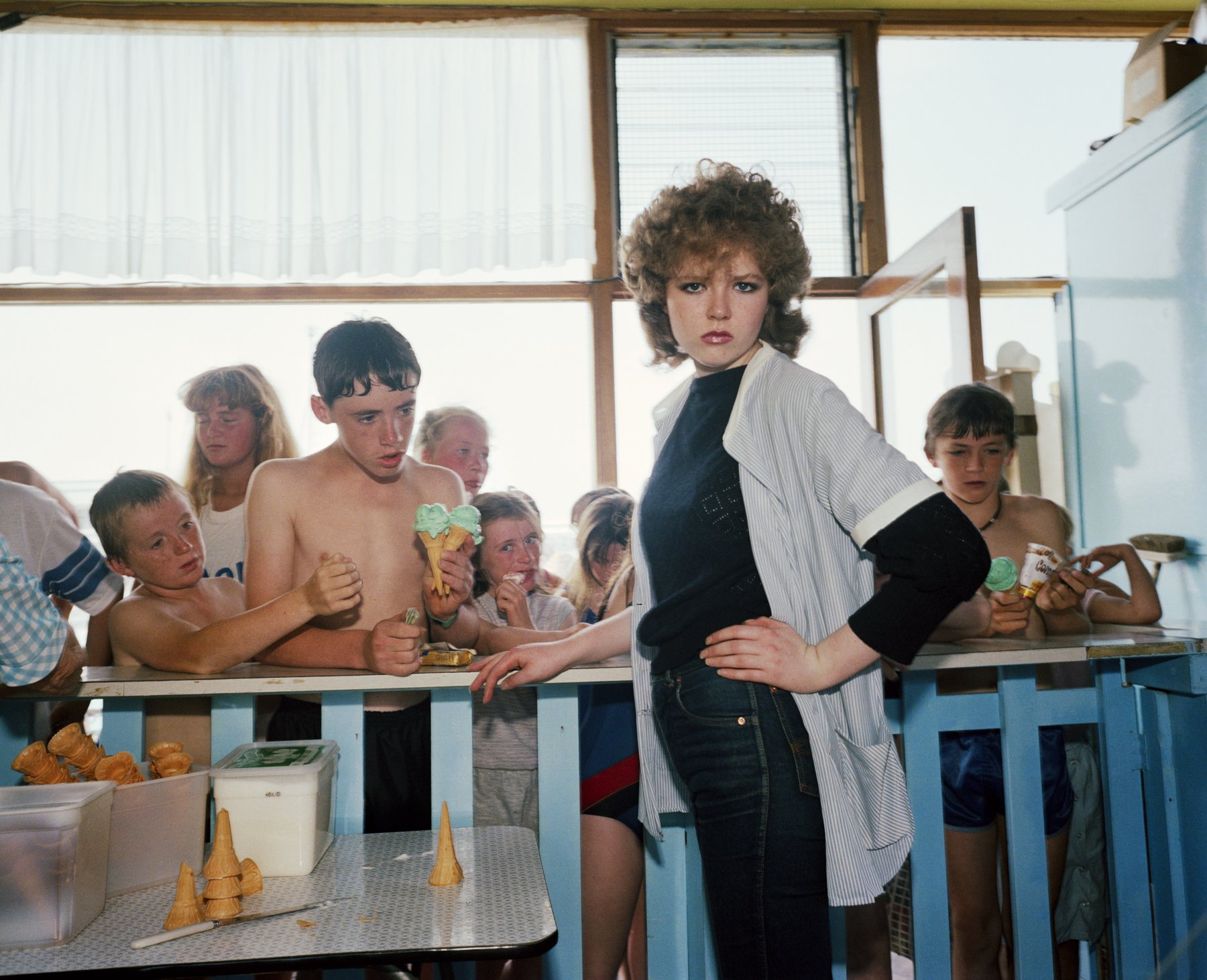
From 1983 to 1985, Martin Parr photographed it again and again. He photographed working families at the sea on rare sunny days: parents stretched out on concrete, children eating chips, queues for ice cream. He photographed the open air pool, the fast food stalls, the arcade machines, corners of the beach mixed with rubbish.
These were also the Thatcher years. Much of industrial northern England was in decline and unemployment was high. The series recorded New Brighton just before its lido closed.
Parr was not photographing a dying town. He was photographing people who still went on holiday, with whatever they had.
Saturated colour and flash
Before The Last Resort, Parr had worked mostly in black and white. This series was where he moved fully to colour. He used a 6×7 medium format camera with a flash mounted on it, firing even in bright sun.
The result is colour almost as loud as advertising. Skin red from the sun, glaring blue swimsuits, golden trays of food. The flash makes everything in the foreground jump out, sharp, with nowhere to hide.
Parr has said he wanted bright, accessible images, drawing on commercial photography and American colour documentary. In the United States, photographers such as Stephen Shore were already using colour for ordinary life, with no special reason needed. Parr brought that way of seeing to an English beach.
He has also said that whenever he adopts a new technique, he usually tries it on the beach first. The beach is a place he returned to throughout his working life.
Cruel or tender
In 1986 The Last Resort was shown at the Serpentine Gallery in London and published as a book. The reaction was harsh. Many critics called the work cruel and voyeuristic, a middle class photographer mocking the working class.
Parr saw it differently. He said his interest was not class but things everyone meets: screaming children, bad weather, the chaos of a day out. Those things were as true of New Brighton as of any beach.
Over time, the reading changed. Later viewers saw more tenderness: the people in the pictures are not turned into victims. They eat, sleep, argue, play. They are fully present in their own day off.
That hesitation is what keeps the series alive. The viewer does not know whether to laugh or to feel for them. Probably both. Parr later admitted that the controversy helped make his name.
A document of leisure
British documentary photography before this had mostly looked at work: mines, docks, factories. The Last Resort turned to the other side of working life, which is free time. What people do when they are not working, and where they do it.
The question sounds small, but it opens a whole subject. Food, clothes, holidays, souvenirs: what people choose for themselves when they get to choose. Parr spent much of his later career photographing these things all over the world.
Looking back, the New Brighton in his pictures is a specific place at a specific time. Yet the feeling is familiar to many. A crowded beach, a brief sunny day, a family trying to have a good time. Nothing grand. Only a day kept, in all its colours.
Photography