
Essays · Photography
Stephen Shore. Uncommon Places.
The ordinary, looked at long enough, turns strange.
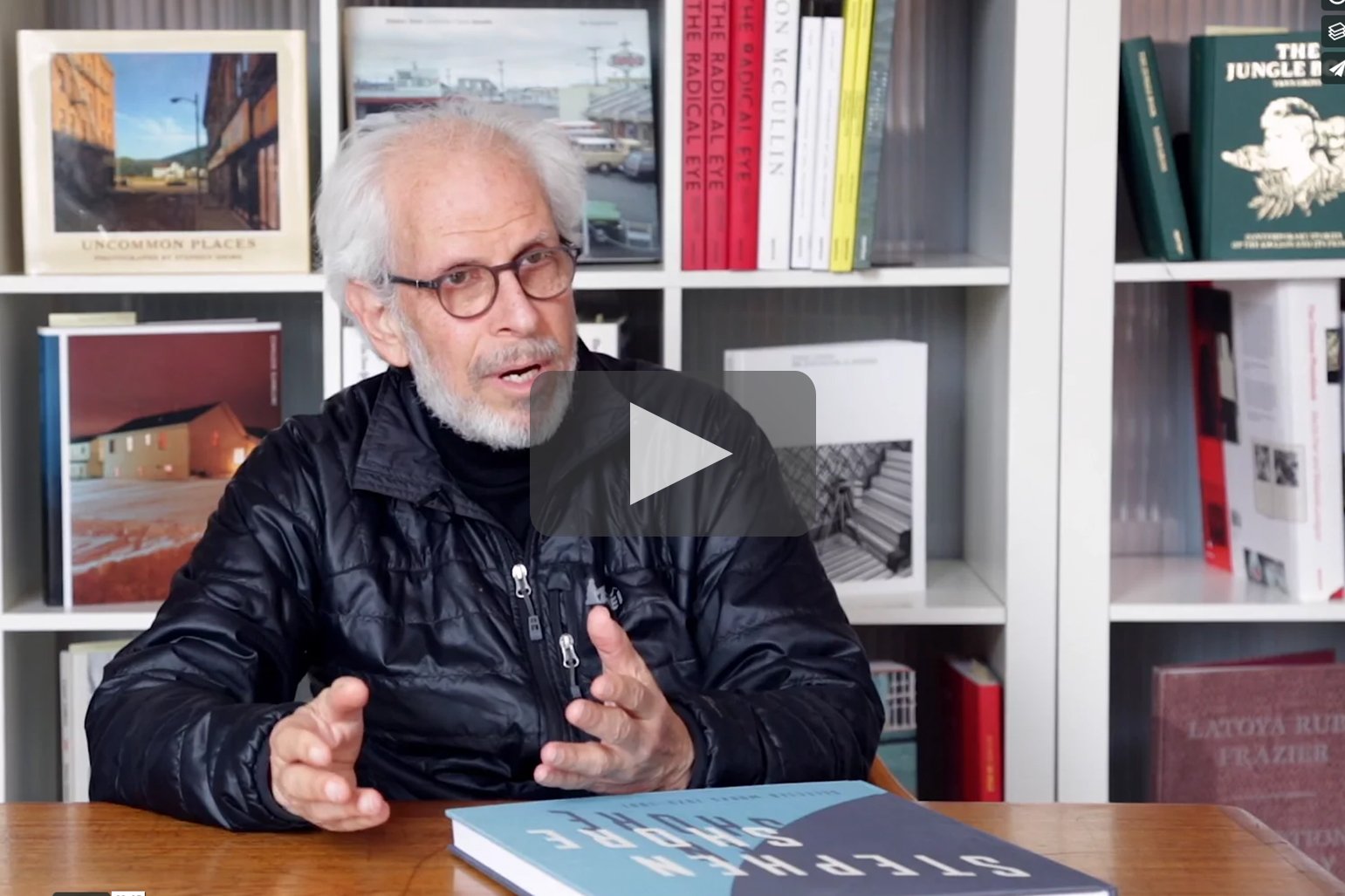
Aperture · Aperture
A camera the size of a window
From 1973, Stephen Shore set out on long road trips across the United States and Canada. He carried an 8x10 inch view camera, a large sheet film camera that sits on a tripod and is focused under a dark cloth.
Before that he had made American Surfaces, colour pictures taken on the road across America, almost a diary in images. Uncommon Places was the next step: slower, heavier, more deliberate.
Each 8x10 negative is close to the size of a page. It holds a quantity of detail no small camera can match. The price is speed. Every exposure takes time to set up, meter, adjust. Every sheet of film is costly. The photographer must decide carefully before opening the shutter.
He worked this way into the early 1980s. In 1982 Aperture published the book Uncommon Places. Later editions expanded it with pictures never printed before.
Intersections, motels, breakfast
Shore photographed what people pass every day. An intersection with a lamppost and billboards. A gas station. The front of a small shop. A parking lot. A motel bed nobody has slept in yet. A plate of eggs and pancakes on a diner table, seen from above.
The titles usually give only a street, a town, a state and a date. Beverly Boulevard and La Brea Avenue in Los Angeles is one. No adjectives. No story. Just a coordinate in space and time.
The pictures have no protagonist. Passers by, when present, are small and part of the scene. The light is usually ordinary daylight. The composition is balanced to the point of vanishing: the viewer does not see the photographer arranging, though every line was weighed.
That calm is what makes the pictures hard to forget. With nothing telling the eye where to look, it begins to travel the whole frame. A gas price sign. A pale blue car. The shadow of a pole on a wall.
Colour leaves advertising
In the early 1970s colour photography was still widely seen as the business of advertising, fashion and family snapshots. Serious art photography was mostly black and white. Shore was among the first to bring large format colour into that territory, and to turn it on the everyday American landscape.
His colour is not pushed for effect. It is the real colour of house paint, of signs, of a summer sky. Because it is real, it fixes a moment precisely. Looking now, we see the 1970s in car colours, billboard lettering, floor tiles.
Decades later Shore spent about five years scanning hundreds of negatives from the series. In 2017 Aperture published a new selection. Many people were invited to choose pictures, among them the director Wes Anderson and the photographers Thomas Struth, Taryn Simon and An My Le. Each chose ten and wrote about them.
That a film director and photographers of several generations returned to this work shows its reach. Uncommon Places is not only a book. It became a way of seeing that people keep relearning.
Why it stays
Uncommon Places moved the line of what deserves a photograph. It showed that a nameless intersection can be looked at as seriously as a cathedral or a mountain.
That way of looking carried on. Alec Soth, in Sleeping by the Mississippi, also drove, also used a large camera, also stopped in small towns. Where Soth looked for people, Shore looked for structure: how a street is laid out, how a room is set.
The title holds a small paradox. The places in the pictures are not rare at all. What is rare is the way of looking at them.
Photography