
Essays · Photography
Richard Misrach. On the Beach.
A small body in a stretch of water with no shore.
Fraenkel Gallery · Fraenkel Gallery
A balcony over a beach
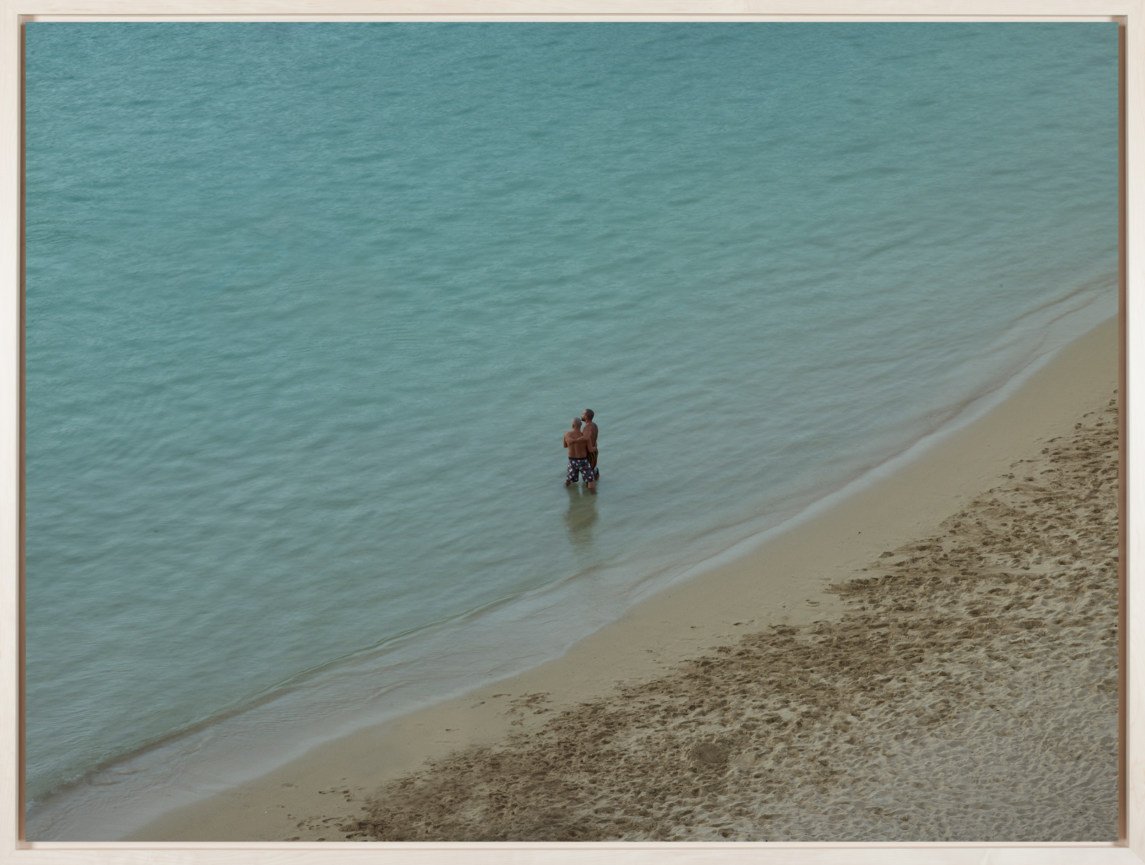
In November 2001, weeks after the September 11 attacks on the World Trade Center and the Pentagon, Richard Misrach took an 8x10 view camera to a beach in Hawaii. He stood on the balcony of his hotel room and photographed downward.
Below was an ordinary holiday scene: people sunbathing on the sand, swimming, floating. But from that height, lens pointed straight down, the scene changed meaning. No horizon. No shore. Only a blue plane and small figures.
Misrach went back to the same beach, the same balcony, for years. The first phase ran about five years. Pictures on Fraenkel Gallery's page carry the years 2012, 2013, 2015 and 2018, showing he kept returning well beyond that.
Water with no edge
Fraenkel Gallery describes the series through two things: the abstract pattern of an edgeless ocean surface, and the gestures and expressions of bathers adrift. The two are always together in the pictures.
Water fills almost the whole frame. It has ripples, glints, patches of deeper and paler blue. Looked at long enough, it becomes nearly abstract. Then somewhere on that surface, a body, sometimes two or three. Their posture, an arm reaching out, a head tipped back, becomes the whole story.
With no shore, the viewer cannot tell how far the figures are from land. They might be a few metres from the sand, or in the middle of the ocean. That not knowing is what makes the pictures uneasy.
A title borrowed from a novel
On the Beach is also the title of Nevil Shute's 1957 novel about the last survivors after a nuclear war, waiting for the fallout to arrive. The title carries that shadow into pictures that look peaceful.
Museums presenting the series point to the mood after September 11: a sense of physical and psychological vulnerability across the country. Misrach did not photograph ruins or crowds. He photographed people at rest. But the frame turns that rest into suspension.
That is the power of the frame. The same people, photographed at eye level from the sand, would be holiday snapshots. Photographed from above, with shore and horizon removed, they become solitary bodies in a wide nameless space. Misrach changed nothing about the beach. He only changed where he stood.
Some see freedom in the bathers. Some see isolation. Over time, the image of a lone floating figure became more metaphysical for Misrach himself.
Scale and distance
The prints are very large. According to Fraenkel Gallery, some measure close to three metres wide framed. At that size a viewer stands before the picture almost as Misrach stood on his balcony, looking down.
The titles say only Untitled, with the date and time: Untitled (November 10, 2012, 5:53PM), Untitled (January 17, 2015, 6:36PM). No place names, no people's names. Each image is a specific moment, yet the people remain anonymous.
This differs from Desert Cantos, where Misrach photographed human traces on the land. Here he photographs people themselves, but from far above, small as a trace. The opposite approach, facing each person on the beach, is in Rineke Dijkstra. Beach Portraits.
Photography