
Essays · Photography
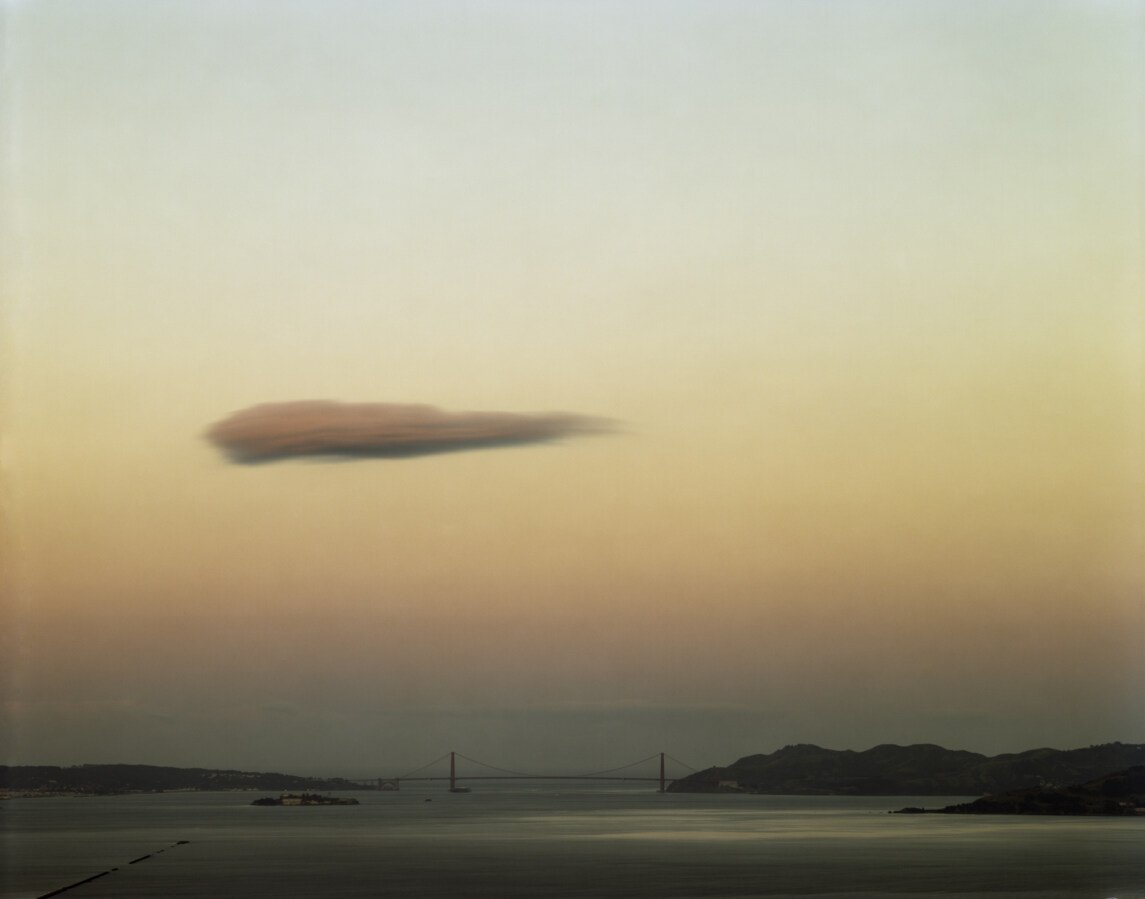
Richard Misrach. Golden Gate.
The view stays. The light never repeats.
Fraenkel Gallery · Fraenkel Gallery
A porch facing the bay
In 1997 Richard Misrach and his wife moved into a house in the Berkeley Hills, across the bay from San Francisco. From the front porch they could see the whole span of the Golden Gate Bridge, Alcatraz and the city skyline.
Misrach began photographing that view. Not once but many times, at different hours, on different days, in different seasons. The camera stayed in the same place, pointed the same way. The bridge was always there, the same size, in the same spot in the frame.
The work continued for years, from the late 1990s into the early 2000s. The result is a great many photographs of a single view, no two alike.
Something is worth noting. The Golden Gate is among the most photographed structures in the world, seen on postcards, in films, on wall calendars. Choosing it as a subject is a challenge: how to see it as if for the first time. Misrach's answer was not an unusual angle. He kept the angle and waited.
The title is a clock
The pictures in Golden Gate have no names. Each is called by its date and time. 5.21.98, 6:04am. 10.31.98, 5:18pm. 12.14.99, 5:29pm. 5.15.00, 7:32am.
Some are long exposures. 3.20.00, 4:05 to 5:00 in the morning. 11.10.00, from 12:50 to 3:40 in the morning, with the lights of boats drawn into lines across the water. In these, time is no longer a moment but a span.
Naming the pictures this way turns the series into a diary of light. The viewer is not invited to admire a famous bridge. They are invited to look at a May morning, a late October evening, a November night. The bridge is the still hand that lets you see time turn.
Light, colour and atmosphere
Fraenkel Gallery describes the series as a meditation on light, colour and atmosphere that transcend a fixed, familiar view. The San Francisco Bay is a place where weather changes fast. Fog can swallow the bridge, then lift within an hour. The sky can be silver grey, pink, almost black.
Because the view does not change, every change in the air is plain. Nothing new distracts the viewer. They are left with the depth of a colour, the thickness of the fog, the position of the sun.
From one picture to the next the bridge is clearer or fainter, lighter or darker, at times nearly dissolved into the ground, at times sharp as a ruled line. The same object, appearing differently each time.
This is a different patience from Desert Cantos. In the desert Misrach drove far to find traces. In Berkeley he only had to step onto the porch. The subject came to him every day; his task was not to miss it.
From photographs to a book
In 2001 the series was published as Golden Gate by Arena Editions in Santa Fe, with essays by art historian T. J. Clark and geographer Richard Walker. The book holds 85 colour photographs, most printed full page. Aperture later published it again in 2005 and 2012.
Turning the pages, the reader passes through those changes like leafing through a calendar. No story, no characters. Only a bridge, and everything that passes over it.
The series is kin to projects that take time as their material. On Kawara's I Got Up stamped the hour he woke on a postcard each morning. Misrach puts the hour in his titles. Both show a simple thing: repetition is the best way to see change.
Photography