
Essays · Olfactory Art
Nitro musks. A discovery and a ban.
A smell that stays too long becomes a problem.
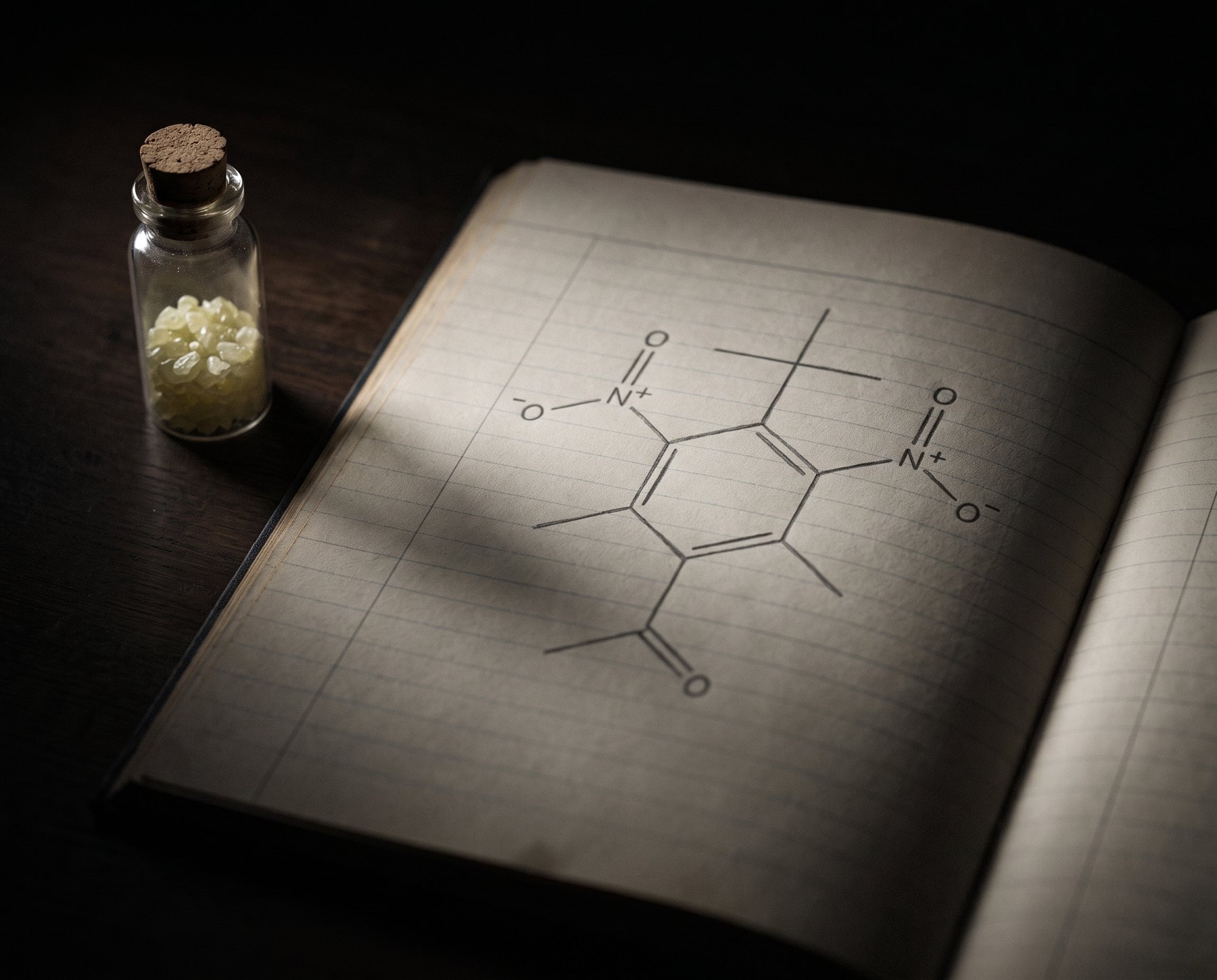
A musk from an explosives lab
In the late 1880s the German chemist Albert Baur was working with relatives of TNT, the explosive that carries several nitro groups on a benzene ring. In those experiments he noticed a substance that smelled strikingly of musk.
This was a surprise, because its structure had nothing to do with natural musk. Animal musk owes its smell to large ring molecules that chemistry only understood in the 1920s. Baur's compound was a small benzene ring carrying three nitro groups and a butyl group. Two entirely different structures, yet the human nose called them alike.
Baur patented the substance and sold it as musk Baur. In the 1890s he described more nitro musks: musk xylene, musk ketone, musk ambrette. Each had its own shade: xylene cheap and powdery sweet, ketone warm and regarded as closest to deer musk, ambrette recalling ambrette seed.
Like coumarin and vanillin before them, nitro musks separated a precious smell from its source. This time the source was an animal, and the substitute came from an explosives laboratory.
Replacing animal musk
Before nitro musks, musk in perfume came from the pod of the musk deer, a small deer of the Asian mountains. Taking the pod usually meant killing the animal. Musk was therefore very rare and very costly.
Nitro musks were cheap and could be made in bulk. Within a few decades they were everywhere. Musk ketone became the base of many classic perfumes. Musk xylene, the cheapest, was used in enormous volumes in soap and detergent throughout the twentieth century. Musk ambrette was popular in men's perfume and shaving products.
They had a quality perfumers prize: they last. A shirt washed with soap containing musk xylene kept its smell for days. That clean, warm smell was, for generations, the smell of fresh laundry.
The same quality later became the trouble.
The bans
From the 1980s scientists began finding nitro musks where no one had put them: in river water, in sediment, in fish, in human fat. The molecules break down very slowly and accumulate in living tissue. At the same time, some studies raised concerns about the safety of musk ambrette on skin.
Restrictions came gradually. IFRA, the body that sets standards for the perfume industry, prohibited musk ambrette, then musk tibetene and musk moskene. In 2008 the European Chemicals Agency placed musk xylene on its list of substances of very high concern, as very persistent and very bioaccumulative. IFRA prohibited musk xylene soon after.
Under European cosmetics law, musk ambrette, musk moskene and musk tibetene are listed as prohibited. Musk xylene and musk ketone are limited in concentration. Musk ketone, the most prized, is still allowed by IFRA under a specification standard, but its use has fallen sharply.
The space left by nitro musks was filled by other families: polycyclic musks from the mid twentieth century, then macrocyclic and alicyclic musks. Most of today's clean musk smell comes from them.
A smell that stays too long
Perfumers always want smell to stay. A smell gone in ten minutes is a failure. Nitro musks answered that wish better than almost anything. That is why they had to go.
So the story has two sides. On one, an achievement: musk without killing deer. On the other, a reminder that something made to last will last in places we never intended.
No smell belongs only to the moment it is sprayed on skin. It moves on: into cloth, into wash water, into drains, into rivers. Most of it disappears. Some does not.
Looking back, nitro musks resemble a letter sent too far. It was written for the person in the shirt, and it reached the river and the fish as well. The bans are how people recalled that letter, slowly, after nearly a century.

Olfactory Art