
Essays · Contemporary Art
Nam June Paik. Electronic Superhighway: Continental U.S., Alaska, Hawaii.
A country drawn from what it watches.
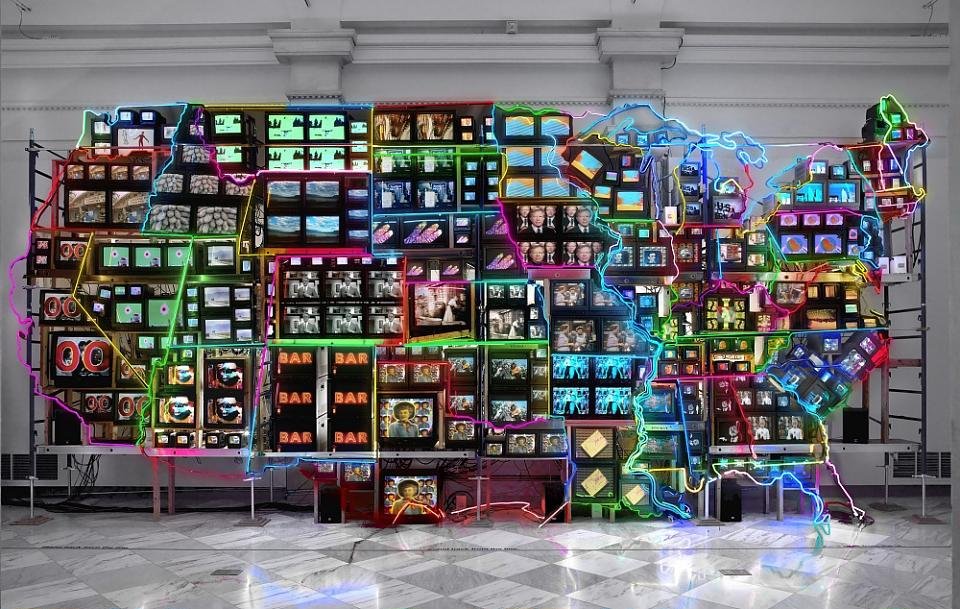
© Nam June Paik Estate · Smithsonian American Art Museum
America on a wall
On the third floor, east wing, of the Smithsonian American Art Museum in Washington, there is a wall of light. About fifteen feet high, forty feet long. From a distance it is the shape of the United States, the continent in the middle, Alaska and Hawaii in the corner. Up close, the map breaks into hundreds of television screens packed tightly together, each state outlined in neon.
This is Nam June Paik's Electronic Superhighway: Continental U.S., Alaska, Hawaii, made in 1995. The museum describes it as a fifty one channel video installation, including one closed circuit television feed, with custom electronics, neon lighting, steel and wood. Colour, sound. Paik gave it to the museum.
Each state plays its own footage. The sound piles up into one continuous noise, like a country with every television switched on at once.
One film per state
Paik chose images for each state the way one chooses a keepsake. Oklahoma plays the musical that bears its name. Missouri is Meet Me in St. Louis. Kansas is The Wizard of Oz, where Dorothy is carried off by a twister. These states are known through Hollywood before they are known through geography.
Arkansas has Charlotte Moorman, the cellist who performed with Paik for years, beside images of Bill Clinton, who came from Arkansas to the presidency. Alabama shows documentary footage of the Montgomery bus boycott of the 1950s. History, entertainment, politics and the artist's friends sit side by side, with no hierarchy.
Washington, D.C. alone has a closed circuit camera. Whoever stands in front of the work sees themselves in the capital's square. The viewer does not stand outside the map. They are part of it, in that moment.
Stay a while and it becomes clear that it cannot all be watched. Fifty one channels run together; the eye catches only fragments. That impossibility is what Paik shows about media life.
Roads, cables and the network
The title points to three things. The interstate highway system, which tied the states together in concrete. Cable television, which tied living rooms together with wire. And the internet of the 1990s, beginning to tie everything together with something no one could yet picture.
Paik was born in Seoul in 1932, lived in Japan and Germany before New York, and is counted among the first to use television as an art material. In 1965 he predicted that artists would one day work with capacitors, resistors and semiconductors as they worked with brushes and violins. Thirty years later he built a whole country out of them.
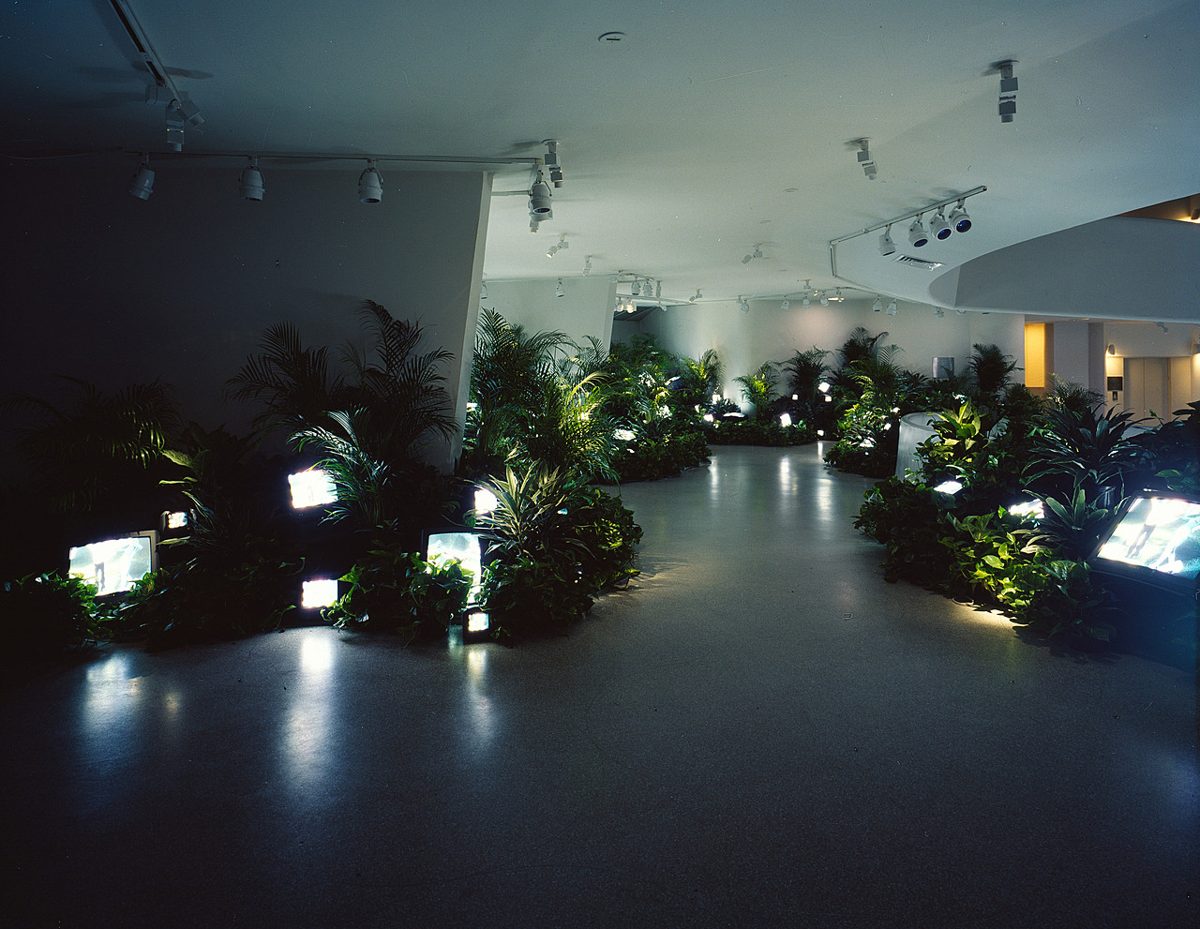
He had made TV Garden, with televisions among plants like flowers in a garden. Electronic Superhighway turns that around: no plants, only screens and neon borders. The garden has become a network.
Today, with a screen in every pocket, Paik's map looks both dated and right. Dated because tube sets have left our homes. Right because the feeling of being surrounded by more images than one can watch is fully intact. The work neither warns nor celebrates. It switches everything on at once and lets the viewer stand in the middle.
Contemporary Art