
Essays · Olfactory Art
Pope.L. Claim (Whitney Version).
A number has a smell, if it is made of meat.
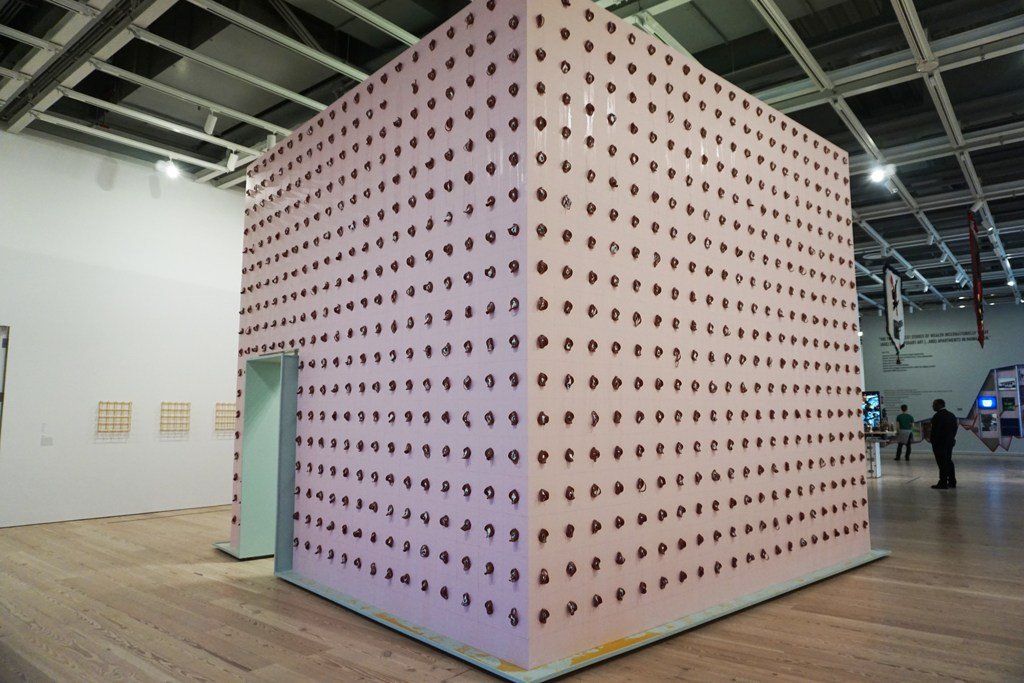
Photo Maximilíano Durón/ARTnews · ARTnews
A pink room
In March 2017 the Whitney Biennial opened at the Whitney Museum of American Art in New York. On one floor stood a square room, pink on the outside, mint green inside. Visitors could walk around it, then step in as into a gallery of its own.
The walls, inside and out, were covered in an even grid from floor to ceiling. Each cell was a slice of bologna, the cheap cold cut familiar from American lunches. 2,755 slices in all.
To each slice Pope.L attached a small photocopied portrait of a New Yorker photographed at random. The work is called Claim (Whitney Version).
On one wall hung a text by the artist, next to a bottle of MD 20/20, a cheap fruit wine. Nearby was a short poem describing slices weeping fat.
A deliberately crooked count
The number 2,755 is not arbitrary. According to the accompanying text, the count of slices was based on the percentage of Jewish people in New York's population. The faces on the meat are said to represent them.
Yet the same text admits that the method is somewhat off, on purpose. The people in the photographs were chosen at random. No one knows whether they are Jewish. A photograph cannot say.
This is the core of Claim. It builds a system that looks scientific: an even grid, an exact figure, one person per cell. Then it shows how hollow the system is. Assigning an identity to a face, turning a group of people into a percentage, are calculations built on assumptions.
The title means both to assert and to take possession. Who has the right to declare which group a person belongs to? Who is claiming what?
Drying meat, shifting smell
The bologna stayed on the wall for the whole show. Over time the slices dried, warped and shrank. Fat and juices dripped into basins set below.
The artist stressed that the meat was curing in the air, not rotting. In English, the word for preserving meat this way is also the word for making a wound or an illness well. A slice of meat being made to last, and a social wound waiting to be made well. Pope.L left both meanings side by side, unresolved.
Smell is the part of the work no one can avoid. Press at the time noted a strong odour in and around the pink room. Visitors might skip the text and ignore the faces. They could not avoid smelling.
As the meat curled, the photographs curled with it. Faces warped and grew hard to read. The identifying mark the system had pinned on each person was slowly erased by the material itself.
An artist of uncomfortable things
Pope.L, born William Pope.L, was an American artist known for his crawl performances, in which he moved on hands and knees through New York streets. He often used cheap, perishable, uncomfortable materials, often everyday food. They carry meanings of class, race and the body.
Claim (Whitney Version) won him the 2017 Bucksbaum Award, which the Whitney gives to one artist in the Biennial. For another of his works, see the essay on The Beginning of the World.
In Claim, Pope.L speaks without slogans. He lets an ordinary thing, a slice of cold cut, act according to its nature: drying, dripping, smelling. The viewer travels from that smell to the question alone.
Olfactory Art