
Essays · Contemporary Art
Rachel Whiteread. Untitled (Stairs).
A familiar way up, turned on its side, made strange.
Tate · Tate
A staircase on its side
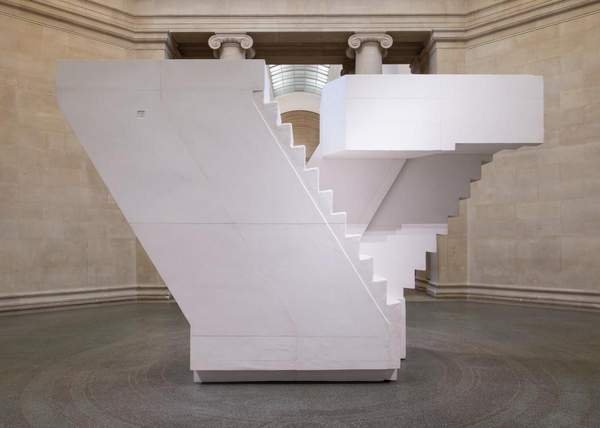
In the gallery stands a large ivory block, nearly four metres high and almost six metres long. It takes a moment to see: it is a staircase. Or rather, the space above a staircase, cast into a solid.
The stairs zigzag down through three square landings. But Whiteread did not set them the way people climb. She turned the cast ninety degrees, so it stands on an edge that was once a wall. The steps now run sideways and upwards, in directions no one could walk.
The work is Untitled (Stairs), 2001. Tate bought it in 2003 with help from the Art Fund and Tate Members. It was shown in the Tate Triennial of 2003, in Whiteread's major exhibition at Tate Britain in 2017, then at Belvedere 21 in Vienna in 2018.
A building that was a synagogue
The staircase was in a building in Bethnal Green, East London. In 1999 Whiteread and her partner bought it as a home and studio.
The building had a layered past. It began as a synagogue. Bombed in the Second World War, it was rebuilt in the 1950s. As the Jewish population of the area thinned, it fell out of use. In the 1970s a textile company used it as a warehouse. Then it stood empty for years, until Whiteread found it.
At the same moment the Guggenheim invited her to make work for an exhibition touring its Berlin, Bilbao and New York venues. She first thought of the Guggenheim buildings themselves. Then she changed her mind and turned to her own.
She cast the basement, three staircases, two flats on the first floor, and the synagogue floor. Untitled (Stairs) is one of the staircases. Another work from the same campaign, Untitled (Rooms), is also in Tate's collection. In this way she kept the building exactly as she had found it, before altering it for her own use.
Solid, yet hollow
Before casting, Whiteread made a model at one tenth scale, to imagine how the solidified space would look and how the sculpture should be placed.
The material is Jesmonite, a polymer reinforced plaster tougher than ordinary plaster, built up with layers of fibreglass matting. It was painted directly onto the stairs, the walls, and panels fitted against the banisters to form moulds. The cast is about eight centimetres thick.
The work is made of ten separate casts bolted together into one unit. From outside it looks dense and heavy. In fact it is a shell, empty inside.
That detail fits the idea strangely well. Whiteread cast empty space, something that was nothing. And the object that stands for that space has nothing inside it either.
Eight years to turn a staircase
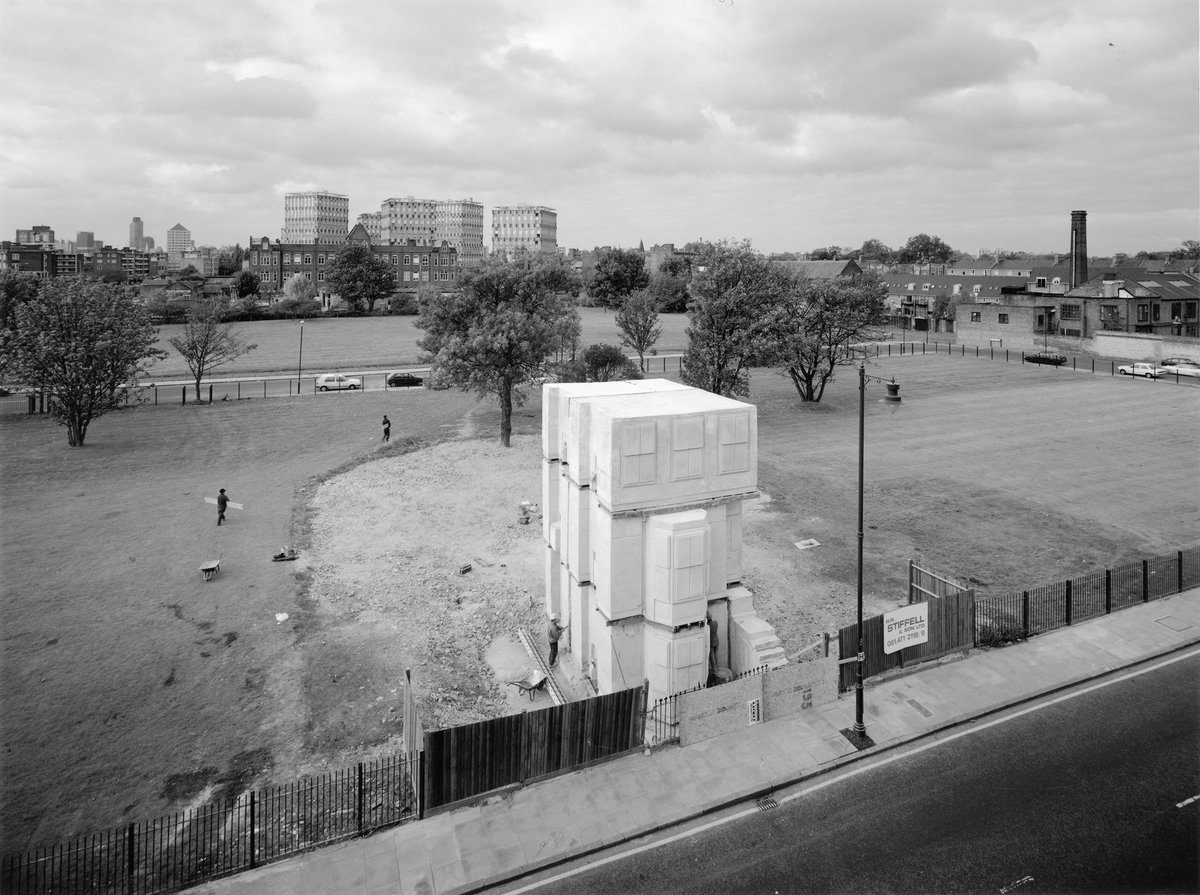
Whiteread had cast at architectural scale before. Ghost, 1990, was a room in a Victorian house in North London. House, 1993, was an entire terraced house in East London, demolished within months, the story Penta tells in its essay on House. But a staircase posed a different geometric problem.
In 2001 she said she had wanted to do this for about eight years. What intrigued her was the sense that a staircase could be turned on its side. She did not want to illustrate stairs; she wanted to flip the architecture a little, and change how one thinks about moving around or through something.
The result is both familiar and puzzling. The body knows the steps at once. The mind has to work: rebuild the real staircase, which way was up, which way down, where people once stood. No one fully solves it. Perhaps that is why people stand before it so long.
Contemporary Art