
Essays · Contemporary Art
Roni Horn. Vatnasafn / Library of Water.
Water kept, while its source disappears.
courtesy Artangel · Artangel
A library on a hill
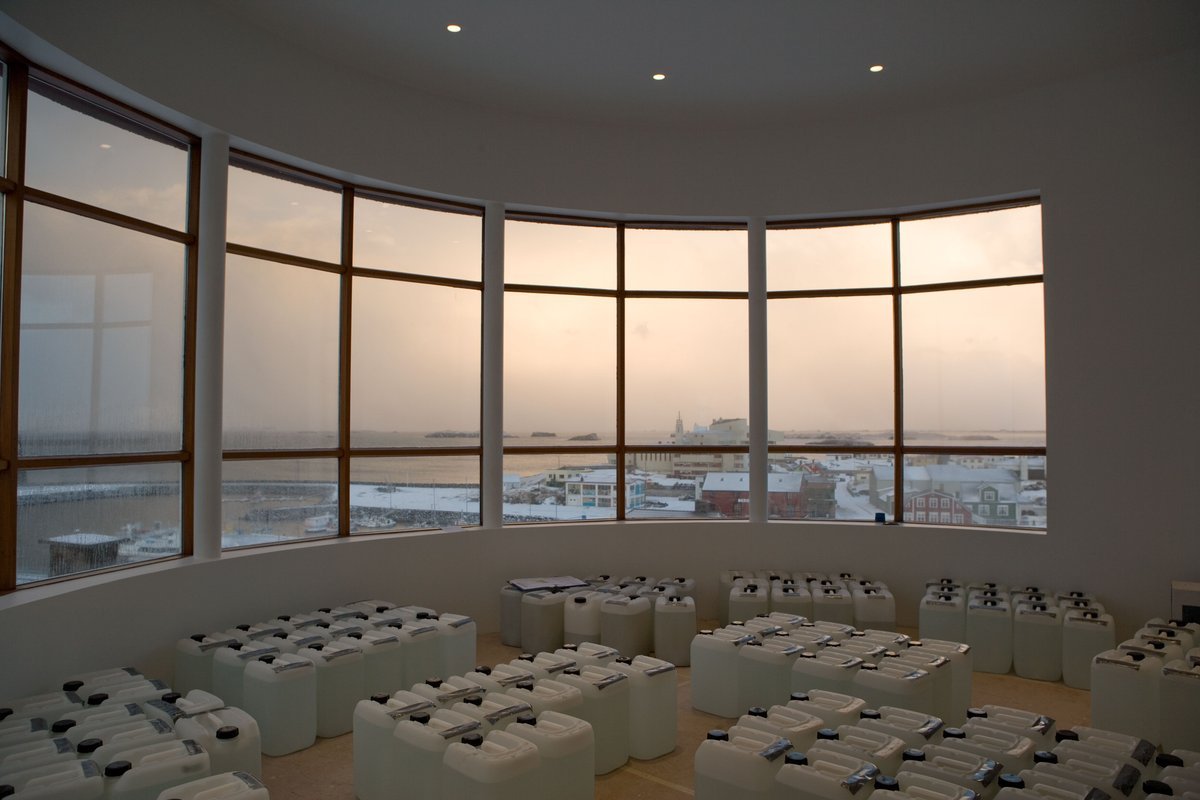
Stykkishólmur is a small harbour town in the west of Iceland. On a hill above the bay stands a building put up in 1950 as the town library. When the library moved, the building emptied. Roni Horn, with the British arts organisation Artangel, turned it into a long term work. Vatnasafn, Icelandic for library of water, opened on 30 April 2007.
In the main room stand 24 glass columns, floor to ceiling. Each holds water. That water was once ice, gathered from glaciers across the island and left to melt inside the tubes.
Light from the tall windows passes through the columns and bends. It falls on the floor as moving patches. Each column comes from a different glacier. From a distance they look alike. Up close, one starts to wonder how far each tube of water has travelled to be here.
No long wall texts. No screens. Only water, glass and light.
A floor that speaks of weather
Underfoot, the floor is rubber, set with words in Icelandic and English. All of them describe weather. Some are everyday terms. Some are poetic, like the way one might call a spring breeze playful. Some come from farming and the sea, where weather decides the work of the day.
In Iceland, weather is not small talk. It shifts fast, and people live alongside it. Horn knew this. She had been travelling to Iceland regularly since the mid 1970s, photographing and writing about its land, climate and people for years. The same patient attention to matter runs through her other works, such as Gold Field, a thin sheet of gold laid directly on the floor.
Alongside the installation runs another part, Weather Reports You. Horn gathered around a hundred accounts from people in the Snæfellsnes region about weather in their lives. They were published as a bilingual book in 2007. Weather here is no longer a measurement. It is each person's memory.
So the building holds two things: glacier water, and the words of people who live under that sky. One is matter. The other is memory.
A place still in use
Vatnasafn is not a sealed gallery. Visitors come in summer. All year, the town uses the room for its own life: meetings, concerts, weddings, chess, yoga classes.
Downstairs is a studio for a writers' residency. Each year someone comes to stay for a few months between May and October. The programme began in 2007; Anne Carson and Rebecca Solnit both stayed in 2008.
This changes the work. The columns do not stand alone in museum silence. They stand among conversation, music, the sound of chess pieces on a table. Glacier water becomes part of ordinary town life.
When the source disappears
In 2007, Library of Water could be read as a meditation on water and light. Today that reading has shifted. According to Artangel, every glacier that gave ice to these columns has since retreated. One glacier, Ok, has gone entirely.
So the room holds a column of water whose source no longer exists. The water is still there, in glass, clear and still. The place it came from is gone.
Horn did not make a warning. No charts, no slogans. She kept a sample and let time do the rest. That quiet is what makes the work heavier each year.
A library usually keeps what people have written. This one keeps what the earth is losing, one tube at a time.
Contemporary Art