
Essays · Olfactory Art
Natural or synthetic. An aesthetic debate.
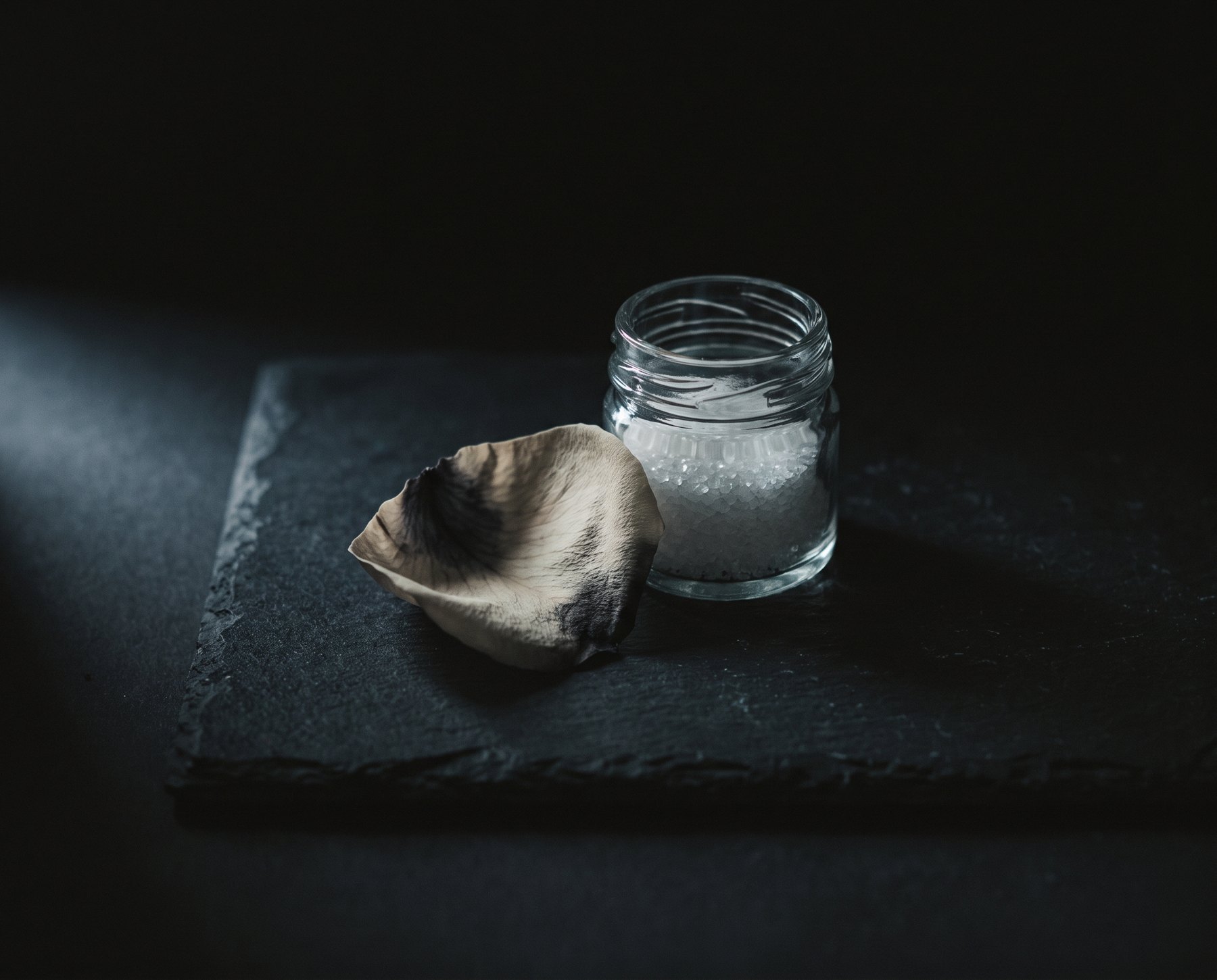
A petal and a molecule are both traces.
Since 1868: modern perfume was never only plants
In 1868 the English chemist William Henry Perkin reported a synthesis of coumarin, the molecule behind the smell of hay and almond in tonka beans. From then on coumarin could be made in quantity without the bean. Six years later, in 1874, Tiemann and Haarmann synthesised vanillin, the main smell of the vanilla pod.
Perfume took up both molecules almost at once. Houbigant's Fougère Royale, composed by Paul Parquet and usually dated 1882, built its axis on synthetic coumarin. In 1889 Aimé Guerlain made Jicky with both synthetic coumarin and vanillin over a resinous base. The two bottles are often cited as the start of modern perfume.
In other words, almost from the beginning, modern perfume was a meeting of plant and laboratory. The idea of an old, wholly natural age later spoiled by chemistry is a lovely story that does not match the history.
Natural does not mean harmless
Today's debate often turns on an assumption: what comes from a plant is gentle, what comes from a lab is suspect. The law paints a more complicated picture.
In 2017 the European Union adopted Regulation 2017/1410, prohibiting atranol and chloroatranol in cosmetics. Both occur naturally in oakmoss and treemoss extracts. According to the regulation, the scientific committee on consumer safety counted them among the allergens behind the highest number of skin contact allergy cases in previous years. A classic natural material of perfume had to be reworked to stay in use.
The reverse holds too: some synthetic molecules are restricted, some are not. Each substance is judged on its own data. Natural or synthetic describes origin. It says nothing by itself about skin.
The aesthetic debate: complexity and clarity
Set safety and marketing aside, and a more interesting question remains: in what ways are these two kinds of material beautiful?
An oil from a plant is a crowd. It holds dozens, sometimes hundreds of compounds, shifting with soil, year and batch. Lovers of natural materials speak of that depth: the smell never keeps still, it has unexpected corners, each time you find another detail.
A synthetic molecule is a single line. Clean, clear, repeatable. In 1966 Edmond Roudnitska used Hedione, a transparent jasmine-like molecule, in Eau Sauvage for Dior; he also wrote at length on the aesthetics of the craft, including L'Esthétique en question in 1977. A molecule lets a perfumer draw a fine line no plant can give.
The two beauties do not exclude each other. Most good perfumes use both. The real debate is not about choosing sides but about understanding what each material brings.
Two kinds of trace
The artist Sean Raspet pushed the question further. In 2018 he designed a floral molecule that had never existed in nature or in the scientific literature, and had it synthesised. A smell with no plant behind it. The trace of an idea.
Penta reads the petal and the molecule the same way: both record what happened. The petal records a season, a piece of land, a morning's picking. The molecule records a human question, a reaction, a patience in the lab.
Asking which is more real is perhaps the wrong question. Better to ask: what does this trace tell, and do we want to hear it.

Olfactory Art