
Essays · Contemporary Art
Dan Flavin. untitled (Marfa project).
Màu chỉ hiện ra khi có chỗ để đổ vào.
Colour appears only when it has somewhere to fall.
The Chinati Foundation · The Chinati Foundation
Sáu toà nhà, mười hai hành lang
Trong khuôn viên Chinati Foundation ở Marfa, Texas, có sáu toà nhà thấp, dài, hình chữ U. Đó là những doanh trại lính của đồn quân sự cũ Fort D.A. Russell. Bên trong mỗi toà, ở hai cánh dài của chữ U, là hai hành lang song song.
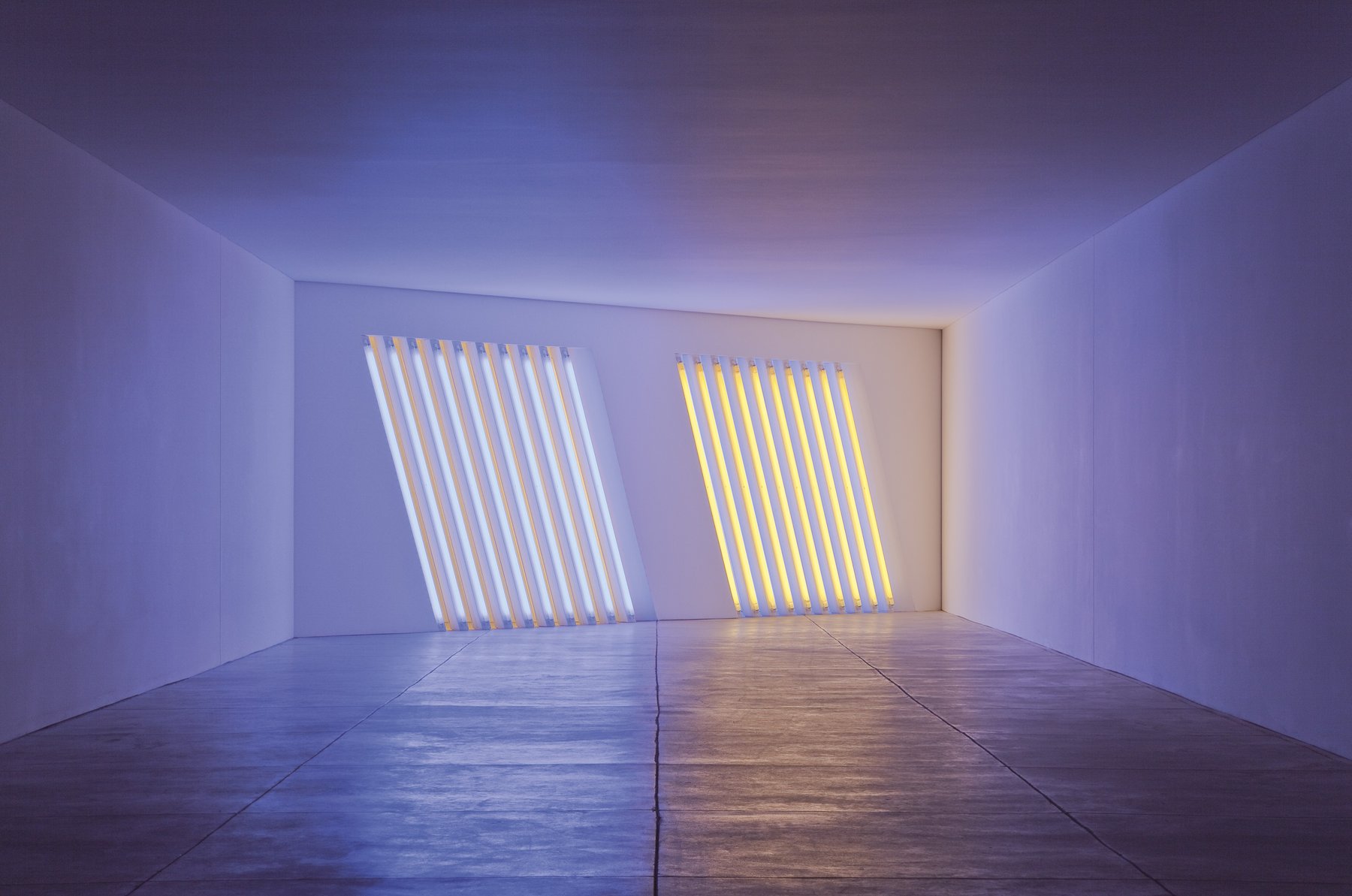
Dan Flavin chọn đặt tác phẩm của mình vào đúng những hành lang ấy. Mỗi hành lang bị chắn ngang bởi một bức vách ánh sáng, cao kín trần và rộng kín tường. Vách được ghép từ những bộ đèn huỳnh quang dài tám feet, khoảng 2,4 mét, đặt cạnh nhau với khe hở vừa đủ để nhìn xuyên qua.
Người xem không đi qua được bức vách. Họ đứng trước nó, nhìn qua các khe, thấy nửa kia của hành lang ngập một màu khác. Muốn sang phía bên kia, phải quay lại, đi vòng.
Ở cuối mỗi cánh dài có hai cửa sổ. Ánh sáng tự nhiên từ đồng cỏ Texas lọt vào, pha với ánh đèn, và cho người xem một khung nhìn ra phong cảnh rộng bên ngoài.
Hai màu trong một bộ đèn
Chi tiết khiến tác phẩm khác những sắp đặt đèn thông thường nằm ở từng bộ đèn. Mỗi bộ giữ hai bóng khác màu, quay về hai hướng ngược nhau. Một mặt vách chiếu màu này, mặt kia chiếu màu khác. Cùng một bức vách, đứng hai phía thấy hai căn phòng.
Màu được sắp theo trình tự qua sáu toà. Hai toà đầu dùng hồng và lục. Hai toà tiếp theo dùng vàng và lam. Hai toà cuối dùng cả bốn màu.
Đi từ toà này sang toà khác, mắt người xem mang theo màu vừa thấy. Bước ra nắng trưa sau một hành lang lục, mọi thứ có thể ngả hồng trong vài giây. Bước vào một hành lang vàng sau hành lang lam, màu vàng như sáng hơn thực tế. Tác phẩm không nằm gọn trong một toà. Nó nằm trong quãng đi giữa các toà.
Dự án cuối cùng
Flavin bắt đầu bàn về dự án từ đầu thập niên 1980, cùng thời Donald Judd dựng Chinati. Kế hoạch được chốt năm 1996. Cũng năm đó, Flavin qua đời ở Riverhead, New York. Ông sinh năm 1933.
Ông không kịp nhìn thấy tác phẩm hoàn thành. Việc lắp đặt tiếp tục sau khi ông mất, và tác phẩm ra mắt công chúng trong ngày hội mở cửa thường niên của bảo tàng vào tháng 10 năm 2000. Đây là tác phẩm quy mô lớn cuối cùng ông thiết kế.
Có một điều lặng lẽ trong việc đó. Một nghệ sĩ cả đời làm việc với ánh sáng đã để lại tác phẩm lớn nhất của mình dưới dạng một bản vẽ, để người khác bật đèn lên.
Vật liệu mua ở cửa hàng
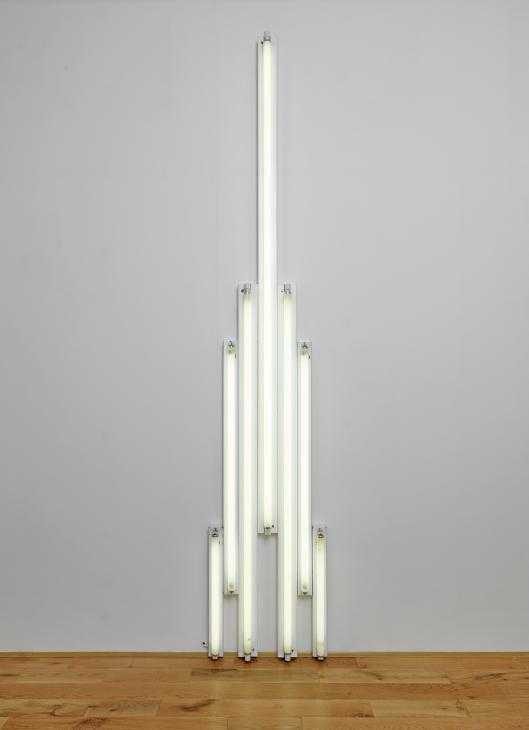
Từ đầu thập niên 1960, Flavin làm việc gần như chỉ với một vật liệu: đèn huỳnh quang công nghiệp, loại bán sẵn, kích thước chuẩn, màu có hạn. Ông không tự chế bóng đèn, không uốn ống. Ông chọn, sắp, và đặt chúng vào không gian. Những tác phẩm đầu như 'monument' for V. Tatlin đã cho thấy cách làm ấy.
Ở Marfa, cách làm này đạt tới quy mô kiến trúc. Vật liệu vẫn bình thường như ở bất cứ văn phòng nào. Nhưng khi được xếp thành vách, lặp lại qua mười hai hành lang, đặt trong những toà nhà từng dùng cho lính ngủ, nó không còn là đèn văn phòng nữa. Nó là màu có thể đi vào.
Ánh sáng huỳnh quang thường bị coi là lạnh, phẳng, vô cảm. Flavin dùng chính thứ ánh sáng ấy để làm một nơi chậm và trầm, nơi người xem đứng rất lâu trước một bức vách chỉ để nhìn màu trôi sang màu.
Six buildings, twelve corridors
On the grounds of the Chinati Foundation in Marfa, Texas, stand six low, long, U shaped buildings. They were barracks of the former army post, Fort D.A. Russell. Inside each, in the two long arms of the U, run two parallel corridors.
Dan Flavin chose to place his work in exactly those corridors. Each is blocked by a barrier of light that fills its full height and width. The barrier is made of eight foot fluorescent fixtures set side by side, spaced just enough to allow a view through.
Visitors cannot pass the barrier. They stand before it, look through the gaps, and see the other half of the corridor flooded with another colour. To reach the far side, they must turn back and go around.
At the end of each long arm are two windows. Daylight from the Texas grassland enters, mixes with the lamps, and gives a view out to the wide landscape.
Two colours in one fixture
What sets the work apart lies in each fixture. Each holds two bulbs of different colours, shining in opposite directions. One face of the barrier casts one colour, the other face another. The same barrier makes two different rooms, depending on where one stands.
The colours follow a sequence across the six buildings. The first two use pink and green. The next two use yellow and blue. The last two bring all four together.
Moving from one building to the next, the eye carries the colour it has just seen. Stepping into noon light after a green corridor, everything may turn pink for a few seconds. Entering a yellow corridor after a blue one, the yellow seems brighter than it is. The work is not contained in one building. It lives in the walk between them.
The last project
Flavin began discussing the project in the early 1980s, in the years when Donald Judd was building Chinati. The final plans were settled in 1996. That same year Flavin died in Riverhead, New York. He was born in 1933.
He did not live to see it finished. Installation continued after his death, and the work was unveiled at the museum's annual Open House in October 2000. It is the last large scale work he designed.
There is something quiet in that. An artist who spent his life working with light left his largest work as a set of plans, for others to switch on.
Materials from the store
From the early 1960s Flavin worked almost entirely with one material: commercial fluorescent lamps, sold ready made, in standard lengths and a limited range of colours. He did not make his own tubes or bend glass. He chose, arranged, and placed them in space. Early works such as 'monument' for V. Tatlin already show that approach.
In Marfa the approach reaches the scale of architecture. The material is as ordinary as in any office. But arranged into barriers, repeated across twelve corridors, set in buildings where soldiers once slept, it is no longer office lighting. It is colour one can walk into.
Fluorescent light is usually thought of as cold, flat, indifferent. Flavin used that very light to make a slow, quiet place, where visitors stand a long time before a barrier just to watch one colour drift into another.

Contemporary Art