
Essays · Contemporary Art
Abraham Cruzvillegas. Empty Lot.
Soil remembers what we did not sow.
Tate Modern · Tate Modern
A field on scaffolding
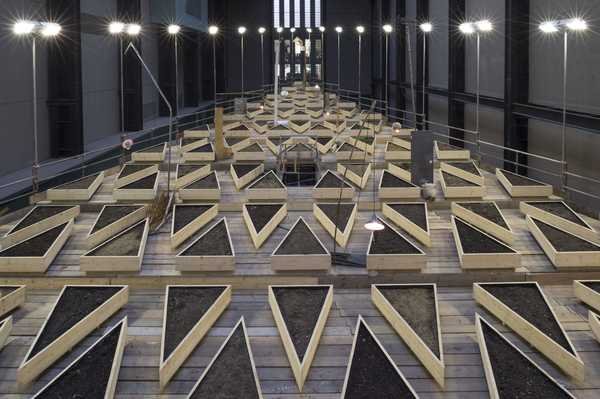
On 13 October 2015 the Turbine Hall at Tate Modern opened a work that looked like a building site. A large scaffolding frame stood in the hall. Inside it were materials discarded from construction sites across London. On top was a broad platform covered with triangular wooden planters, laid out in an almost geometric pattern.
Each planter held soil, taken from parks and green spaces all over London, including sites in Peckham, Haringey and Westminster. Each was a small piece of a particular place, carrying its history.
Lamps shone on the planters. The soil was watered regularly. No one sowed seeds, no one planted anything. The work was called Empty Lot and ran until 3 April 2016.
It was the first Hyundai Commission for the Turbine Hall. Tate describes it as a sculpture designed to change unpredictably from week to week.
Abraham Cruzvillegas is a Mexican artist born in 1968. He calls his method autoconstrucción, roughly self construction. The word comes from where he grew up: Ajusco, on the outskirts of Mexico City, where he still lives and works.
According to Tate, in the 1960s many people moved from the countryside toward the city. They formed their own communities and makeshift homes from whatever materials they could afford, on volcanic land thought uninhabitable. Houses grew by stages, added to and repaired whenever there was money, material or help.
Cruzvillegas carries that logic into art. His works are improvised from mixed materials: wood, plastics, human hair, glass, screws, plants, ceramic, bone, cement, feathers. No complete plan at the start. The structure grows from what is at hand.
In London he did the same. The scaffolding gathered the city's construction waste. The soil came from its parks. A self built structure, made of the leftovers and forgotten parts of the very place it stood.
No seeds
The most important decision in Empty Lot was something not done. No seeds. A gardener decides in advance what to plant, where, how much. Cruzvillegas skipped that step.
But soil is never truly empty. Every handful from a park already holds weed seeds, spores, leftover roots, things carried by wind and birds. Given light and daily water, they have a chance to come up. Or not.
So the work had no fixed form. One planter turned green first, another stayed brown. One corner grew thick, another bare. Each planter told a little about where its soil came from, about what had lived there unrecorded.
The Telegraph called it a living city of weeds. The phrase catches something: what grew here is what the city usually pulls out.
An empty lot indoors
An empty lot in a city is usually seen as unused land waiting to be built on. Cruzvillegas turns that around. An empty lot is where anything might still happen. It has not been defined yet. Tate reads the work through ideas of urban nature, chance, transformation and hope.
The lamps in Empty Lot did the sun's work in a room without sky. Another work once did something similar in the same hall: Olafur Eliasson's The weather project, an artificial sun for people to stand beneath. With Eliasson, visitors were the ones warmed. With Cruzvillegas, it was the soil.
Seeing Empty Lot once shows a single moment. Returning a few times shows the real work: the difference between visits. It lies in no single planter, but in the time between two looks.
Contemporary Art