
Essays · Contemporary Art
Mire Lee. Open Wound.
Each skin is the mark of a shift of work.
Tate Modern · Tate Modern
A living factory
From 9 October 2024 to 16 March 2025, the Turbine Hall at Tate Modern ran again as a factory. The work was Open Wound by Mire Lee, an artist born in South Korea in 1988, made for the Hyundai Commission.
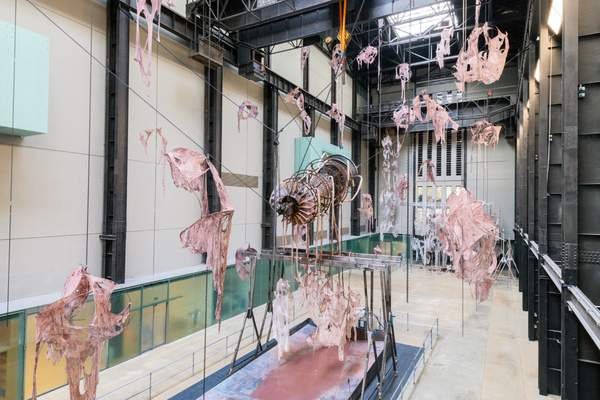
Coming down the ramp from the main entrance, visitors walked beneath rows of long metal chains hanging from far above. On the chains hung torn, mesh like pieces of fabric, dyed muted shades of dirty pink and grey. Lee calls them skins. The further down the ramp, the clearer the detail. The sound of dripping liquid drew people on, beyond the bridge.
At the east end of the hall, hanging from a ceiling crane that belongs to the original building, was a motorised metal turbine eight metres long and weighing over three tonnes. It turned slowly. From thick silicone hoses attached to it, which Lee calls tentacles, a viscous reddish brown liquid ran down into a large tray.
Below stood three six metre metal gantries draped with white fabric over curved steel frames. Around this area ran a chest high fence of scaffolding poles, ten metres wide and seventeen long. Visitors could walk all the way round but not enter.
How a skin is born
Open Wound was not a still scene. It was a production line. New skins were wetted under the turbine. Technicians moved them to nearby racks to harden. Then they were hauled into the air and hung on the chains.
Over time the skins accumulated overhead. Tate describes them as birthed from the body of the building while appearing to shed from the ceiling. Birth and shedding, production and decay, happening at once, through machinery and human hands.
The drying of fabric recalls textile manufacture. The chains come from pit head baths, where a pulley system let coal miners hang their clothes from the ceiling while they worked underground or rested at home. Generations of workers gathered in those passing spaces to wash away dirt, pain and fatigue.
Lee also had the cladding removed from both sides of the bridge, exposing the wiring and supports inside. Tate calls these the guts of the industrial body. The ceiling crane was put back into use. Dormant parts of the building were woken.
A wound that does not close
Tate Modern occupies the site of the former Bankside Power Station. The turbine hall once held coal and oil fired boilers that generated electricity for London. Lee finds the histories of industry awe inspiring in their violence and scale. She thinks about the physical and emotional labour of people living through precarity and decline, about watching an individual life get caught in a larger system.
The turbine at the heart of the hall, in Lee's words, is an open wound that never closes. The title comes from there. Lee is drawn to the way industrial machinery takes on human qualities. A motor works like a stomach. A pump has pipes like intestines. Her sculptures look like organisms and machines turned inside out, silicone tubes and low tech motors exposed.
She rejects the clean, sterile look of modern technology. In its place is what she calls the time of decline, the mood of a deserted construction site where something has begun to wither.
Skin, and other people
Lee says she has always been interested in skin because it registers otherness. In this work the skins are also about the tension between individual and collective. They differ only in size. Hung together they suggest dissolved or malleable bodies, sharing the same flesh.
She draws on feminist and queer artists and thinkers, among them the South Korean poet Kim Eon Hee, born in 1953. Tate writes that the work invites us to stay with contradictory emotions: awe and disgust, compassion, fear and love.
Three years earlier, in the same commission series, Anicka Yi released flying machines into the hall like living creatures. Both works ask how alive a machine can be. In Lee's answer everything is wetter, slower, and more painful.
Tate ends with a question: what is it that the museum generates today? Open Wound answers not in words but in new skins, a few more on the ceiling each week.
Contemporary Art