
Essays · Contemporary Art
Kara Walker. Fons Americanus.
Water does not forget what it has carried.
Tate · Tate
A fountain in the Turbine Hall
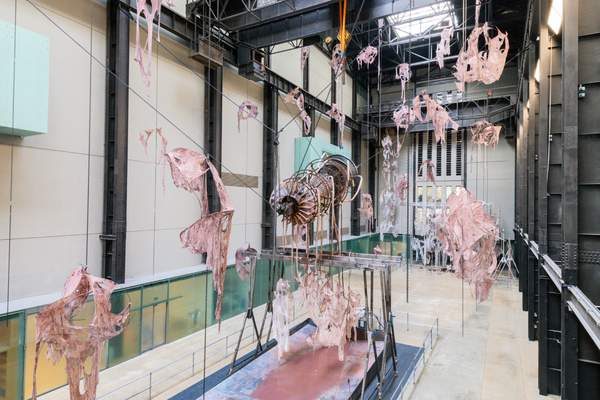
From 2 October 2019 to 7 February 2021, the Turbine Hall at Tate Modern in London held a fountain. It was 13 metres tall, in four tiers, and the water ran.
This was Fons Americanus by Kara Walker, the New York based American artist, made for the Hyundai Commission. Walker was the fifth artist in the ten year series, after Abraham Cruzvillegas, Philippe Parreno and SUPERFLEX, and immediately after Tania Bruguera. Years earlier in New York she had raised a sugar coated sphinx inside a sugar refinery due for demolition.
Walker is best known for black cut paper silhouettes that recall the history of slavery and the antebellum American South. With Fons Americanus she moved into large scale sculpture, while keeping the same concerns: race, violence, and the way history is retold.
A monument turned inside out
The fountain's model is the Victoria Memorial in front of Buckingham Palace, designed in 1901 and unveiled in 1911 in honour of Queen Victoria. Walker has said she first saw it through a taxi window on the way to the airport. She took a few quick snapshots and forgot about it.
Monuments, she observes, have a peculiar quality: the larger they are, the more they sink into the background and disappear. Fons Americanus borrows the form of a monument to empire but does the opposite: instead of celebrating, it questions power, and tells the histories that bind Africa, the Americas and Europe across the Atlantic.
The full title of the work was painted on the Turbine Hall wall in Walker's own words. She presents the work as a gift to the heart of an empire that redirected the fates of the world. She signed it with the letters NTY, for Not Titled Yet, a play on British honours.
Water as subject
Entering the Turbine Hall, visitors first met a smaller monument: a great scallop shell, in the manner of shells in paintings of Venus. Inside, a weeping boy is almost fully submerged in a well, only his head above the surface. Tate links this part to the ruins of a slave trading fort on Bunce Island, Sierra Leone.
The main fountain is an allegory of the Black Atlantic, the historian Paul Gilroy's term for how the transatlantic slave trade shaped Black culture and identity in the Americas and Europe. Around its tiers stand figures: a laughing Queen Vicky, a bowed figure of Melancholy, a kneeling man Walker suggests may be a Caribbean plantation owner, a tree with a noose.
In the lowest basin a fishing boat has sprung a leak, water pouring in, recalling Winslow Homer's The Gulf Stream. Sharks circle. Walker also points to Turner and Copley and their paintings of perilous voyages. Water here is the source of power, and the place where stories go under.
From clay to the Turbine Hall
Walker began with small clay models, made daily, then scanned them and arranged them within a digital model of the Turbine Hall. Machines enlarged the forms, and then human hands returned to finish them. She wanted her own hand to remain present in the work.
The fountain was built from recyclable or reusable cork, wood and metal, and covered in a non toxic acrylic and cement composite. It was not made to stand forever like the stone of the Victoria Memorial. It was made to stand for a time, and then come down.
Walker compared the Turbine Hall to a one person version of a nineteenth century World's Fair, where rich nations displayed wealth carried on the backs of colonised people. Within it she made a space for reflection, even joy, amid conflicts that have not eased.
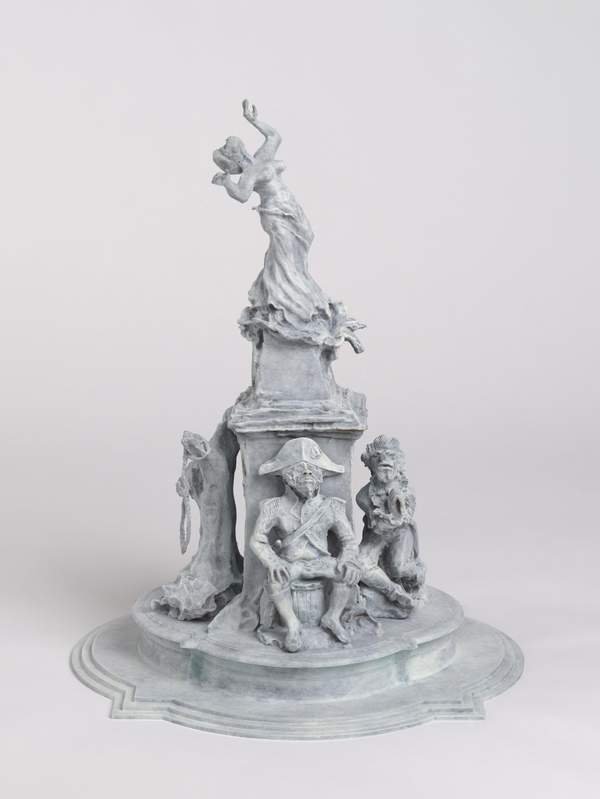
Walker later gave Tate a small bronze version of Fons Americanus, about half a metre tall. The great fountain has left the Turbine Hall. But the question it raised still stands: whose story are the monuments around us telling?

Contemporary Art