
Essays · Contemporary Art
Kara Walker. A Subtlety, or the Marvelous Sugar Baby.
Every sweetness has a history.
A sphinx in a sugar factory
In the late spring of 2014, inside the Domino Sugar Factory in Brooklyn, New York, a giant figure lay in the middle of a dark warehouse. Her body was a sphinx. Her head was that of a Black woman wearing the kerchief familiar from the mammy figure of American popular culture. Her whole surface was coated in white sugar.
The work was by Kara Walker, presented by the public art organisation Creative Time. Its full title reads like a dedication: A Subtlety, or the Marvelous Sugar Baby, an homage to the unpaid and overworked artisans who refined our sweet tastes from the cane fields to the kitchens of the New World, on the occasion of the demolition of the Domino Sugar Refining Plant.
The title says almost everything. The work stood at a precise moment, just before the building disappeared to make way for new development. It was a farewell. The title tells us to whom.
The English word subtlety has an old meaning few remember. In medieval Europe it named the elaborate sugar sculptures set on aristocratic banquet tables to display wealth. Walker took the word back and scaled it up to the size of a warehouse.
The building that whitened sugar
The refinery was built by the Havemeyer family in 1856. According to curator Nato Thompson, by 1870 it was refining more than half of the sugar in the United States, over 1,200 tons a day.
Refining sugar means taking dark cane juice and turning it into white crystals. Thompson writes that the building's whole history was one of sweetening tastes and gathering wealth, moving from dark to white. Walker read that sentence both ways.
Sugar did not begin at the factory. It began on plantations in the Caribbean and the Americas, where millions of enslaved Africans planted, cut and boiled the cane. Sugar, enslaved people and goods made from sugar tied the continents into a triangular trade across the Atlantic. The Brooklyn refinery was the last step, where the dark colour was filtered out.
The boys and the molasses
The sphinx was not alone. Along the approach stood a procession of Black boy figures carrying baskets and loads. Thompson describes them as scaled up versions of tchotchkes, the small decorative figurines once widely sold that carry racist imagery.
Walker became known in the 1990s for black cut paper silhouettes that restage the slave era American South through exactly those stereotypes. She does not avoid uncomfortable images. She uses them, enlarges them, and puts the viewer where they must look straight at them. Thompson calls the feeling a giddy discomfort.
Then there was the molasses on the walls. The warehouse was dark and old, steeped in sugar after more than a century. In the warm summer air everything was sticky, sweet, heavy. Visitors did not stand outside the work. They stood inside its material.
A sugar statue cannot be kept
A Subtlety existed for only one short season. Sugar is not marble. It absorbs moisture, runs, gathers dust. The work was made to vanish along with the building that held it.
That impermanence is part of its meaning. The workers it honours have no monuments. Their names were not written down. Their labour dissolved into spoonfuls of sugar in kitchens they never entered. A statue of sugar, made to melt away, is the memorial closest to that fate.
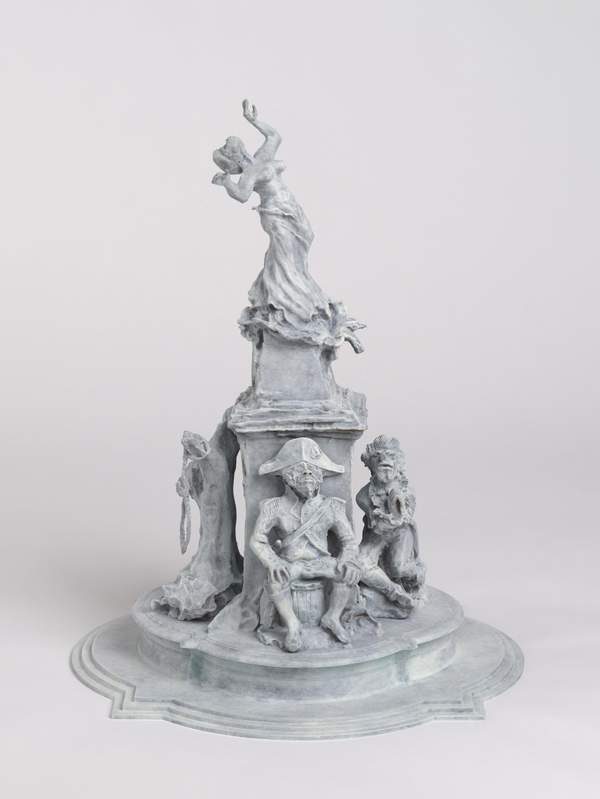
Walker has carried these questions into later works, such as Fons Americanus at Tate Modern, where water takes the place of sugar. But A Subtlety remains the work most bound to a single place: a factory that whitened the sweetness of a whole country, and a brilliant white woman sitting at its centre, facing the door.
Contemporary Art