
Essays · Olfactory Art
Ade Darmawan. Tuban.
Oil soaks into the page, and the page changes colour.
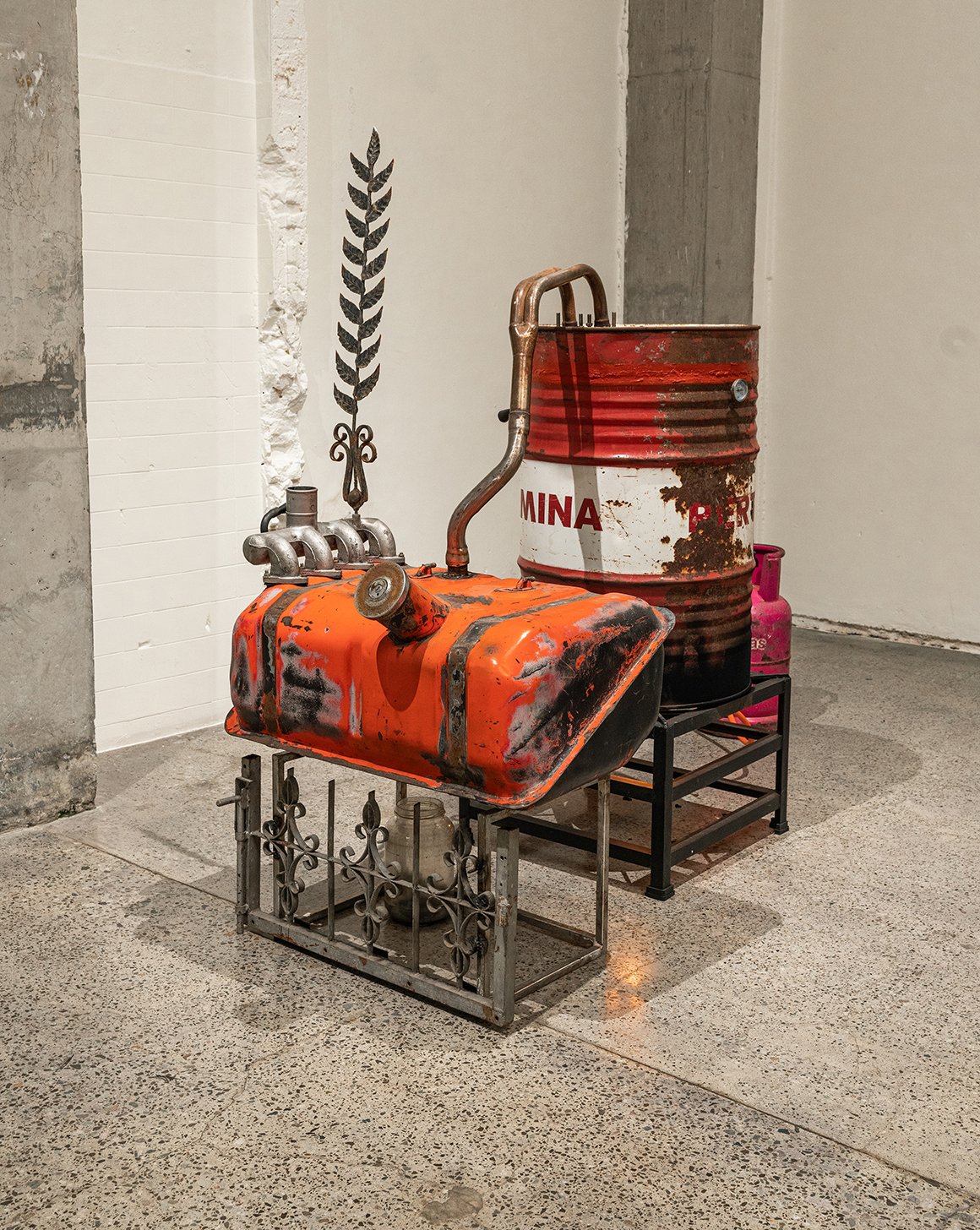
Exhibition view "Ade Darmawan: Water Resistance", 2024 (from Artforum article) · Artforum
A room that distils
Tuban is an installation Ade Darmawan began in 2019. At first glance it is a room in a house: a dining table, chairs, a wardrobe. But on the table, the chairs and the wardrobe sit electric hot plates, and on them glass distillation vessels.
Inside are spices: nutmeg, clove, cinnamon. As the plates heat, vapour rises, moves through tubes, meets cold and condenses into dark drops of oil. A sweet, peppery smell fills the room. Visitors smell it before they understand what they are looking at.
The oil is not collected in bottles. It drips onto biographies of Suharto, Indonesia's second president, who ruled for more than thirty years. The drops soak into the paper and spread across the table, leaving marks that will not wipe away.
Time is part of the work. The longer it runs, the further the stains spread and the darker the books become. The room is not still. It is slowly writing over whatever lies on the table.
From a novel
Darmawan did not choose these spices because they smell pleasant. He chose them because they appear in Arus Balik, the novel by Pramoedya Ananta Toer published in 1995. Pramoedya drafted it in the 1970s while imprisoned for his ties to Lekra, the Institute for People's Culture, an organisation close to the communists.
Arus Balik tells of a moment when maritime power turned, when Western traders and warships came to the archipelago for spice and the coastal kingdoms of Java lost their standing. Tuban, a port city in East Java, is central to the story.
Darmawan started by reading the novel, then made field trips to Tuban. The work takes its name from there. A port city, a book written in prison, and the spices that once sent people halfway around the world.
Placing Suharto's biographies under the dripping oil is deliberate. It was under Suharto that Pramoedya was imprisoned and his books banned. The smell of the novel comes back and soaks into the official story of the man who banned it.
Distillation as analogy
In 2024 Tuban was shown in Water Resistance, Darmawan's exhibition split between ROH in Jakarta and the Cemeti Institute for Art and Society in Yogyakarta. The whole show uses distillation as an image for the history of colonial extraction in Indonesia.
As Frieze describes the installations, nutmeg, cloves and jasmine travel from tanks through makeshift exhaust pipes and glass condensers and ooze into jars as dark, fragrant distillates. The machinery looks improvised, pieced together from used parts.
Distilling means taking the most valuable part of a material and leaving the rest. It is also how a colonial economy works: take the spice, take the oil, take the wood, leave the land spent. Darmawan, a co-founder of the Jakarta collective ruangrupa, turns that analogy into something one can breathe.
In the same exhibition he showed Santalum Album Family, where the smell of burnt sandalwood comes out of an oil drum. If Santalum speaks of oil and power, Tuban speaks of writing: who gets to write history, and which smell is strong enough to soak through the page.
Olfactory Art