
Essays · Olfactory Art
Maryanto. Brimming in Wonocolo.
The smell of oil is the part of the landscape no one can paint.
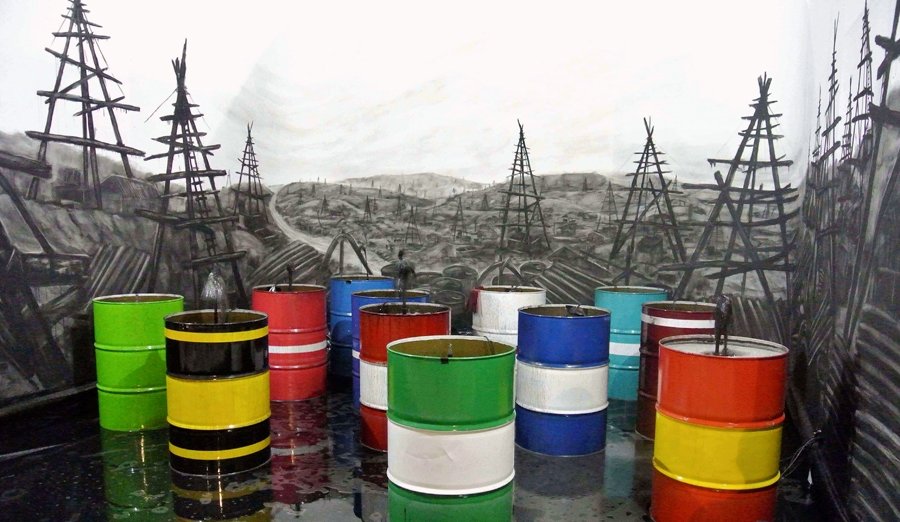
Maryanto, Brimming in Wonocolo · ArtReview Asia
A field of derricks on the wall
Brimming in Wonocolo was first shown at the Jakarta Biennale in 2015. The work has two parts. Behind is a panoramic mural, spread out like a horizon, showing a dense field of oil derricks. In front are real drums, the kind of oil drum found at every extraction site.
The drums do not sit still. They spray crude oil in a steady rhythm, like small working wells. With the movement comes the smell. Heavy, thick, faintly sweet, it fills the space in front of the painting.
The viewer stands between two things. On one side, an image: still, at a distance. On the other, a material: flowing, smelling, right there. The painting is a map. The drums are the land itself, carried into the exhibition.
Wonocolo, since 1893
Wonocolo is an area in East Java, Indonesia, where oil lies close to the surface. In 1893 a Dutch company, the Dordtsche Petroleum Maatschappij, began drilling there. Indonesia was then a colony, and oil was one of the things taken away.
After independence in 1949, around five hundred old wells in Wonocolo passed to local and foreign operators. According to ArtReview Asia, the decades that followed left two things behind: damaged land and a chain of political corruption around oil.
The title uses the word brimming. It reads two ways. A land full of oil, and rich. And a land overflowing with oil, soaked into soil, water and the lives of the people there. The drums spraying oil in the gallery hold both meanings at once.
A landscape painter working with matter
Maryanto was born in Jakarta. He studied printmaking at the Indonesian Institute of the Arts in Yogyakarta, did a short residency in Spain and spent 2012 and 2013 at the Rijksakademie in Amsterdam. He lives and works in Yogyakarta.
Landscape is his main genre, but not landscape to admire. For Maryanto, painting a place is a way of asking who owns it, who extracts from it, and who lives with the result. He has also worked in social work, and it shapes the subjects he chooses.
His materials always carry meaning. In Pandora's Box, 2013, he drew coal mining scenes on studio walls in charcoal and carbon powder: a coal mine drawn in its own black dust. In 2015, the same year as Wonocolo, he made Sweet Crude, Black Gold with the Nigerian artist Victor Ehikhamenor, a multi panel painting on wood about oil drilling in Nigeria. In 2016 came Mineral Desire, a landscape canvas beside a cabinet of minerals.
Brimming in Wonocolo goes one step further. Here the material is not used to paint. It is left as it is, set in motion, allowed to smell.
Why the smell matters
We can look at a photograph of an oil well and see nothing. There are so many news images, advertisements and documentary pictures of oil that the eye has grown used to them. Smell is harder to get used to. Crude oil in a closed room is something the body reacts to at once, before the mind catches up.
In Wonocolo that smell is part of daily life. It is in the air, in the soil, on the hands of those who work the wells. By bringing it into the gallery, Maryanto brings in a piece of that life. A viewer in Jakarta does not need to travel to East Java to know what the place smells like.
The rhythm of the drums matters too. It is the rhythm of a pump, of something repeating without end. For more than a hundred years, oil has been drawn up at a pace like this. The work does not tell history in words. It lets history spill out in front of us, with shape, sound and smell.
The Belgian artist Peter De Cupere has also let viewers choose between releasing clean or dirty smells into a gallery, in Air Polluter. In Maryanto's work, though, the smell does not stand alone. It is tied to a named place, a date, 1893, and a painting for the eye.
Olfactory Art