
Essays · Olfactory Art
Ambrox. Ambergris without the whale.
One smell, two different origins.
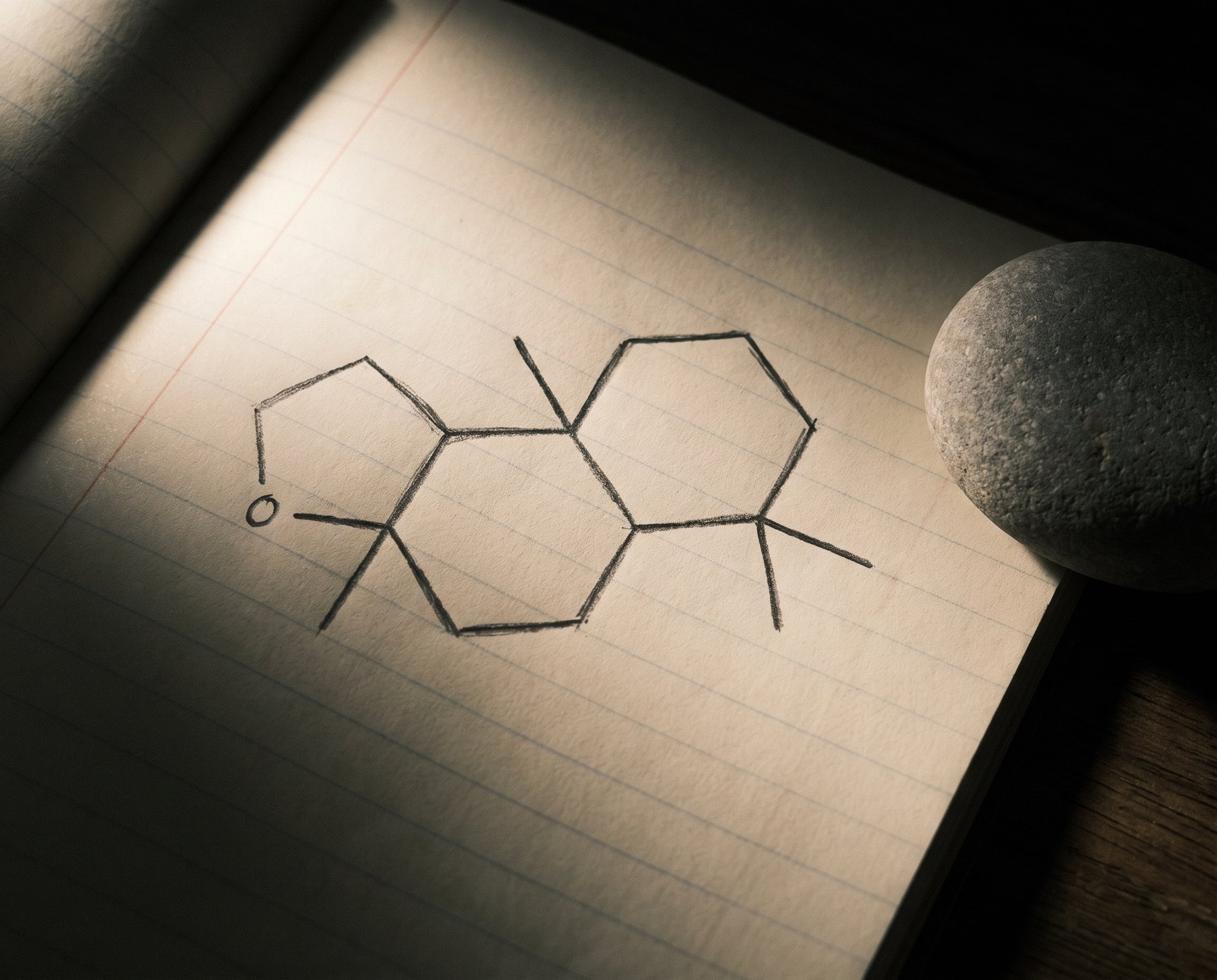
Ambergris: an object made by sea and time
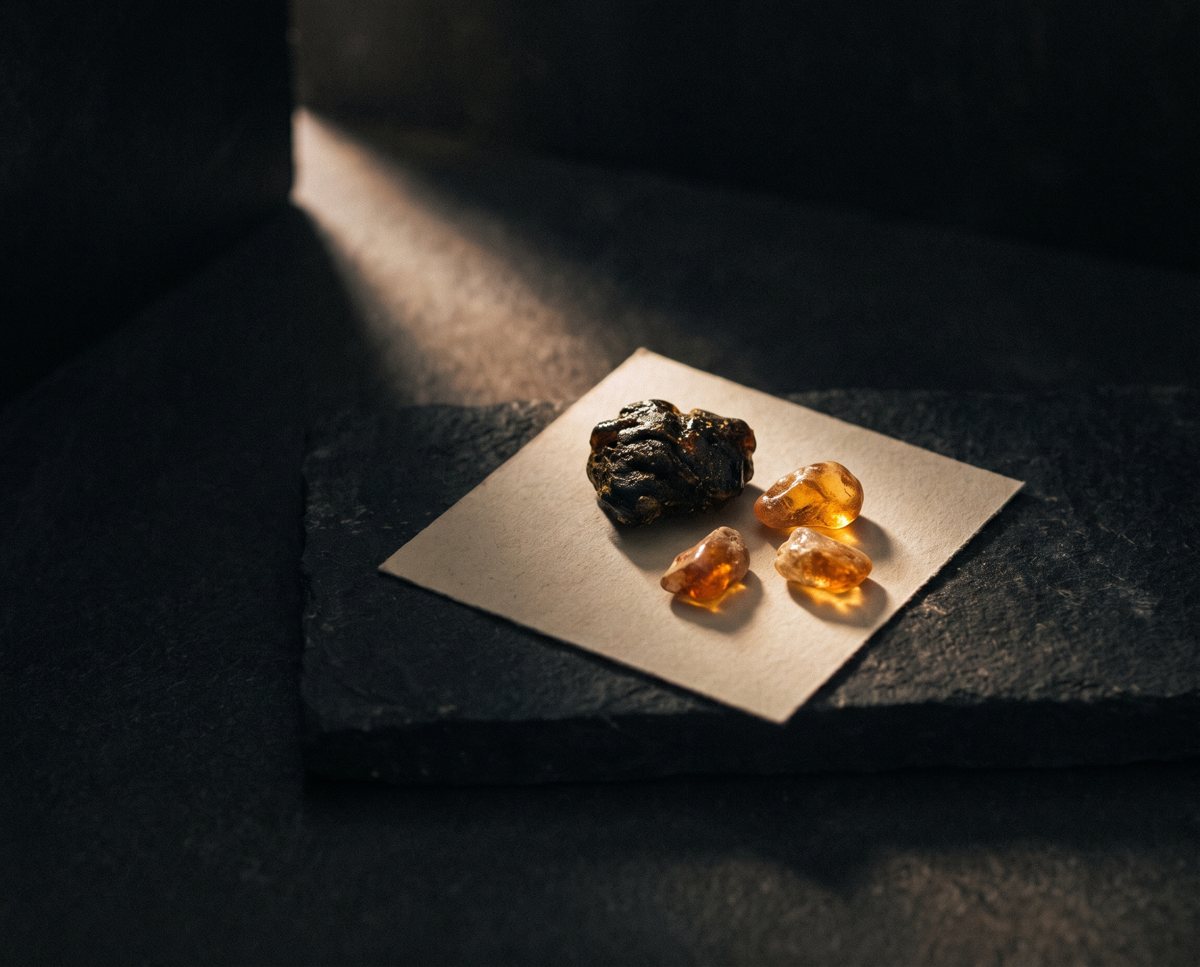
Ambergris forms in the gut of the sperm whale. When it first leaves the animal it is a dark, soft mass with an unpleasant smell. Then it floats. Some pieces drift for years before washing up on a beach somewhere.
While drifting, the material changes. The main component of ambergris is ambrein, which is almost odourless when pure. Light and air slowly break ambrein into smaller molecules. Two of them carry most of the smell people look for: ambroxide, dry, warm and mineral; and ambrinol, animalic, earthy, like damp tobacco.
So ambergris has no fixed smell. A piece that has drifted long is paler and more fragrant. A fresh piece is dark and harsh. Its smell is a reading of time: how many years of sun, how many of salt.
Perfumers used ambergris for a long time, as a tincture in alcohol. It was rare, unpredictable, and dependent on someone happening to find a lump on the shore. That is a hard material to build a steady craft on.
Stoll and Hinder, 1950: from sclareol to Ambrox
Firmenich, a materials house in Geneva, began studying the composition of ambergris in the 1930s. The question was simple: inside that lump, which molecule makes the smell?
In 1950 Max Stoll and M. Hinder at Firmenich published a synthesis of the molecule later sold as Ambrox. The starting point was not a whale but sclareol, taken from clary sage, Salvia sclarea. Sclareol is oxidised to a lactone called sclareolide, reduced to a diol, then closed into a ring. The result has the same skeleton the sea makes out of ambrein.
In the same decade Firmenich also made ambrinol, the second molecule of ambergris. Two sides of one object, one clean and dry, one animal and damp, could now be made in a laboratory.
The story did not end there. Clary sage has good years and bad ones. In 1988 Firmenich released Ambrox DL, made by a different route so as not to depend on the sage harvest. Later, some processes began using sugar fermentation to make the precursor instead of sclareol. Each time the molecule stayed the same while the road to it changed.
Today several houses sell this molecule under their own names: Ambrox from Firmenich, Ambroxan from Kao, Ambrofix from Givaudan. Chemists call it ambroxide.
Mineral, warm skin, wet wood: how Ambrox smells
Ambrox does not smell like a flower or a piece of timber. It is dry, clean, faintly salty, like skin after a day in the sun, like warm stone, like wet wood that has dried again. It carries far and lasts long.
The smell is faint. It does not stand in front or ask to be named. Because it is so faint, it often sits underneath the smells people describe as clean or close to skin, a warm blank.
In real ambergris, ambroxide is only one part. There is also ambrinol, many other compounds, moisture, the smell of the sea. Ambrox takes out the cleanest part and leaves the animal behind. It is ambergris that has been washed.
When the origin changes, does the smell tell the same story?
A lump of ambergris carries a whale, a sea journey and years under the sky. A gram of Ambrox carries a field of clary sage, a reactor and a scientific paper from 1950.
The two can yield the same molecule. But standing before a smell, one rarely knows which object one has met. The nose only receives the molecule. The story has to be told in words.
This is a question Penta asks of every smell: are we smelling the thing, or a memory of the thing? Ambrox is a clear case. It keeps the smell the sea and time once made, but it keeps neither the sea nor the time.
Perhaps that is why Ambrox is so easy to live with. It does not need to be found on a beach. It does not need an animal. It comes from a plant and becomes something almost transparent on skin.
Olfactory Art