
Essays · Olfactory Art
Damascenone. A millionth of a rose.
A thing is known by its smallest part.
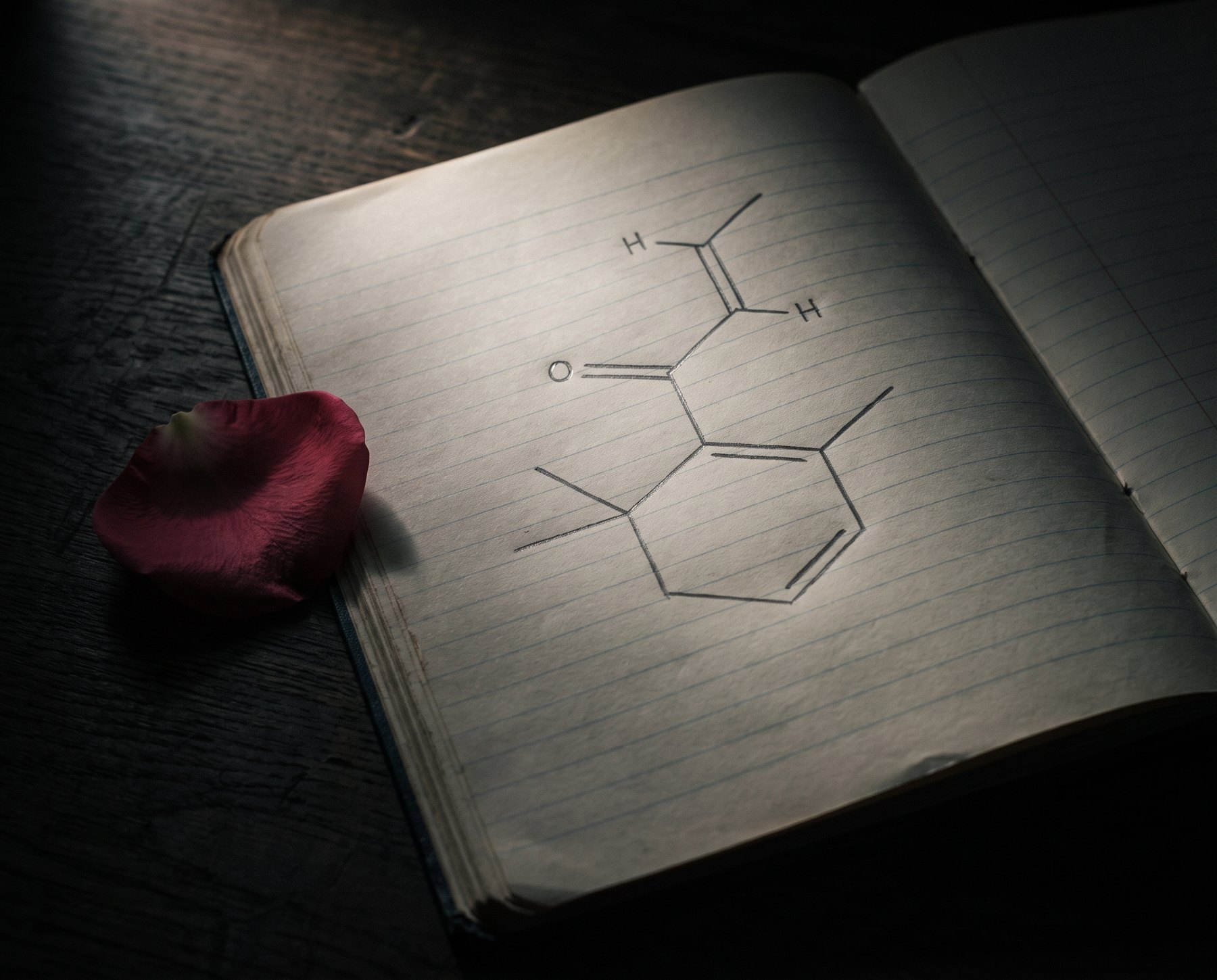
Bulgarian rose and a nearly invisible molecule
Bulgarian rose oil is distilled from the damask rose, Rosa damascena, grown in the Kazanlak valley. It is one of the most labour intensive materials in the craft of smell: great quantities of petals, picked early in the morning, distilled the same day.
Its composition had long been analysed. The compounds making up most of its weight were known: citronellol, geraniol, phenylethyl alcohol, some odourless waxes. Yet when the main compounds were put back together in the right proportions, the result still did not smell like rose. Something was missing.
What was missing did not lie in quantity. It lay in compounds present in tiny amounts, so small the instruments of the time could barely see them. The nose could. The human nose is more sensitive to certain molecules than any instrument.
The chemists' problem became a tracker's problem: separate the oil into small fractions, smell each one, and ask which carries the smell everyone recognises as rose.
Demole and colleagues, 1970: finding damascenone
At Firmenich in Geneva, Edouard Demole's team did exactly that. In 1970 they published in Helvetica Chimica Acta the structure of a molecule isolated from Bulgarian rose oil, along with a synthesis. They named it after the rose: damascenone.
Damascenone belongs to what the materials trade calls rose ketones, close relatives of the ionones of violet. The same group includes the damascones, smelling of ripe apple, plum and rose, very powerful. Damascenone is the best known of them.
What makes the discovery memorable is proportion. In the oil, damascenone is a faint trace. Yet it contributes strongly to the rose smell people recognise, far more than compounds present many times over. Quantity and importance do not travel together.
It was not Demole's first time. Earlier he had studied the methyl jasmonate of jasmine, work that led to Hedione. The method was the same: find the small part inside the thing, name it, make it again.
The same molecule in black tea, whiskey, ripe fruit
Once it had a name, damascenone began to be found elsewhere. In wine. In cask aged bourbon. In apples. In tobacco leaf. In brewed black tea.
The shared reason: damascenone forms when carotenoids, the yellow and orange pigments of plants, break down. Those pigments sit in leaves, fruit skins, petals. When tea leaves are withered, oxidised and dried; when grapes ferment and rest in casks; when apples are cooked; when tobacco is dried in the sun, carotenoids split, and some become damascenone.
So the smell of this molecule is not only rose. It is baked apple, honey, prune, tobacco. Beside rose, one hears rose. Beside a spirit, one hears ripe fruit. The same thing, read differently according to what stands next to it.
The smallest part makes the thing: on thresholds
Every molecule has a threshold: the smallest amount the human nose can still detect. Some must be quite concentrated before we notice them. Some need only a trace. Damascenone belongs to the second kind, with an extremely low threshold.
This changes how we understand a smell. A thing does not smell according to the proportions of what it contains. It smells according to what the nose catches. A compound that makes up most of the weight can be nearly silent. A trace can speak loudest.
Penta takes this as a lesson in observation. To recognise a thing, one need not see all of it. Only the right spot. A rose, a cup of black tea, a glass of old spirit: all three share one very small part, and that part is enough for us to name them.
Olfactory Art