
Essays · Contemporary Art
Antony Gormley. Bed.
A body can appear through what it has taken away.
Tate · Tate
A bed made of bread
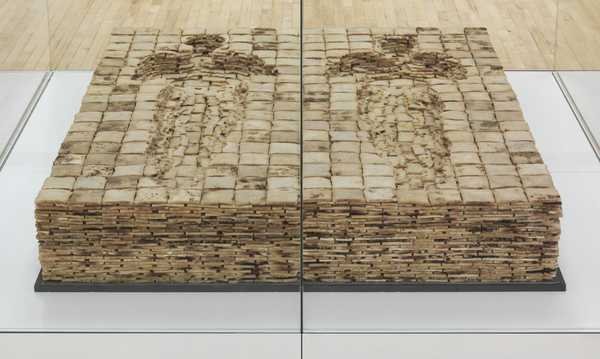
Bed is a work Antony Gormley made over 1980 and 1981. Tate, which holds it, lists the materials in one line: bread and paraffin wax on aluminium panels.
As the title says, the work suggests a bed. But in place of mattress and blanket there are slices of bread, stacked in layers. The most ordinary bread, the kind people buy for breakfast.
In the middle of the block are two hollows. Each is the outline of a person lying down. No statue, no figure built up. Only absence.
Made by eating
How Gormley made those two figures is what makes Bed hard to forget. He did not cut or carve with a knife. He ate away at the slices himself, portion by portion, until the hollow took the shape of his body.
Consider that for a moment. Every bit of bread missing from the bed went into the artist's body. The figure on the bed and the living man are made of the same stuff. One appears as the other is fed.
To stop the bread from moulding and rotting, the slices were soaked in paraffin wax. The wax holds the shape and colour of the bread, so that something that normally lasts a few days can lie in a museum for decades. The bread stops being food. It becomes sculptural material.
Gormley chose something cheap and familiar, touched by everyone. Not bronze, not marble. Bread is what people use to feed the body every day. Using it to shape a body closes a circle.
The body as a hollow
Later Gormley became one of the best known sculptors in Britain, with figures cast from his own body. In Bed, though, the body is not yet a solid. It is a void.
The idea raises a simple question: do we recognise a person by the space they fill, or by the space they leave? A chair still warm after someone stands. A dent in a pillow. A pair of shoes keeping the shape of a foot. None of these is a person, yet we know at once that someone was there.
The idea of working with negative space, the overlooked volume around things, carried on in British art in the years that followed, as Rachel Whiteread later did when she cast the inside of an entire house. Bed is a very personal version of that interest, because its void was made with a mouth, by eating.
Two figures lie there. The work does not say who they are. The viewer wonders: one person, lying down twice? Or two people sharing one bed?
The bed as a container
A bed is where we spend the most time without noticing. Sleeping, being ill, loving, lying awake. It takes our shape each night and lets it go each morning.
Bread belongs to the morning too. Baked at night, bought early, eaten before leaving the house. Shaping bread into a bed joins the two ends of a day: where we wake and the first thing we eat. Gormley does not explain the link. He lets the material speak.
Bed keeps that shape for good, in wax and bread. It is a bed no one can lie in, yet it always looks as if someone has just left. People standing before it often stay silent longer than they expect.
Perhaps because the work touches something everyone knows but rarely says. Our bodies are made of what we eat. And when we leave, what remains is a hollow, exactly our size.
Contemporary Art