
Essays · Olfactory Art
Northern India. Perfume Sprinkler.
Flowers painted outside, flowers as liquid inside.
The Metropolitan Museum of Art, Fletcher Fund, 1975 (Open Access, public domain) · The Metropolitan Museum of Art
Fourteen centimetres of glass
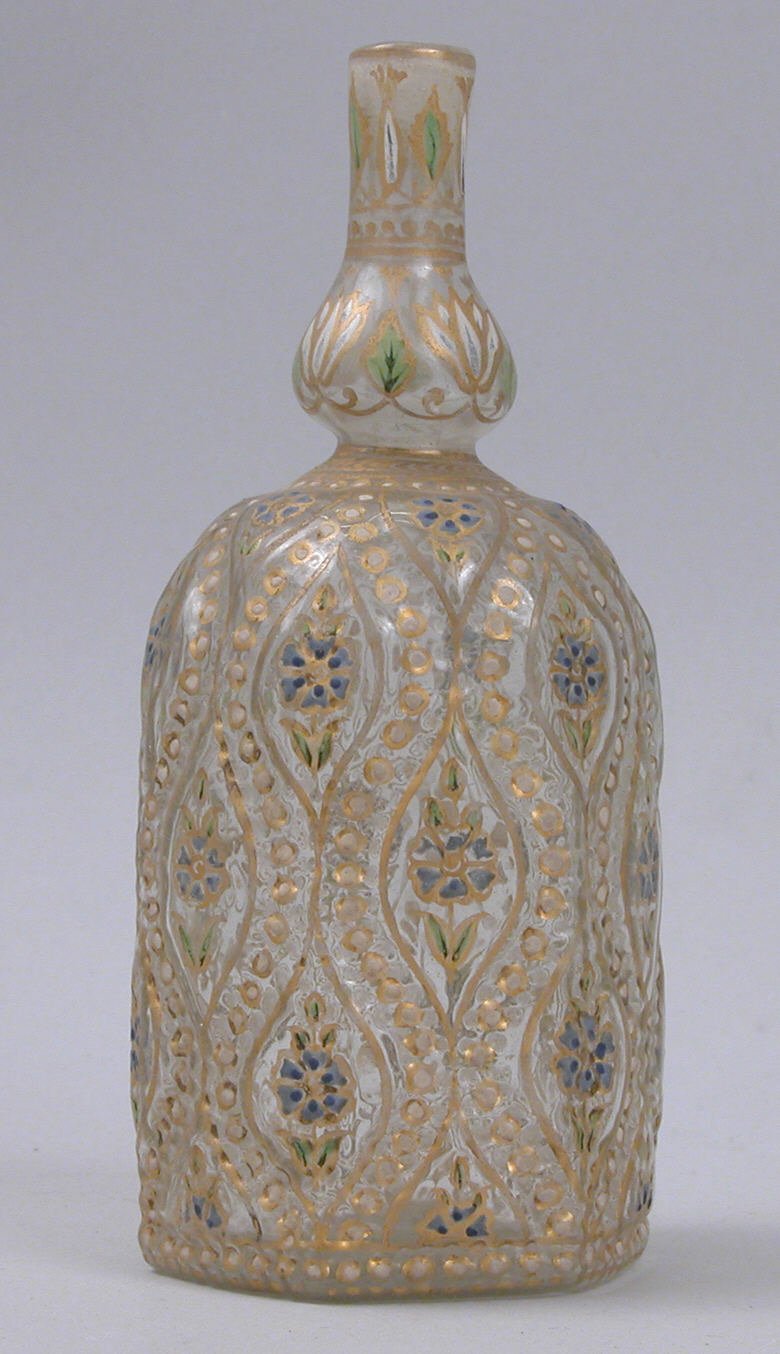
In the Islamic art galleries of The Metropolitan Museum of Art in New York stands a perfume sprinkler in colourless glass. It is 14 cm tall and under 6 cm across. The museum dates it to the eighteenth century and attributes it to Northern India, an attribution based on style rather than on a signature or document.
No one knows who blew the glass. No one knows who painted the enamel. The record speaks only of material and method: colourless glass, mould blown, enamelled and gilded.
Mould blowing means the glassworker blows a gather of hot glass into a mould so it swells against the walls. The method allows many vessels of the same shape. Decoration comes after: coloured enamels are painted on, gold is applied, and the piece returns to the fire so the enamel fuses to the glass.
The Met acquired it in 1975 through the Fletcher Fund. It is one of many perfume sprinklers in the museum's Islamic collection, each of a different material, region and century.
Lotus outside, rose inside
According to the museum, the sprinkler was filled with rosewater and sprinkled to scent a space on festive occasions. It is not a bottle for dabbing on a wrist. It is a tool for scenting a room, a crowd, a whole day.
The decoration shows lotus and other flowers in coloured enamel. The museum reads them as a reference to the sweet smells held inside. The painting outside works as a label for the liquid within.
What is interesting is that the flowers do not match. The liquid is rosewater. The flower that stands out on the glass is lotus. The painter did not depict the flower that made the smell. They painted a general idea of flowers, freshness, garden. The eye does not need the nose's precision. It only needs to be told that something sweet is coming.
Colourless glass makes this clearer. Silver or brass hides its contents; glass does not. The holder could see the level of the liquid drop after each sprinkle. Scent became something the eye could count.
Sprinklers across the Islamic world
Rosewater has a long place in the cultures of the Islamic lands, from Persia to South Asia: in cooking, in ritual, in receiving guests. The sprinkler serves the last of these, with a narrow neck that releases a little at a time, enough to scent without soaking.
The Met's collection shows one function taking many forms: a gilded green bottle, a sprinkler with birds, a sprinkler bearing an emblem. At the South Asian courts, meanwhile, craftsmen made sprinklers in gilded silver twice this height, far heavier and grander.
This glass sprinkler sits at the other end of that range. Light, fragile, small. It displays wealth not through precious metal but through colour, a thin gleam of gold, the clarity of glass.
Because it is fragile, its survival for nearly three centuries is worth noticing. How many such vessels fell, cracked, or were thrown away once used? This one stands in its case like a survivor of festivals no one remembers.
Why a small bottle deserves a long look
Before it today, a visitor can use only the eyes. No liquid inside, no smell. The only thing that speaks of scent is the enamel flowers.
That is what makes the object worth a long look. It shows how early people tried to turn scent into image. Not with words, not with formulas, but with a picture placed on the vessel itself. The scent goes; the picture stays.
Penta notices how short the museum's record is. A few lines on material, one sentence on use, one on flowers. The rest the viewer fills in: how loud that festival was, who held the bottle, whom the drops fell on, how long the rose stayed in the room.
Olfactory Art