
Essays · Olfactory Art
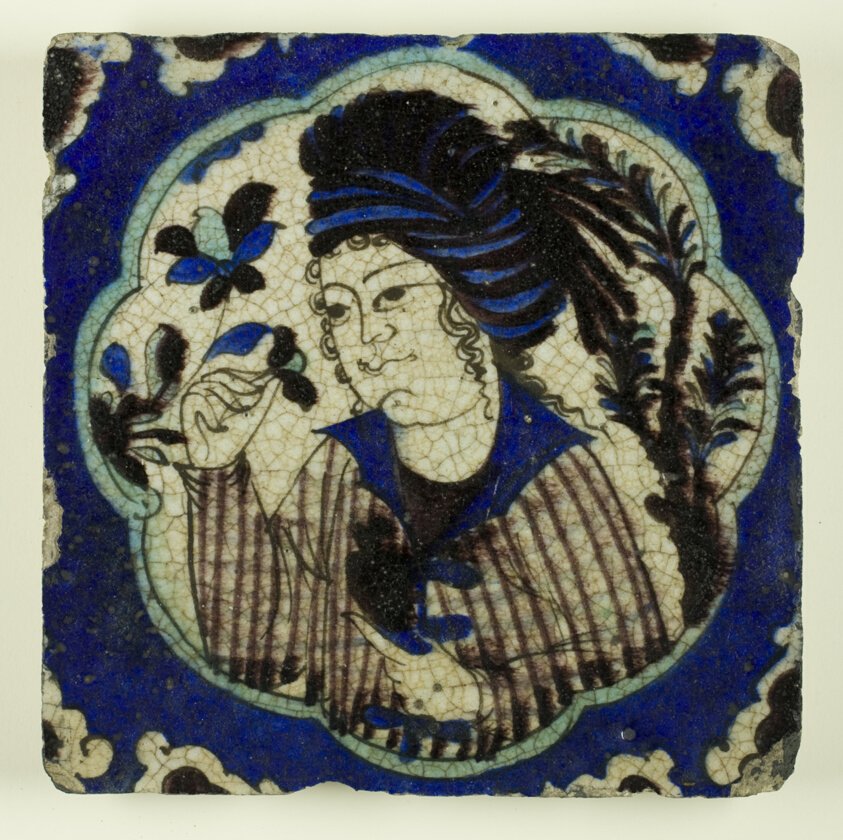
Safavid Iran, Kubachi ware. Tile with a Portrait of a Young Man Inhaling the Perfume of a Flower.
One breath, fired into clay, kept four hundred years.
The Art Institute of Chicago, Mary Jane Gunsaulus Collection · The Art Institute of Chicago
A square tile, three glaze colours
The tile at The Art Institute of Chicago is nearly square, about 22 cm a side and 2 cm thick. The museum records it as made in northwestern Iran under the Safavid dynasty, late sixteenth or early seventeenth century. Its full title is Tile with a Portrait of a Young Man Inhaling the Perfume of a Flower.
The material is fritware, also called stonepaste, a body made mostly of ground quartz mixed with crushed glass and a little clay. The image is painted in three colours, blue, black and turquoise, then covered with a transparent glaze. The colour sits under the glaze, so after firing it is protected as if behind glass.
The tile belongs to the Mary Jane Gunsaulus Collection and carries the number 1915.245. It is currently shown in Gallery 143.
Named after a village that did not make it
Kubachi ware takes its name from a town in Dagestan, in the North Caucasus, now part of Russia. A large body of fifteenth and sixteenth century pottery was found there. From the 1870s, collectors from Europe and North America bought many pieces, which later passed to major museums.
The name stuck. Yet scholars believe Kubachi ware was not made in Kubachi. It was made in northwestern Iran, in the Safavid period. The village was where it was kept, not where it was fired.
The story of the name has an interesting side. It shows that objects can carry the trace of the places they passed through, sometimes more clearly than the trace of where they were born. The tile is remembered by the village that kept it.
A portrait on a tile
Kubachi tiles often show figures in Safavid dress, painted mainly in cobalt blue and copper turquoise on white. That stands out in Islamic decorative ceramics, where surfaces were mostly given to plants, script and geometry. Here a person is placed at the centre.
And that person does something very small. No riding, no hunting, no feasting. Only lifting a flower and breathing in. The gesture has a long history, from the ancient Egyptian relief of a woman smelling a water lily to the five senses series of Europe.
In Persian culture, flowers and their scent are familiar images in poetry and in the life of gardens. This tile takes the image off the page and sets it on a wall, where it can be seen every day.
Why it is worth another look
A tile is a piece of architecture. It is made to join others, into a wall panel, a doorway, a room. We do not know for certain where this one once sat. Today it stands alone in a case in Chicago.
Alone, it becomes a portrait. A young man, a flower, a moment of smelling, drawn in three colours inside a square the size of two hands side by side.
The scent of that flower was lost long ago. Yet anyone can see at once what the young man is doing. Perhaps that is why the gesture was chosen: it reads clearly to anyone, in any age.
Olfactory Art