
Essays · Olfactory Art
Ancient Egypt. Relief Showing a Seated Woman Smelling the Blossom of a Water Lily.
A flower that opens every morning, and someone leaning in.
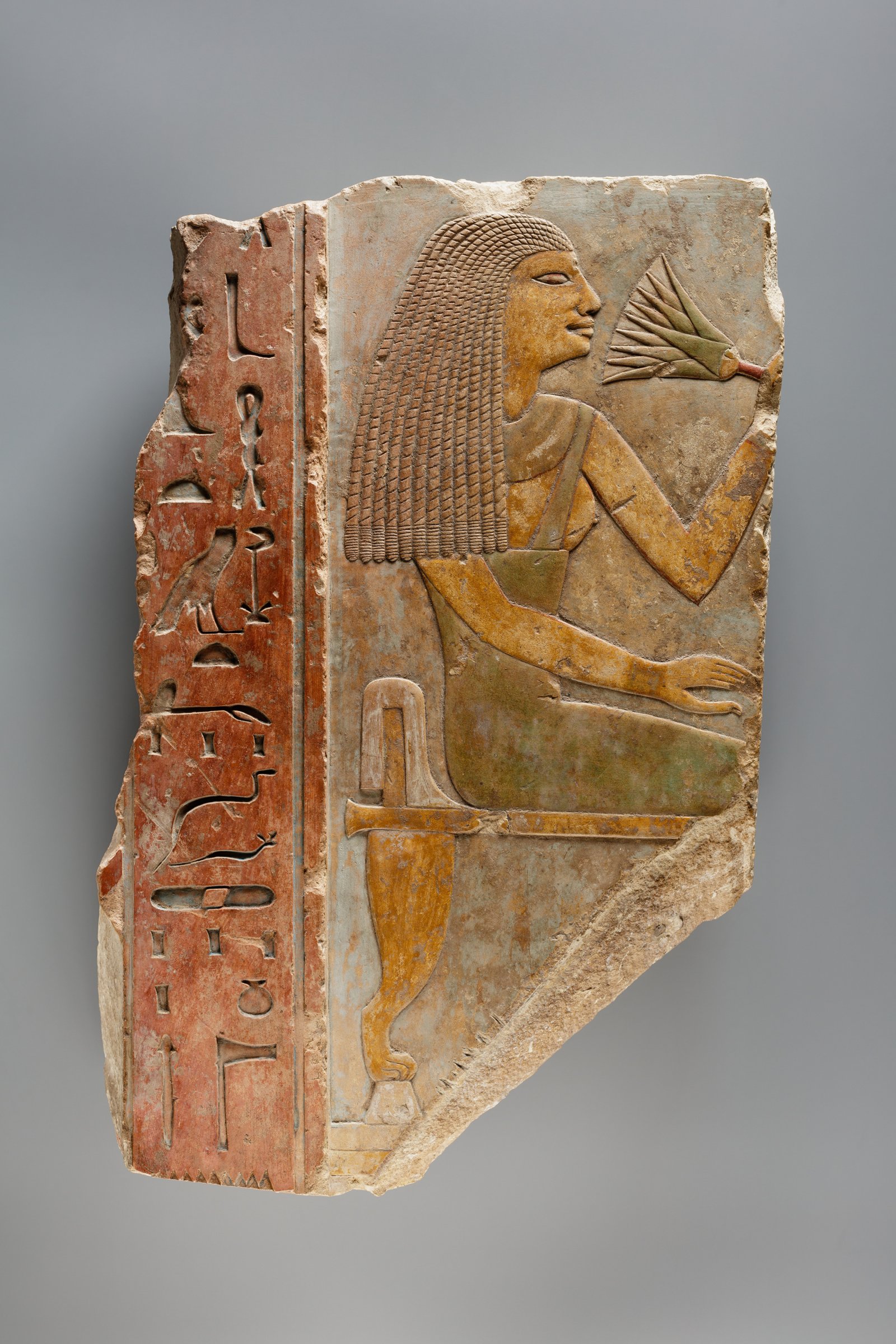
The Metropolitan Museum of Art, Rogers Fund, 1908 (Open Access, public domain) · The Metropolitan Museum of Art
A limestone fragment from the Middle Kingdom
The relief at The Metropolitan Museum of Art is a piece of painted limestone, 42 cm high, almost 28 cm wide, 7.5 cm deep. The museum places it in the Middle Kingdom, Dynasty 12, possibly the reign of Amenemhat I, around 1981 to 1952 B.C.
The stone is not whole. Its lower right corner breaks away on a diagonal. But what remains is clear. A woman sits facing right. Her hair is long, braided into many fine strands falling past her shoulders. One hand lifts a water lily to her nose. The other reaches forward at knee height. Of her chair, only part of a leg shows.
To the left of the figure runs a column of hieroglyphs, carved on a red painted ground between two blue lines. The colour survives: red in the column, ochre on the skin, green on the dress. The fragment came to the Met in 1908 through the Rogers Fund.
A lily that opens each morning
The flower she holds is a water lily, often called the Egyptian lotus. It was one of the most familiar plants and one of the most common symbols of ancient Egypt.
The Egyptian water lily is blue or white. It closes at night, and in the morning opens to show a yellow centre. To the Egyptians this echoed the sun rising at the dawn of creation. The flower became a sign of daily rebirth.
So an image of someone smelling a water lily is more than a scene from ordinary life. In many tomb paintings and reliefs the deceased is shown holding or smelling one. Breath and the flower's scent are tied to the idea of life going on.
A gesture repeated for centuries
Egyptian art is known for its stability. The same way of drawing a figure, the same poses, the same colours, repeated over thousands of years. Lifting a water lily to the nose is part of that vocabulary. Viewers of the time recognised it at once, like a familiar word.
That makes the Met fragment both particular and shared. Particular, because it shows one woman on one chair, beside a column of text that belongs to this stone alone. Shared, because her gesture existed before her and continued long after.
The carver did not try to depict smell. They carved a hand, a flower, a nose, and set them close together. The viewer understood the rest.
The method is economical. No smoke, no curl rising from the flower, no sign of scent at all. Only a distance of almost nothing between petal and nostril. Smell is told through nearness.
Why the gesture still feels familiar
Nearly four thousand years later, the gesture in the stone is not strange. Someone holds a flower, lifts it, breathes in. We do it at the flower market, in the garden, beside a vase on the table.
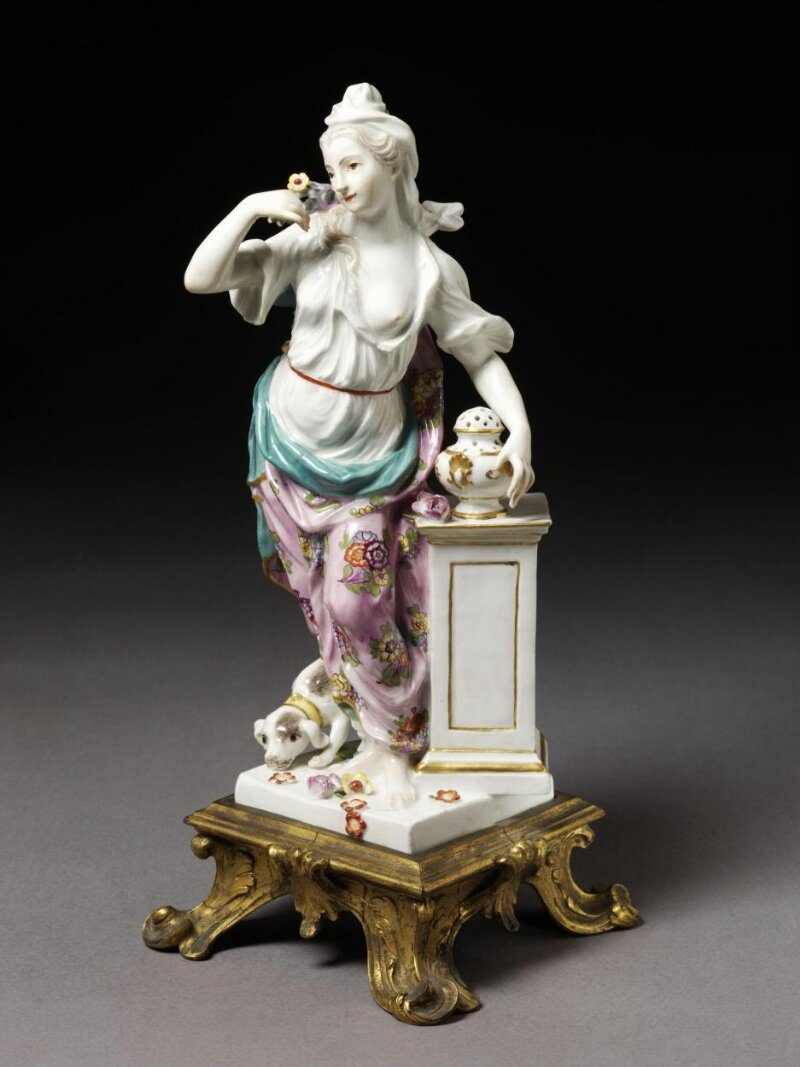
Many other traditions kept the same gesture. In Safavid Iran, a glazed tile shows a young man inhaling the perfume of a flower. In Europe, series of the five senses picture smell as a figure holding flowers. Each place gives the gesture its own meaning. In Egypt, it was life returning.
The stone has no smell. The flower carved nearly four thousand years ago has long lost its scent. Yet anyone standing before it knows what she is doing. Some understanding survives even a span of time that long.
Olfactory Art