
Essays · Olfactory Art
Eberlein and Kändler (Meissen). Smell.
Flower, smoke and ground: three places a smell begins.
© Victoria and Albert Museum, London; Bequeathed by Miss Florence Augusta Beare in memory of Arthur Doveton Clarke · Victoria and Albert Museum (V&A)
A woman, a posy, a dog
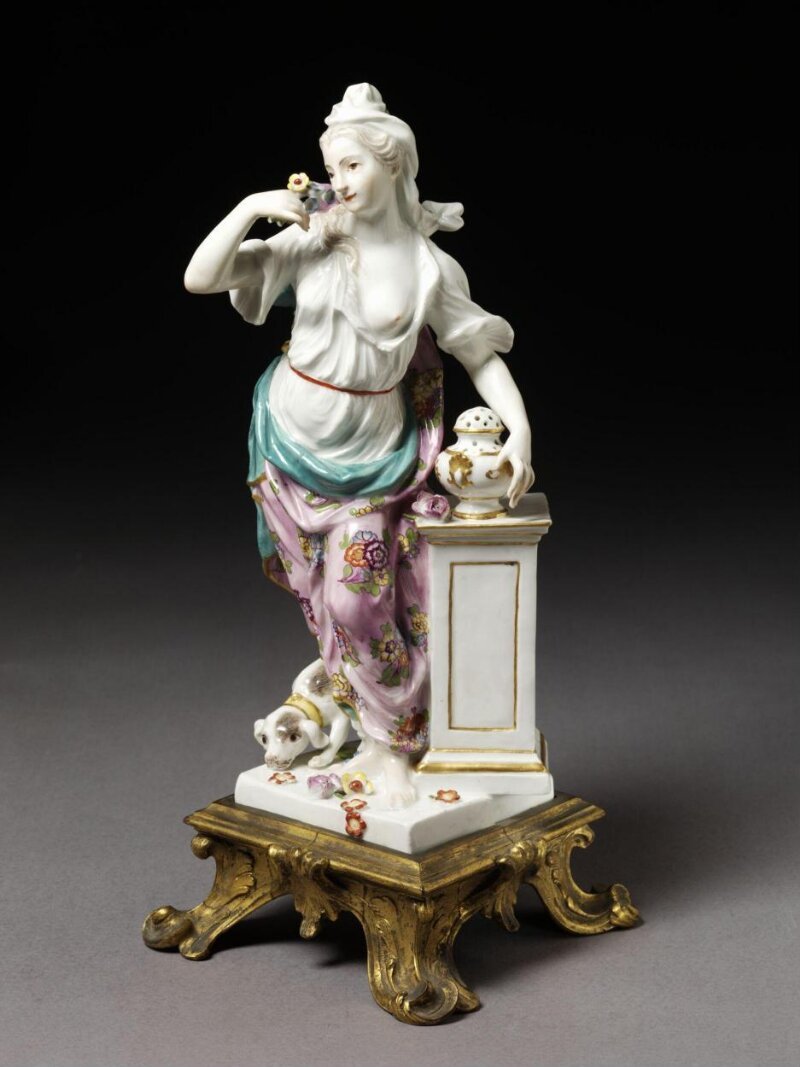
The figure at the Victoria and Albert Museum stands 28 cm tall, 33 cm with its mount. It is hard paste porcelain, painted in enamels and gilt, made at the Meissen porcelain factory in Germany around 1745.
A woman stands beside a tall square plinth. She wears a white undergarment and a classical drape in puce, painted with coloured Indian style flowers and lined in turquoise. One hand lifts a small posy to her nose. The other rests on a lidded, pierced incense burner at the top of the plinth. At her feet a hunting dog sniffs the ground.
The base is square and scattered with flowers. Beneath it sits a curling gilt bronze mount, which the V&A believes is probably French and of the same period. The figure entered the museum in 1919, bequeathed by Miss Florence Augusta Beare in memory of Arthur Doveton Clarke.
Two modellers
The V&A names the modeller as Johann Friedrich Eberlein, probably with Johann Joachim Kändler. The model dates from 1745. In the factory price list it carries mould number 1054.
Meissen, near Dresden, was the first place in Europe to make hard paste porcelain, early in the eighteenth century, a material Europe had until then bought from Asia. Kändler was the factory's most famous modeller; Eberlein worked beside him. The method was shared: a master model shaped by hand, divided into moulds, cast in parts, assembled, fired, painted, fired again.
That is why the number 1054 matters. It says this figure is not a single object. It is a model in a list, one that could be ordered again, like a page in a catalogue. Each piece was painted by hand after firing, so no two are exactly alike.
Five senses on a table
Smell belongs to a set of the Five Senses. Picturing the senses as five figures had been done for centuries in prints and painting. In the eighteenth century the idea moved into a new material: porcelain, made for the drawing rooms and dining rooms of the aristocracy.
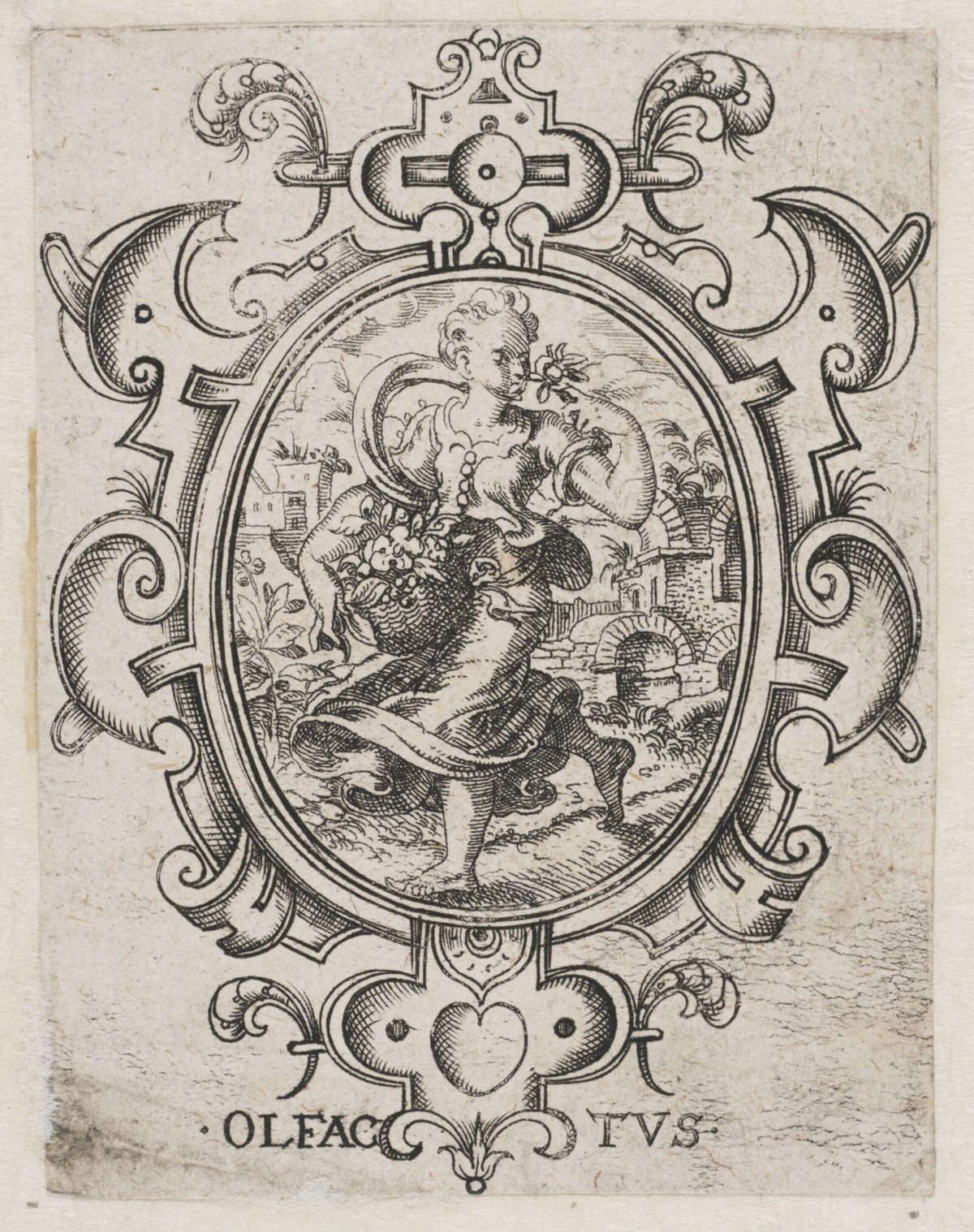
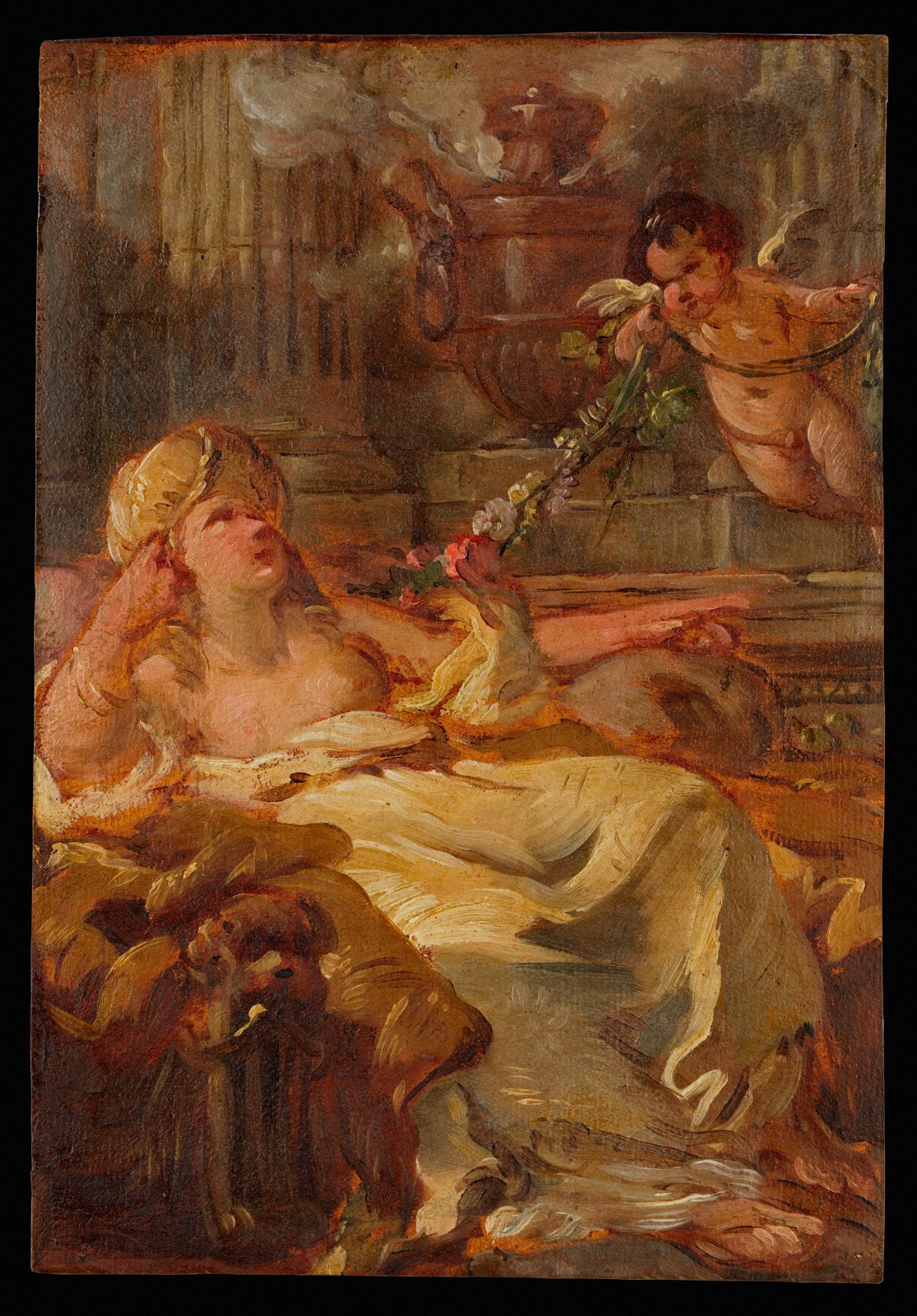
The signs of smell are familiar: flowers and a dog. They appear in Renaissance prints, and François Boucher's Smell, made in France in the same century, takes up the same sense. Meissen adds a new object: the incense burner, a real item in the wealthy rooms of the day.
That object is what separates the figure from pure allegory. It reminds us that people in Meissen's time did not only smell flowers in the garden. They burned scent indoors and kept it in boxes, jars and vases of this very porcelain.
A small object about an invisible sense
The figure is beautiful in the eighteenth century way: glossy white skin, patterned pink drapery, gold at the edges. It was made to be looked at. Yet its subject is a sense that cannot be seen.
The problem is solved through gesture. The woman tilts her head, eyes lowered, flowers touching her nose. The dog drops its head to the ground. Two creatures do the same thing at two heights. The viewer grasps the subject before reading the title.
Nearly three centuries later the porcelain posy has no scent, the burner no smoke. Only the pose of smelling remains, fired hard at great heat. The pose still says exactly what it means.
Perhaps that is something an object does better than a smell. A smell fades in hours. A porcelain figure keeps the way people once bent to smell, through many owners and many rooms, all the way to a museum case in London.
Olfactory Art