
Essays · Olfactory Art
Franz Xaver Messerschmidt. The Strong Smell.
Smell leaves no image. The face does.
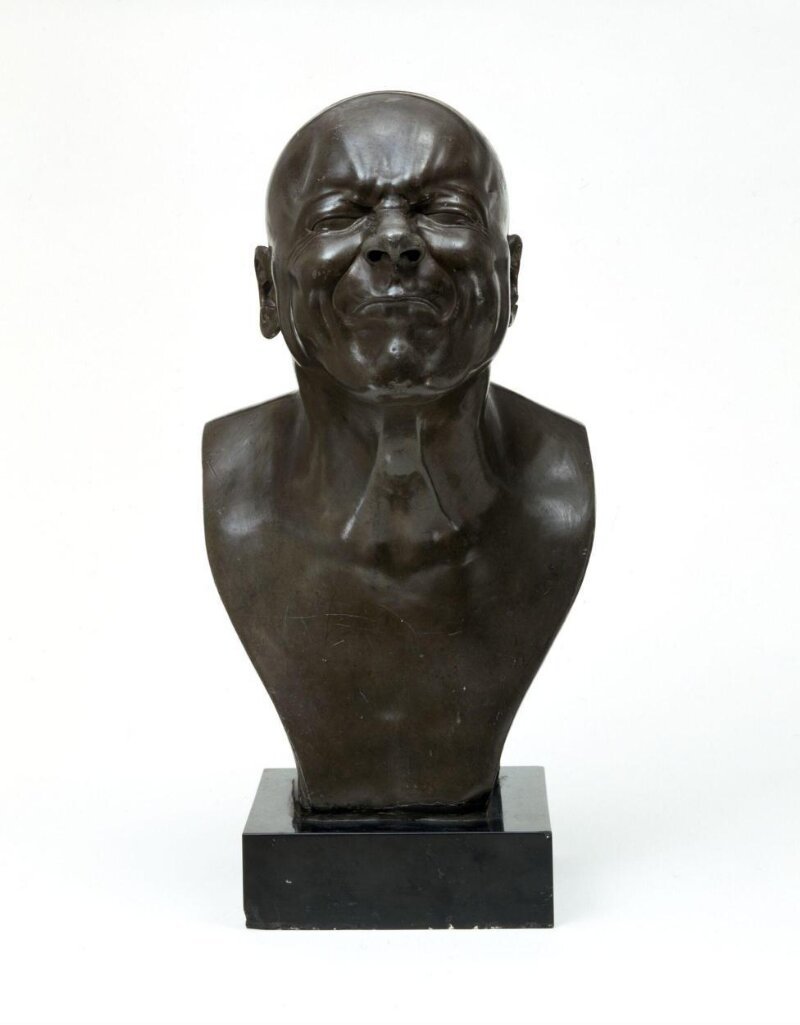
© Victoria and Albert Museum, London; Purchased under the Murray Bequest · Victoria and Albert Museum (V&A)
A bald head with closed eyes
The bust at the Victoria and Albert Museum is almost 49 cm tall without its base. It is cast in a metal alloy, which the museum records as probably lead and tin, dark, close to black. The man has no hair. Shoulders and chest are cut into a smooth block, no clothing, no detail.
Everything rises to the face. The eyes are shut tight, not in sleep but in endurance. The nose wrinkles upward, nostrils flared. The lips press into a flat line. The chin lifts, the neck strains with two cords of muscle. Up close, every fold of skin around the eyes shows, like grain on bark.
The work is known as The Strong Smell. According to the V&A, it may be the original of a head of intense odour, but more likely a variation of the strong odour head: a man with his eyes closed, smelling an unpleasant odour intently. Some have read it as a face in pain. The two readings are closer than they seem.
A court sculptor leaves Vienna
Franz Xaver Messerschmidt was born in Bavaria in 1736. He trained with an uncle who was a sculptor, then went to Vienna. There he succeeded early, with royal commissions for the Austrian court. His busts and portrait reliefs of the 1760s were known for uncompromising realism.
In 1774 he returned to his home town of Wiesensteig, and later moved to Pressburg, then the capital of Hungary, now Bratislava in Slovakia. In these years he devoted himself to a series of character heads. The V&A notes they were completed by June 1781. He died in 1783.
Several reports from the time suggest he suffered from psychiatric illness, with hallucinations, and perhaps a painful digestive complaint. He is said to have pinched himself in front of a mirror, twisting his face into extreme expressions, then sculpting them. No one is sure what he intended. He left no explanation for the series.
Sixty nine faces
An older V&A label gives the series as 69 heads. This one belongs to the third group, the bald heads. The heads record different states of mind, and reactions to smell. Each one is a set of facial muscles pushed to its limit.
After his death the heads were kept together and shown for nearly a century. In 1889 the group was split and sold. This head entered the V&A in 1948, bought with funds from the Murray Bequest.
What sets the work apart in eighteenth century sculpture is that it is not beautiful in the usual sense. A portrait bust then honoured someone with a name. Messerschmidt removed the name, the clothes, the hair, and kept only a reflex. As the V&A puts it, the heads anticipate the interest in psychology and emotional intensity that later artists pursued.
Smell as a sentry
The V&A gallery label places beside the head a definition of smell from the French Encyclopédie of 1765. In short: smell seems less a sense of its own than the sentinel standing before taste, and few know how finely the inside of the nose is built to receive it.
Set beside Messerschmidt's face, the definition explains the violence of the expression. The sentry has just found something. The body shuts: eyes shut, mouth shut, chin drawn back from the source.
Two centuries later, artists such as Clara Ursitti worked with the smell of fear, in The Smell of Fear. They came from the other side, releasing the scent of an emotion into the air. Messerschmidt came from the face. Both show that smell and feeling travel the same road.
The bust has no smell. It has only a face. And that face is enough to make the viewer's own nose wrinkle, just slightly.
Olfactory Art