
Essays · Olfactory Art
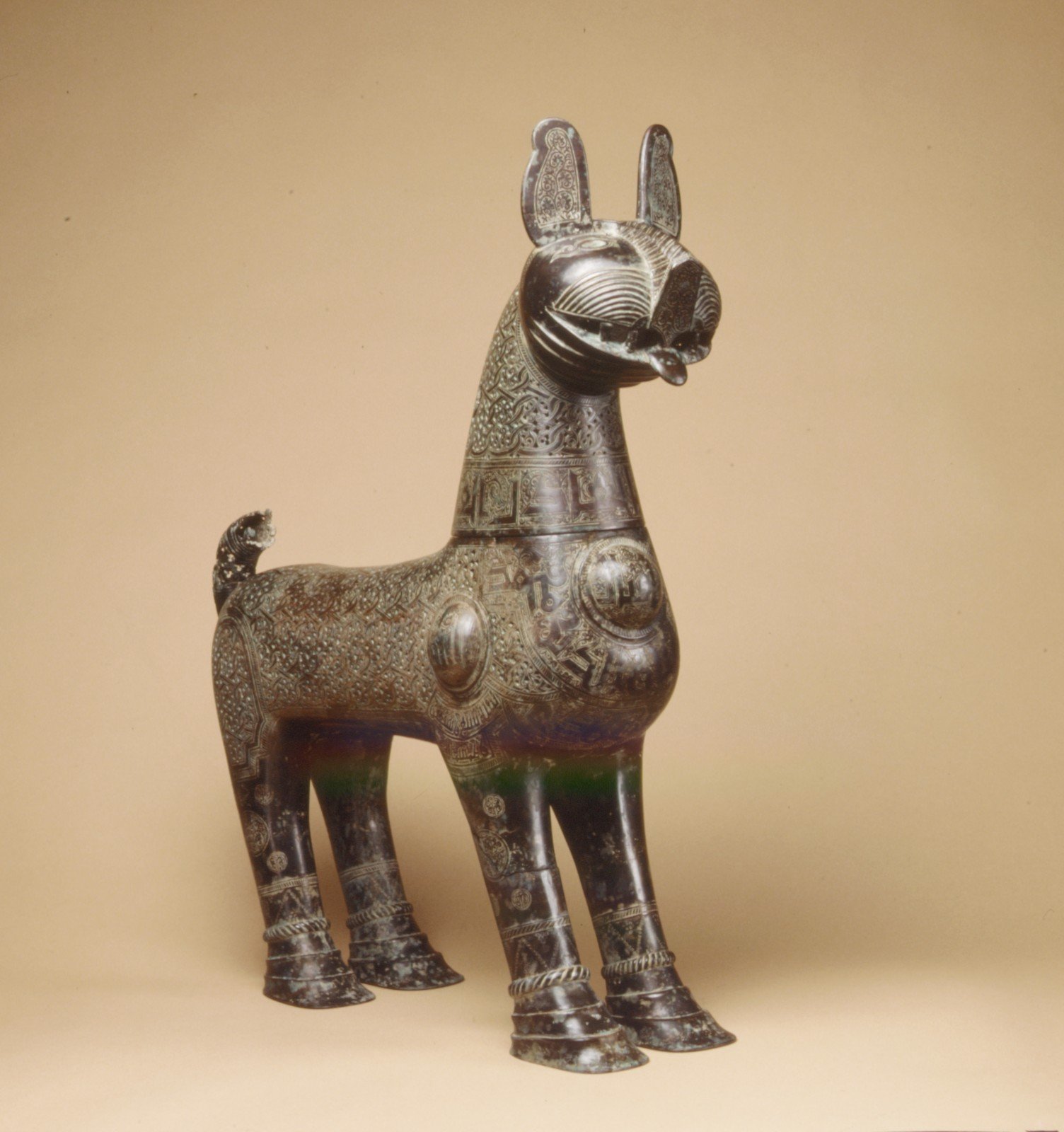
Ja'far ibn Muhammad ibn 'Ali. Incense Burner of Amir Saif al-Dunya wa'l-Din ibn Muhammad al-Mawardi.
A lion that does not roar. It breathes out scented smoke.
The Metropolitan Museum of Art, Rogers Fund, 1951 (Open Access, public domain) · The Metropolitan Museum of Art
A lion for burning incense
In the Islamic art galleries of the Metropolitan Museum in New York stands a bronze lion. It is 85.1 cm high and 82.6 cm long, but only 22.9 cm wide. A slender animal in profile, as if cut from a picture and stood upright.
It is an incense burner. The Met lists how it was made: cast, engraved, chased, pierced. The lion's head comes off, so that coal and incense can be placed in its belly. The body and neck are pierced to let the scented smoke escape.
The Met counts it among the museum's highlights, and says why: its unusually large scale, the refinement of its engraving, and the Arabic inscription bands running around its body, which name the patron, the maker and the date.
The museum bought it in 1951 through the Rogers Fund. The record gives its findspot: the ruins of Kariz, near Taybad, in Khorasan, Iran.
Names engraved on the body
Many old objects come down to us with no names attached. This one is the opposite. It carries two.
The maker: Ja'far ibn Muhammad ibn 'Ali. The patron: an amir, a man of rank, named Saif al-Dunya wa'l-Din ibn Muhammad al-Mawardi. The museum names the object after the patron, not the maker. The burner was his.
The date is given in the Islamic calendar: the year 577 of the Hijra, roughly 1181 to 1182 in the Western calendar. A medieval incense burner with a date on its body is not common. It gives scholars a firm anchor against which to compare other bronzes of the region.
Penta notices that the writing sits on the very surface that heats up when the burner is used. When coal burns in the lion's belly, the names of patron and maker grow warm too. Writing and smoke share one place.
Khorasan in the twelfth century
In 1181, Khorasan, a region now spread across northeastern Iran and parts of Afghanistan and Turkmenistan, lay in the Persian-speaking Islamic world where the Seljuk dynasties had left a deep mark. It was a region with a strong tradition of bronze: candlesticks, ewers, basins, incense burners, densely engraved.
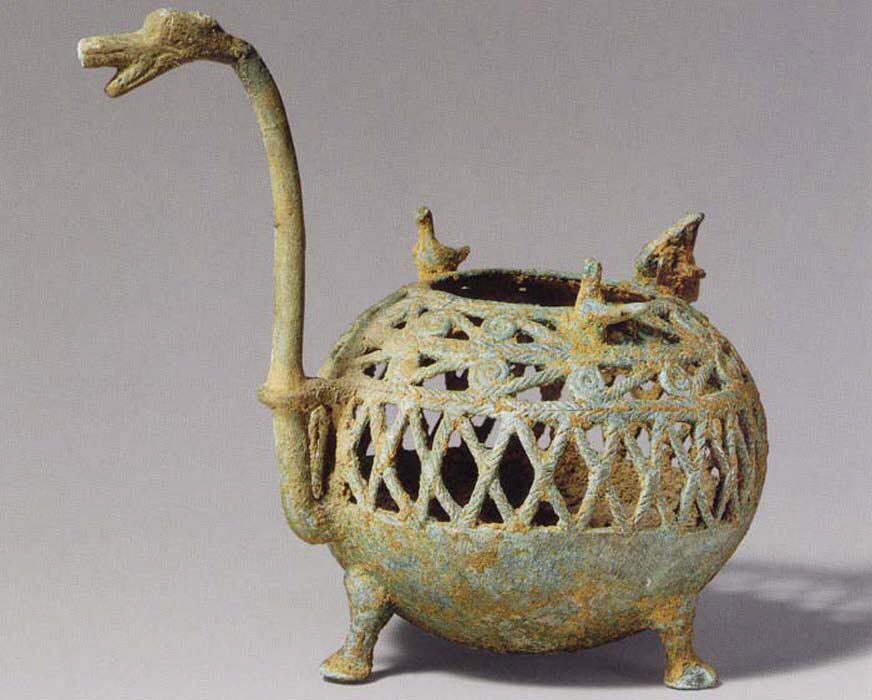
Animal-shaped burners are not rare in Iranian bronze of the period. Makers used lions, birds and other creatures, and turned their bellies into a chamber for fire. What sets the Met's burner apart is its size: an animal close to life-size, not a small object for a table.
Burning incense in the medieval Islamic world was tied to hospitality, to cleanliness, to refinement at home. A burner of this size was most likely set on the floor in a broad space, where smoke could spread among those seated around it. The Met's record does not say exactly where it once stood, so Penta stops there.
The same question was answered more than six centuries later in Paris, when Claude Galle made a gilt bronze perfume burner nearly a metre tall. Two places, two eras, one wish: to give smoke a body worthy of the room.
Today the lion stands in gallery 453 at the Met. Its belly is empty, no coal now. The piercings on its body let only lamplight through, and the visitor's eye into the dark inside.
Olfactory Art