
Essays · Olfactory Art
Unknown maker, Vietnam. Incense Burner with Dragon Spout.
The bronze remains. The smoke we must imagine.
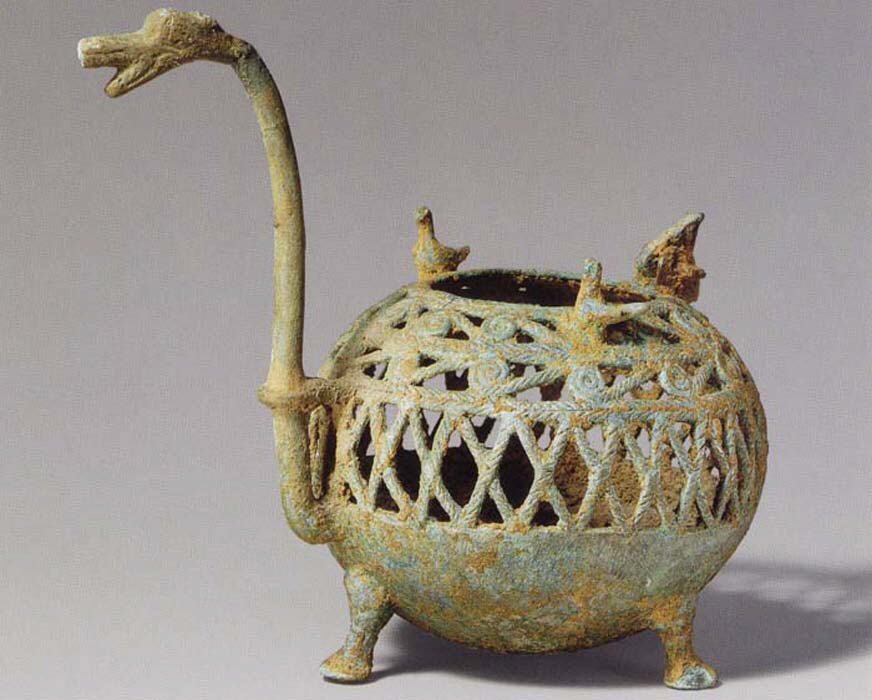
The Metropolitan Museum of Art, Samuel Eilenberg Collection, Bequest of Samuel Eilenberg, 1998 (Open Access, public domain) · The Metropolitan Museum of Art
What the record says
The Metropolitan Museum in New York has a bronze incense burner called Incense Burner with Dragon Spout. Culture: Vietnam. Date: 1st to 3rd century.
That is almost everything. The record also gives its height, 15.9 cm. Material, bronze. Classification, metalwork, in the Department of Asian Art. The burner belongs to the Samuel Eilenberg Collection, bequeathed to the museum in 1998 and accessioned in 2001. Eilenberg was a mathematician and a major collector of South and Southeast Asian antiquities.
No maker's name. No findspot. No line explaining how it was used. A date range of three hundred years shows that scholars can place it in a period, not in a single lifetime.
For many writings on art this would be a weakness. For Penta it is the first thing worth looking at. An object for burning incense has come through two thousand years intact, while almost everything about the people who used it has gone. Bronze outlasted paper. Bronze outlasted memory.
Vietnam, 1st to 3rd century
In those years the Red River delta lay within the commandery of Jiaozhi, under Han rule and then the Three Kingdoms. It was a time when local bronze, with its long tradition reaching back to the great drums, met new kinds of objects arriving from the north.
The incense burner was one of them. In Han China, burning incense indoors had spread among the elite, with the famous bronze burners whose lids formed immortal mountains for smoke to wind through. The Met's burner shows that on Vietnamese soil people cast burners too, and in their own way: add a spout, add a dragon.
One rare historical line links incense to Jiaozhi in this period. The Records of the Three Kingdoms, in its account of Shi Xie, who governed Jiaozhi at the end of the Han, says that whenever the Shi brothers went out, bells and chimes sounded, pipes and drums followed, carriages filled the road, and dozens of foreigners walked beside the wheels burning incense.
That line is not about this burner. But it shows that incense smoke was already part of public life in the region, tied to power, to ceremony, to people from far away. Incense was not only in temples. It moved along the road.
A spout, a dragon
The burner's name points to one detail: the dragon spout. Penta has not been able to confirm from a reliable source what the spout was for, or whether smoke came out of it. This essay will not guess on the museum's behalf.
But this much can be said. A simple burner needs no spout. Adding a part shaped like an animal shows the maker thinking about how the object looks at rest, and how it looks at work. Across the region the dragon is a creature of water, cloud, and all that rises. Attaching a dragon to a thing that makes smoke is a meaningful choice.
The burner is 15.9 cm tall. Small enough for a table, an altar, or to be carried. Not an object for a crowd to see from afar. Only someone standing close would see the dragon and smell the smoke.
Today it stands in gallery 244 at the Met, half a world from where it was cast. No one knows when it was last lit, or with what. Resin, fragrant wood, some tropical leaf. That smell is gone.
What remains is a question cast in bronze: how did people here, nearly two thousand years ago, want their smoke to look?
Olfactory Art