
Essays · Olfactory Art
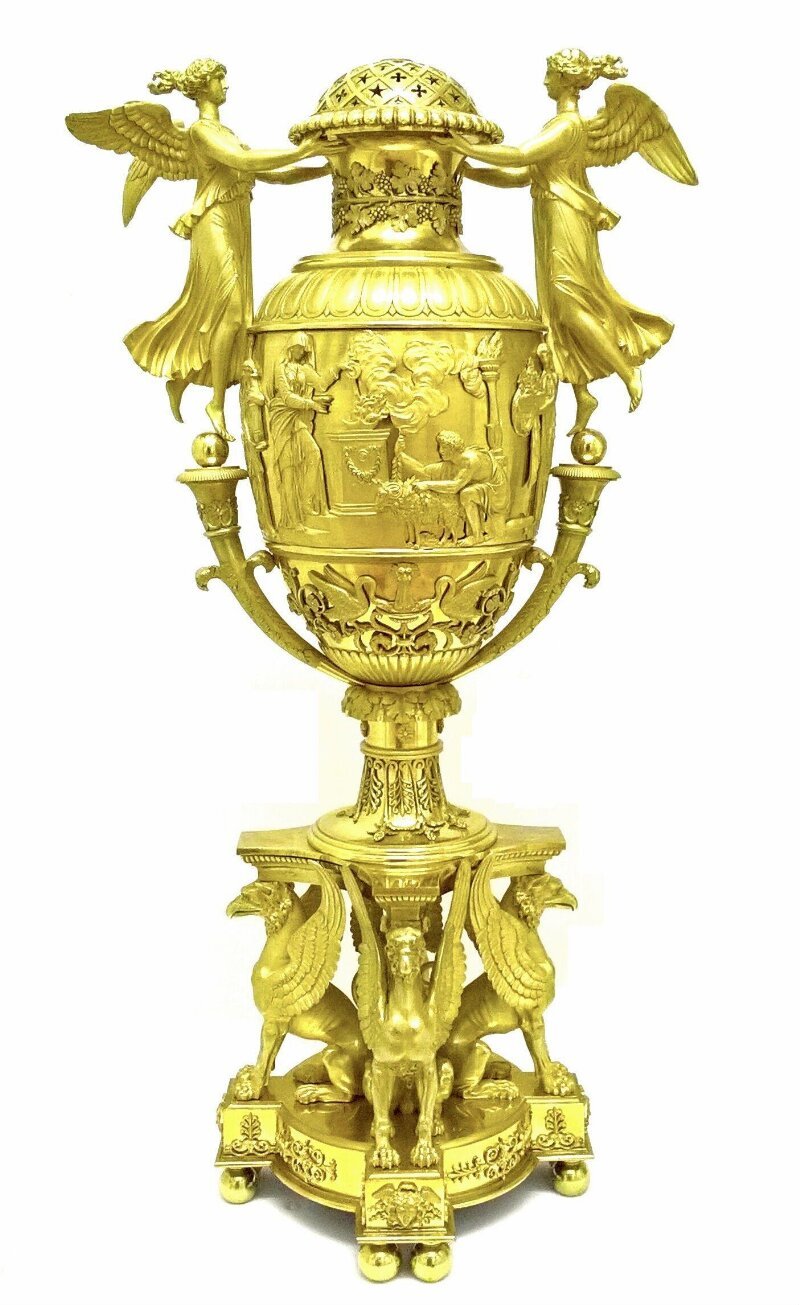
Claude Galle. Perfume burner.
Smoke has no shape. So they cast it a pedestal.
© Victoria and Albert Museum, London; Given by Miss J. J. Beattie · Victoria and Albert Museum (V&A)
An object almost a metre tall
The Victoria and Albert Museum in London holds a perfume burner in bronze, cast and then chased, and gilded. It stands about 95 cm high, with a diameter of about 34 cm. This is not a burner for a tabletop. It is a piece of furniture, standing on the floor, roughly at hip height.
The museum records it as made in Paris, around 1800 to 1810. Designer and maker are given as Claude Galle, with the word "probably". The museum does not claim certainty, and the record mentions no signature.
The gilding is matt rather than polished, rendered in two different tones of gold, which gives the surface a satin finish. After casting, a chaser went over the details by hand to make the lines sharper than the mould alone allowed.
It was given to the museum by a Miss J. J. Beattie. The record also notes that a similar example was sold at Sotheby's in 1981. Like much bronze of the period, it may not be unique: a good model was often cast again for other clients.
Claude Galle's foundry
Claude Galle was born in 1759 at Villepreux, near Versailles. He trained in Paris under the founder Pierre Foy and in 1784 married his master's daughter. In 1786 he became a master founder, and in 1788, after Foy's death, he took over the workshop.
He was what the French call a bronzier, a maker of gilt bronze for interiors: clocks, candlesticks, vases, mounts for furniture. By accounts of his career, the workshop employed around 400 people at its height. In 1805 it moved to 60 rue Vivienne.
Under the Consulate and the Empire, Galle became an official supplier to the Garde Meuble, the office that furnished state residences. His bronzes went to Fontainebleau, Saint Cloud, the Tuileries, Compiègne and Rambouillet. Most of the decorative bronze at Fontainebleau in the Empire years came from his shop.
A burner like the one at the V&A is therefore not a stray object. It belongs to a system: drawings, moulds, chasers, gilders, and rooms furnished in one shared language.
Scent in the Empire style
The Empire style took its models from ancient Rome and Greece. Vases, burners, tripods, things that once stood in temples, were brought into the drawing room. A tall gilt burner was a way of saying that this room had rituals.
Burning perfume indoors in Europe then served several ends: sweetening the air, covering the smell of candles, of fireplaces, of crowds. But in an object like this, scent is only half the story. The other half is presence. Unlit, the burner still stood there, still catching candlelight.
In the same years, across the Channel, the Wedgwood works in England made ceramic pastille burners out of the same classical enthusiasm. Different material, different scale, the same question: how to give a scent a form worthy of the room it passes through. In Paris, Galle's answer was bronze and gold, heavy and tall.
Penta notices that the museum record says a great deal about material, gilding and size, and nothing at all about what was burned inside. No one wrote down the smell. The scent of a Paris room in 1805 is gone. Only the vessel remains.
That is why the object is worth pausing on. It is an uneven piece of evidence: a large mass of bronze made for the lightest thing in the room. Casting, chasing, gilding in two golds, all so that smoke could have a place to stand.
Olfactory Art