
Essays · Olfactory Art
Unknown maker. Pair of perfume burners.
A small flame, hidden in bronze, so a room could have a scent.
The Metropolitan Museum of Art, Gift of Mr. and Mrs. Charles Wrightsman, 1977 (Open Access, public domain) · The Metropolitan Museum of Art
Two burners, half gold, half dark
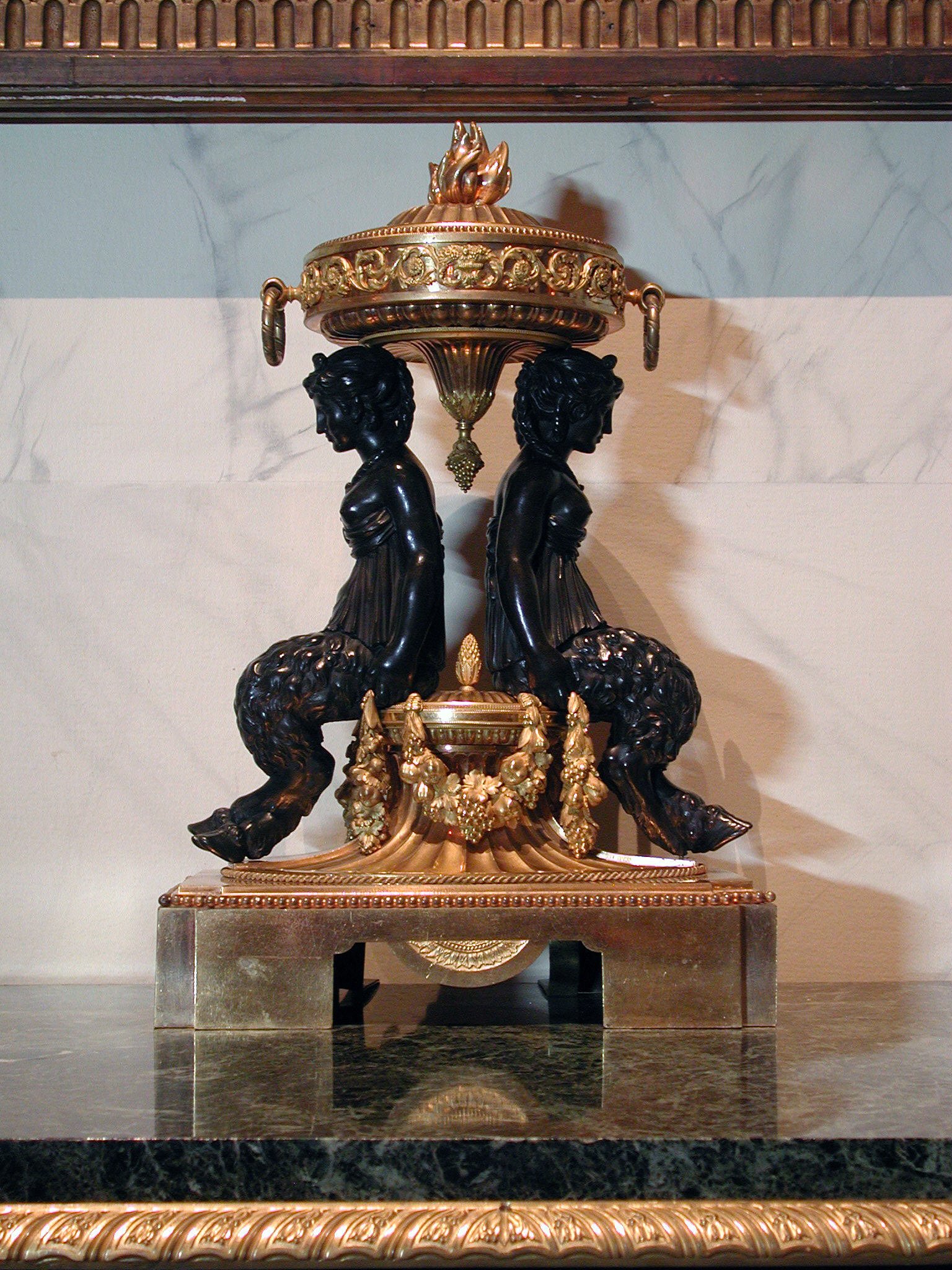
This pair of perfume burners was made around 1785. The Metropolitan Museum of Art in New York catalogues them as French. Each is 55.2 cm high, 34.6 cm wide, 21 cm deep. More than half a metre of bronze, a matched pair, made to stand symmetrically in a room.
The material is chased bronze, partly gilded and partly patinated. Patina is the dark colour on a metal surface, produced with chemicals or by time. The two surfaces sit side by side: bright gold, deep brown. According to the museum, this contrast between patinated and gilt bronze is the pair's most notable feature.
At the top is a pinecone finial. The base flares out, fluted and flattened, hung with heavy swags and pendants of fruit and flowers. This is the vocabulary of neoclassicism, fashionable in France in the later years of Louis XVI, when designers looked back to the architecture and objects of Greece and Rome.
The pair was a gift of Mr. and Mrs. Charles Wrightsman in 1977. They are on view in gallery 524 at the Met, among the European decorative arts.
A small machine for scent
From a distance, the burners look like two ornamental vases. But inside there is a clear function. According to the museum, a miniature stove or spirit lamp could be set into the receptacle, over which pastilles or sweet smelling essences were heated.
Pastilles of the time were pressed mixtures of fragrant resins, spices and substances that helped them smoulder. Warmed, they gave off scent without breaking into open flame. The smell rose with the heat, then spread through the room.
So the pair is a device. It has a heat source, a place for the aromatic material, a path for smoke and vapour to escape. Yet every technical part is hidden inside a beautiful form. No one wanted to see the machine. They wanted to see gilt bronze, fruit, pinecones.
Who the bronze worker may have been
The museum does not name the maker with certainty. But the Met suggests the pair may be by Pierre Philippe Thomire. Born in 1751, died in 1843, Thomire was one of the great sculptors and bronze workers of Paris in his day. He made gilt bronze for the aristocracy, and later for the court of Napoleon.
Recording the maker as unknown is not a gap. French decorative bronze of the eighteenth century usually passed through several hands: designer, caster, chaser, gilder. Very few pieces are signed. The museum states only what it knows, and marks what it supposes.
So the visitor today stands before an object clear in place and date, but blurred in its hand. The burners belong to a workshop, a city, a period, more than to a name.
Why the burners matter
In the late eighteenth century, the scent of an aristocratic European room was something calculated. People chose wood for the floor, silk for the walls, bronze for the lights, and a smell for the air. These burners show that smell being entrusted to some of the most costly objects, made by the most skilled hands.
They also show an odd relationship between fire and beauty. The room was heated, lit and scented by small flames hidden everywhere. The burners were among them. They are beautiful to disguise the fact that they are burning.
France at the time produced many other gilt bronze perfume burners, some with a clearly named maker, such as Claude Galle's perfume burner. Seen together, they reveal a whole trade: the trade of making casings for scent.
In gallery 524 there is no fire now. The two burners stand still, clean, cold. Their scent survives only in their name. But look closely and you can still see where the flame once sat.
Olfactory Art