
Essays · Olfactory Art
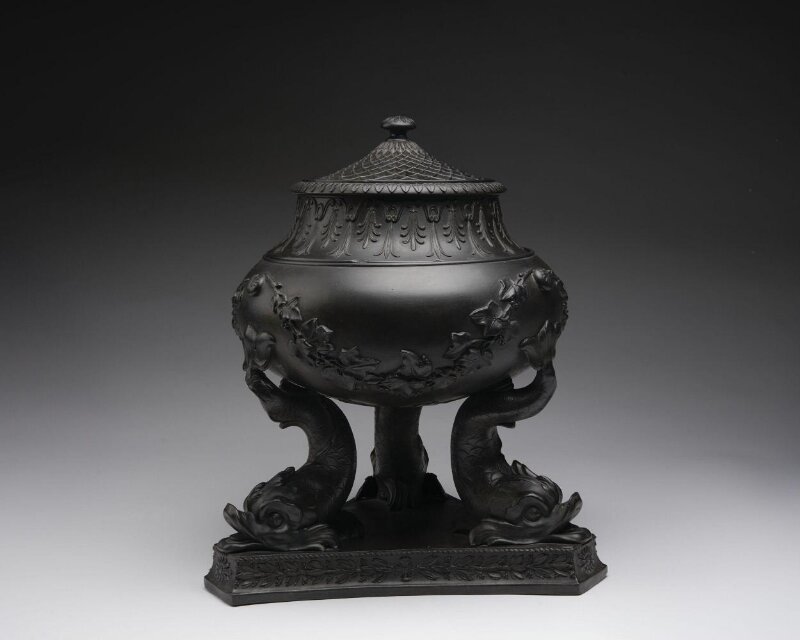
Josiah Wedgwood and Sons. Pastille Burner, Dolphin Tripod.
One smell lit so that another goes unmentioned.
© Victoria and Albert Museum, London; V&A Wedgwood Collection. Presented by Art Fund with major support from the National Lottery Heritage Fund, private donations and a public appeal. · Victoria and Albert Museum (V&A)
Three dolphins and a black bowl
The burner is 320 mm high and 280 mm wide, in two parts: bowl and cover. It was made at the Etruria works of Josiah Wedgwood and Sons around 1807 and now belongs to the V&A Wedgwood Collection. WEDGWOOD is impressed on the base. The record notes one short line of history: found on the works.
The form is easy to describe. A triangular foot with incurved sides. At each point of the triangle a dolphin, the three together supporting a round bowl. Around the bowl hang grapevine festoons from three bosses decorated with flower heads. The edge of the foot carries a laurel border.
The cover is conical, pierced at the top, with a round flower head finial. Its rim has a laurel border, its neck bellflowers and anthemion. The whole piece is unglazed.
The gallery label calls it a pastille or incense burner, shape 496. Its common name is the Dolphin Tripod.
Pastilles and drains
Pastille burners were popular vases in the eighteenth and nineteenth centuries. According to the V&A, they burned what were called cassolette perfumes: powdered willow charcoal mixed with scented oils and gum arabic, shaped into small cones. The pastille sat in the bowl and smouldered. Scented smoke escaped through the holes in the cover.
The reason is stated plainly: to counteract the smells of stuffy rooms and inadequate drains. Houses of the time had nothing like modern drainage. The smell of a home was a problem everyone knew and few wanted to mention.
The burner answered that problem with a beautiful object. It did not remove the source. It added another smell, stronger and more pleasant, and placed it inside a shape people wanted to look at. A guest entering the room saw three dolphins first. Then charcoal and oil. The remaining smell, the one being covered, was never introduced.
One thing is worth noticing. The object is not named after the smell it gave off. It is named after its shape. People remember dolphins and a tripod, not what the pastille smelled like that day.
From oil lamp to burner
The Dolphin Tripod did not begin as a burner. According to the V&A, it was first produced as an oil lamp and adapted as a pastille burner around 1804. The same shape, the same small fire in a bowl, moved from giving light to giving smell.
The material is black basalt. Josiah Wedgwood I, who lived from 1730 to 1795, used a local clay that fired black, known as Carr. He refined it and named the body black basalt, after the hard stone it imitated. Like stone, it could be cut and polished to a high shine.
So a burner made in 1807 came more than a decade after the man who created its material had died. The firm kept speaking the language he left: black clay imitating stone, classical ornament, reliefs applied to the body.
The tripod is an ancient form. Greeks and Romans used it in temples, tied to the sacrificial altar. Eighteenth century designers brought it into the drawing room, like the perfume burner the architect James Stuart designed for Spencer House. Wedgwood brought it one step further down, into fired clay, into an object many households could own.
The Dolphin Tripod is worth remembering because it shows that scent at home was once a practical matter. Not for relaxing, not for mood. For being able to live in a room. And people still chose to do that practical work with three dolphins.
Olfactory Art