
Essays · Olfactory Art
Josiah Wedgwood and Sons. Scent Bottle.
A face outside. A vanished smell inside.
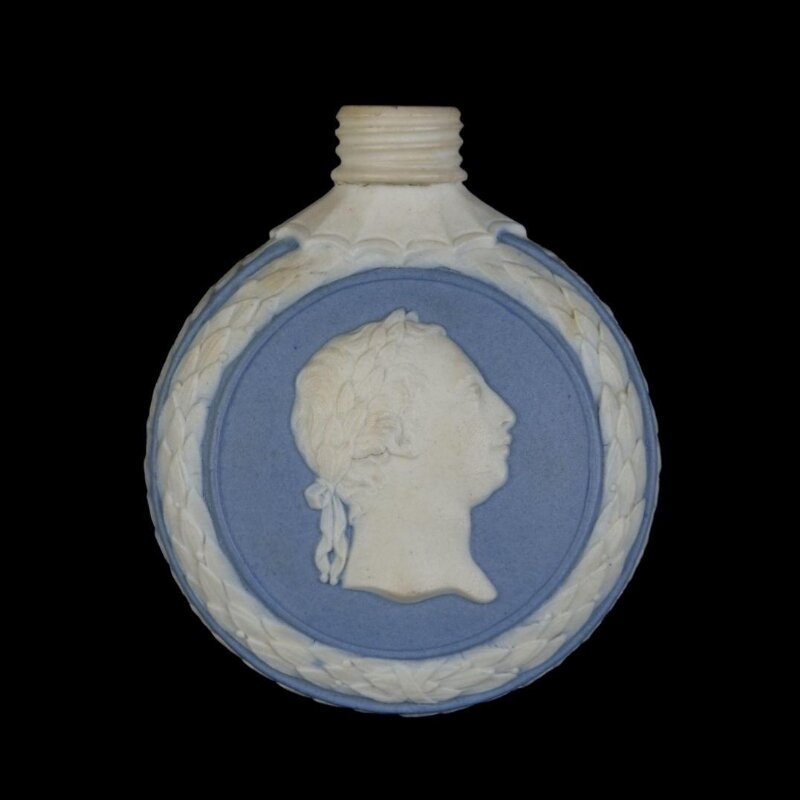
© Victoria and Albert Museum, London; V&A Wedgwood Collection. Presented by Art Fund with major support from the National Lottery Heritage Fund, private donations and a public appeal. · Victoria and Albert Museum (V&A)
An object the size of a palm
The bottle is 52 mm high, 43 mm wide and 17 mm deep. Round and flat, about the size of a pocket watch. It was made by Josiah Wedgwood and Sons at their Etruria works in Staffordshire, England. The Victoria and Albert Museum dates it to around 1785 to 1790.
The material is jasperware, a stoneware fired at high temperature. The bottle is blue, and the label calls it solid blue jasper: the colour runs through the clay itself rather than sitting on the surface. On that blue ground sit white reliefs, made separately and applied.
One side shows King George III in profile. The other shows Queen Charlotte, also in profile. Two faces set back to back through the thickness of a bottle.
The V&A holds two bottles of this type. One frames the portraits in a laurel border, the other in a classical border. Both belong to the V&A Wedgwood Collection, on display at the World of Wedgwood in Barlaston.
A material found by trial
Jasperware was Josiah Wedgwood's own invention in the 1770s. According to the V&A, it took him thousands of experiments over several years to perfect. The result could be coloured, cut and polished, which made it useful for many kinds of object: vases, medallions, buttons, and small bottles like this one.
The technique produces a very clear image. The ground is flat and matte. The white relief sits on top, crisp as a seal. There is no glossy glaze to blur the edges. A profile on a blue field reads clearly even when the object is barely larger than a fingertip.
That is why jasperware suited portraits. The profile head was the familiar format of coins and medals. People of the time knew at a glance who such a face was, and knew it was something worth keeping.
Wedgwood already had royal links. From the 1760s the firm's cream coloured earthenware was sold as Queen's Ware, named after Queen Charlotte. Her portrait on a jasper bottle continues that relationship, this time as a small object anyone with the means could buy.
A portrait for carrying a smell
A scent bottle is a private object. It lives in a pocket, a purse, on a dressing table. It is opened alone or very close to someone else. Placing the king and queen on such an object brings the most public image into the most private space.
Whoever carried this bottle carried two things. One was a smell, their own, changed at will. The other was an image the whole country recognised. The smell evaporated and had to be refilled. The faces stayed fixed in fired clay.
The museum record does not say what the bottle held. Perhaps a scented water, perhaps something else. Nobody wrote it down, and this essay does not guess. What is certain is that it was made to contain a smell, and that smell is gone.
So today a visitor at the case can only look. Blue ground, two faces, a laurel wreath. Nothing to smell. An object made for the nose now speaks only to the eye.
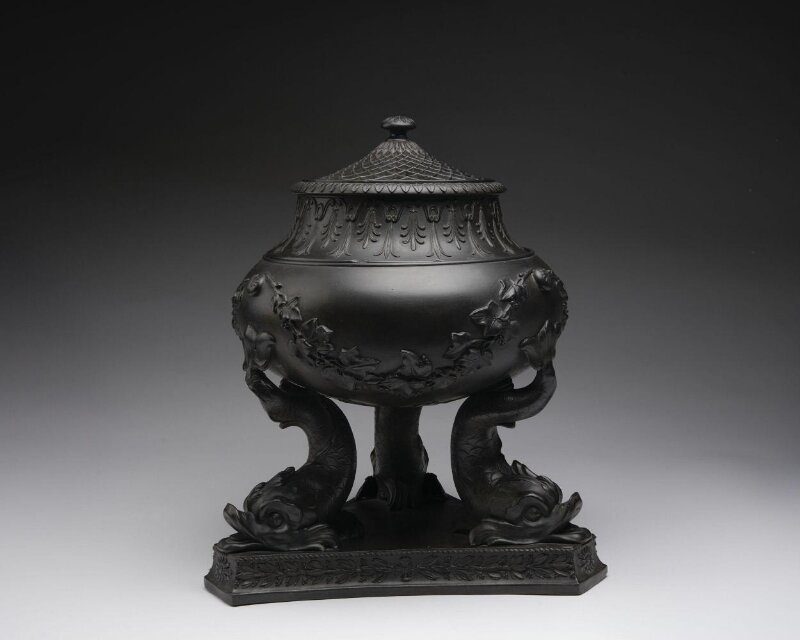
The bottle is worth remembering because it shows scent wrapped in other layers of meaning: a new material, an image of power, the fashion of a decade. The shell has lasted more than two hundred years. The core lasted only until the stopper was lifted for the last time. For Wedgwood objects that scented a whole room, see the Dolphin Tripod pastille burner.
Olfactory Art