
Essays · Olfactory Art
Fabergé. Miniature Easter Egg with Scent Bottle.
An egg that never hatches, only opens to release a scent.
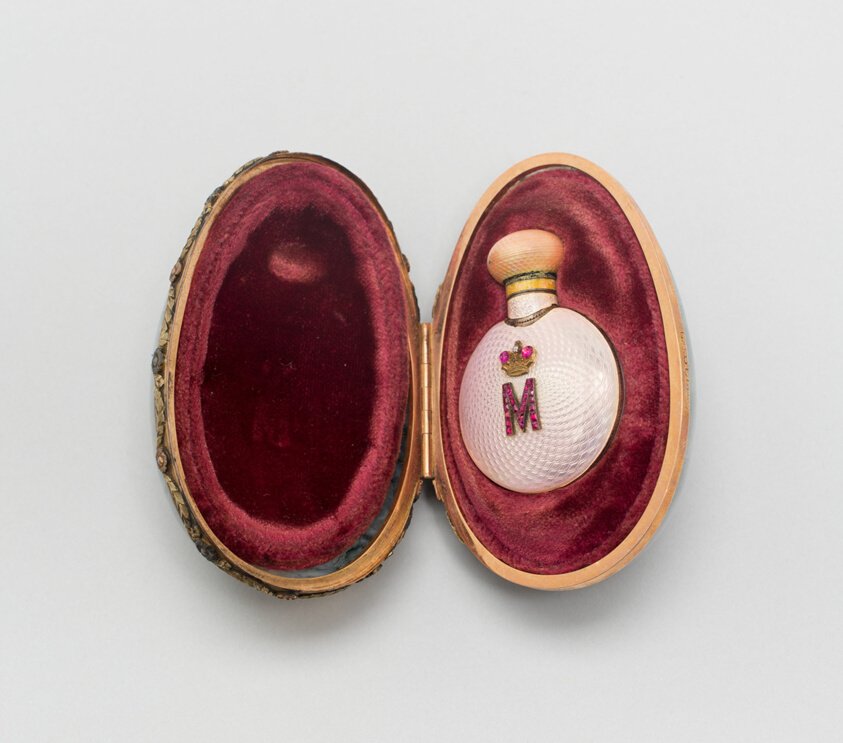
The Art Institute of Chicago, Gift of Mrs. Burton W. Hales through the Antiquarian Society in memory of Miss Grace M. Merchant · The Art Institute of Chicago
An egg that fits in a palm
This object sits in the Applied Arts of Europe collection at the Art Institute of Chicago. The museum's title is plain: miniature Easter egg with scent bottle. Its maker was the Fabergé workshop in Saint Petersburg. The date is given as before 1899.
It measures 5.1 cm high, 8.3 cm long and 5.6 cm deep. It fits in a palm and is heavy enough to remind you it is stone.
Four materials: moss agate, gold, enamel, and cabochon rubies. Cabochon means the stone is polished round and smooth, not faceted. It does not sparkle; it glows softly, like a drop of water.
The egg came to the museum as a gift of Mrs. Burton W. Hales, through the museum's Antiquarian Society, in memory of Miss Grace M. Merchant. An object made to be given, given once more.
The house of Fabergé began in Saint Petersburg in 1842 and worked until 1917. The name is tied to the imperial Easter eggs commissioned by Tsars Alexander III and Nicholas II as annual gifts for their wives and mothers, from 1885 to 1917.
But Fabergé made far more than imperial eggs: boxes, frames, desk objects, jewellery, scent bottles. The work was divided among a network of independent workmasters, each a specialist in enamel, stone carving or metal, all working under one name. Before 1917 the house employed some 500 people, from modellers and stone setters to enamellers.
The word workshop in the museum's attribution matters. This egg carries no single craftsman's name. It carries the name of a system, where stone, gold and enamel passed through many hands before becoming one object.
Egg, stone, scent
In Russia, giving eggs at Easter is an old custom. The egg stands for life beginning again. People gave painted eggs, wooden eggs, porcelain eggs, and among the wealthy, eggs of precious stone and metal. Small eggs could be kept, worn, displayed, never breaking like real ones.
Fabergé gave this egg a use: holding scent. It is not only a symbol but a tool. The recipient opens it and smells. The symbol of new life is filled with something living, a scent that slowly leaves.
Moss agate is a choice worth noticing. It is a translucent stone with branching mineral traces inside, like moss or small plants in water. It already carries an image of vegetation. Cut into an egg, the stone becomes a locked garden. Gold, enamel and rubies accompany the stone, smaller than it, like punctuation.
Why this small object matters
Fabergé's imperial eggs are often described as the summit of the jeweller's art: large, elaborate, with mechanisms inside. The Chicago scent egg is far more modest. Because it is small, it shows something else: scent had a place in the most luxurious world of late nineteenth century Russia, and that place fit in a hand.
It also shows how scent was thought of as something worth keeping. Not in ordinary glass, but in stone and gold. Scent treated as jewellery.
Another scent bottle of the same years, across the ocean, was made of silver and chased with ferns: Tiffany's Fern and Daisy bottle. Two objects, two cities, one idea: wrapping scent in the image of plants. In New York, leaves of silver. In Saint Petersburg, moss already inside the stone.
No one today knows what the egg once held. What remains is the shell: an egg that never hatched, holding the place of a scent that has gone.
Olfactory Art