
Essays · Olfactory Art
Tiffany & Co. Fern and Daisy Perfume Bottle.
A garden in silver, small enough to rest in a palm.
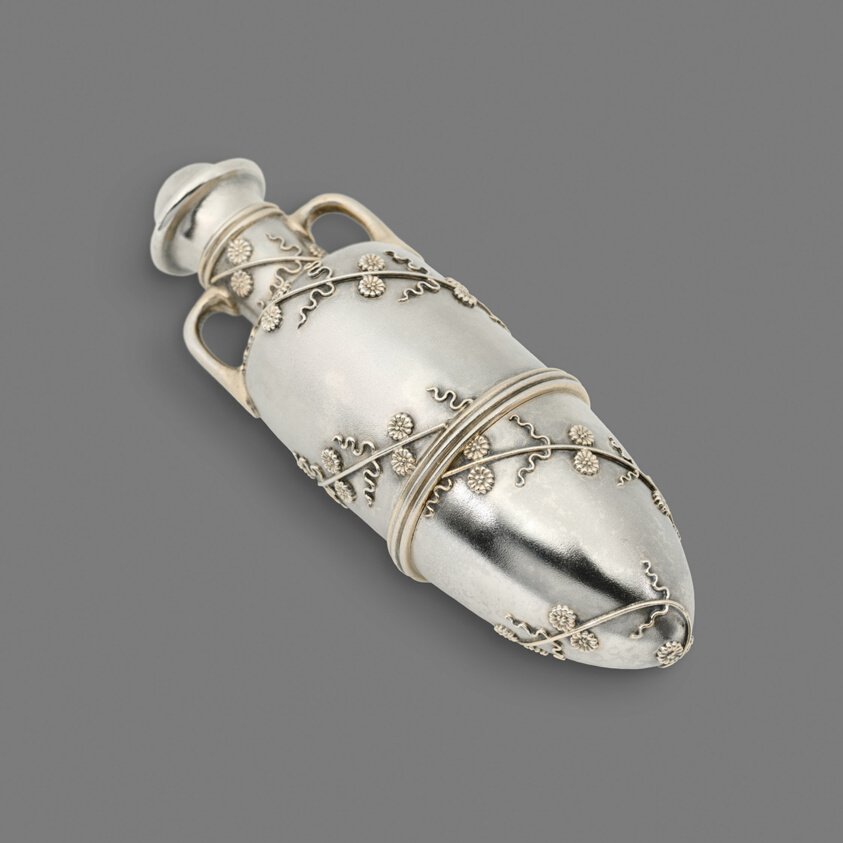
The Art Institute of Chicago, Gift of Anna Mantel Fishbein · The Art Institute of Chicago
An object twelve centimetres long
The bottle was made in New York between 1870 and 1875. According to the Art Institute of Chicago, it is 12.2 cm long and 3 cm wide, made entirely of silver. The size of a pen, of a long finger. Small enough for a handbag, a drawer, a palm.
Its name comes from its maker: Fern and Daisy. The number 2661 is the pattern number. The upper half is stamped with Tiffany and Company, 2661, Sterling, M2197 and Union Square. Each mark is a piece of information: who made it, to which design, in what silver, sold where.
The motif pairs two plants that rarely share a bouquet. The fern is all leaf, flowerless, living in shade and damp. The daisy is a field flower that opens in sun. On the bottle they share a narrow surface, the same silver, the same shine.
The bottle entered the museum in 1975, a gift of Anna Mantel Fishbein of Chicago. It belongs to the Arts of the Americas department, catalogued among silver, bottles and containers for personal grooming.
Marks that describe a silver shop
Tiffany & Co. was founded in New York in 1837. By the 1870s it had its own silver division, led by Edward C. Moore. Moore kept a vast design library of books on architecture, plants and metalwork, and taught his apprentices to draw and model from natural objects, a method borrowed from Parisian technical schools.
The M in the stamp is usually read as a mark of the Moore period. Sterling states the fineness of the silver. Tiffany was the first American firm to adopt the English standard of 925 parts silver per 1,000, before it became the standard in the United States. Union Square was the shop's address at the time, on the Manhattan square of that name.
So before it is a beautiful thing, the bottle is a document. The buyer could turn it over and read its origin. A visitor today can still read it, more than a century and a half later.
Nature, cast again
In the second half of the nineteenth century, American silver turned hard toward plants. Leaves, stems, flowers and fruit were chased and cast onto teapots, trays, vases and boxes. The fern in particular was loved in Britain and America then: collected, pressed, grown under glass, printed on fabric and ceramics. A fern on silver was a familiar image to buyers of the time.
But putting plants on a perfume bottle is not the same as putting them on a tea tray. Perfume in those years still came largely from flowers and plants. The bottle acts like a label without words. It says the contents belong to the garden, without naming the scent.
Silver was a reasoned choice too. It is opaque and keeps the liquid in the dark. It survives knocks, which suits an object carried on the body. And it brightens with use, as hands polish the places they touch most.
Why the bottle matters
Fern and Daisy is not a major work. It was not made for an exhibition or a court. It is a numbered pattern, made to be sold in a shop on a square. That is what makes it worth looking at: it shows scent entering the daily life of a city growing rich, and entering through silver.
It also preserves a way of thinking about scent. Scent wrapped in precious metal, decorated with plants, carried as a personal object. Scent belongs to the body, yet needs a shell to travel with the body.
Later the perfume bottle would move to glass, and designers such as René Lalique would make the bottle itself the image of the scent, as in the Cyclamen bottle for Coty. Tiffany's silver bottle stands one step earlier: the scent still hidden in the dark, the garden growing only on the outside.
Whatever liquid it held is surely long gone. What remains is form: fern, daisy, marks. A garden without a smell, holding the place of a scent that has passed.
Olfactory Art