
Essays · Olfactory Art
Incense burner in the shape of a goose.
An old form, recast for new smoke.
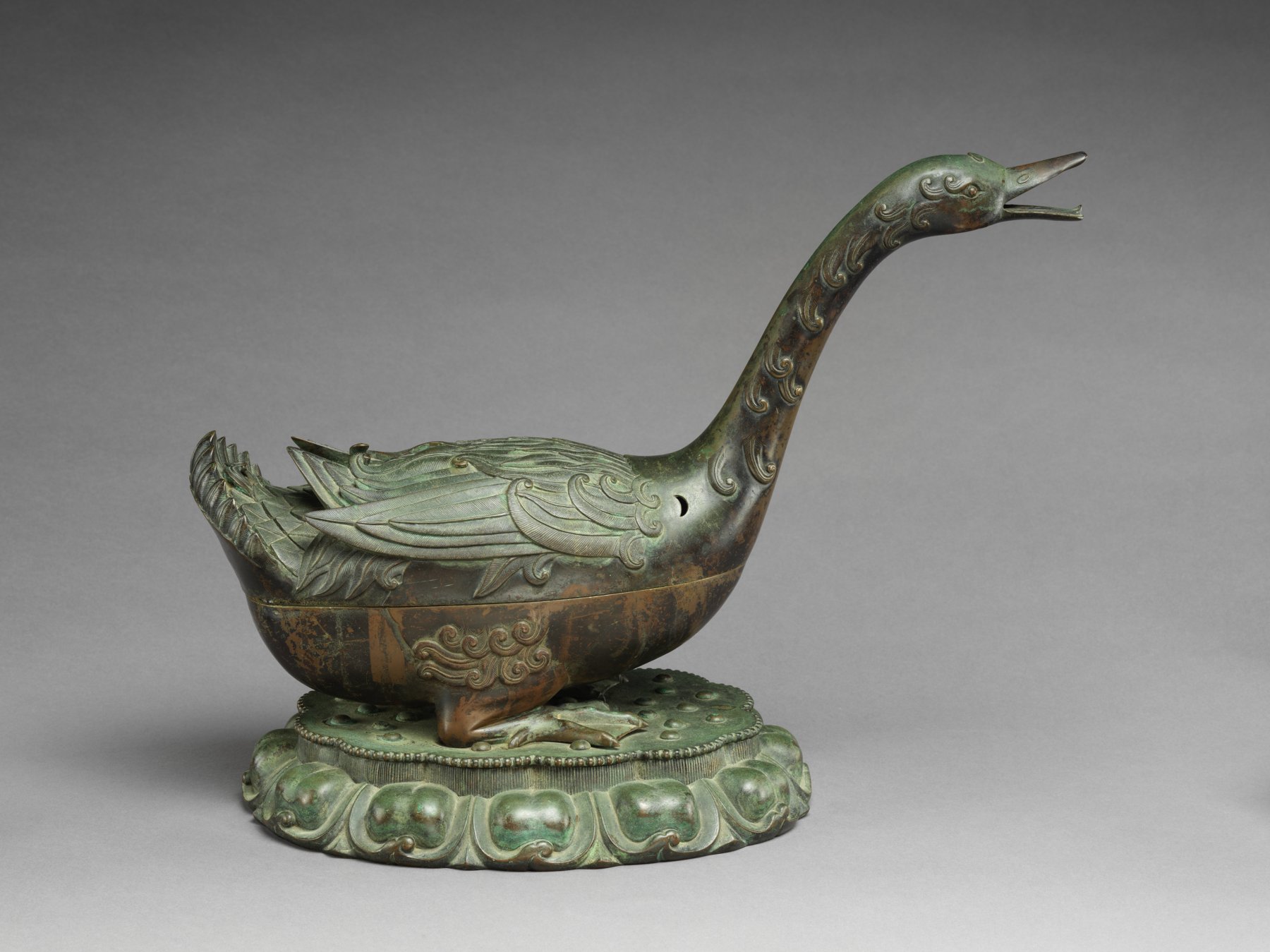
The Metropolitan Museum of Art, Purchase, The Vincent Astor Foundation Gift, 2020 (Open Access, public domain) · The Metropolitan Museum of Art
A goose nearly half a metre wide
The Metropolitan Museum of Art in New York holds an incense burner in the shape of a goose, made in China in the early 15th century, Ming dynasty. The museum dates it between 1400 and 1433. The material is recorded as copper alloy.
The size is worth a pause: 36.8 cm high, 47.6 cm wide. This is not a hand held object. It is a bird close to the size of a real goose, taking up a whole corner of a table. Its accession number has two parts, a and b: it is made in two separate pieces, most likely body and cover, so that it can be opened, filled with incense and closed again.
The museum bought it in 2020 with a gift from The Vincent Astor Foundation. It sits in the Department of Asian Art and is listed among the collection's highlights.
Incense burned inside the goose's body. Fragrant smoke left through its open beak. A heavy, cold metal bird suddenly had breath.
Bird burners, from the Han to the Ming
According to The Met, bird shaped incense burners were first made in the Han dynasty and revived in the 13th and 14th centuries. The goose belongs to that revival. It combines observation of the living animal, careful ornament, and a deliberate look back at history.
All three are in one object. The animal's form comes from looking at real geese. The ornament comes from the decorator's hand. And the whole idea, a bird exhaling smoke, looks back more than a thousand years. These do not conflict. A Ming maker could watch a goose by a pond and study an ancient burner in a book, then cast an object that holds both.
Chinese bronzes from the Song onward share a clear habit: ancient shapes and motifs were borrowed and put to new uses. Incense burners, flower vases, objects for the scholar's desk. Antiquities were not only kept. They were studied, copied, repurposed.
The goose stands in that current. It is not an antique. It is a new object made to remember antiques.
The one thing not recast
Looking at the burner, one sees time in layers. The Han, where the idea began. The 13th and 14th centuries, when it returned. The early 15th century, when this goose was cast. And 2020, when it entered a museum in New York.
Only one thing did not pass through those layers: the scent. No one knows what its first owner burned inside it. The record is silent. The form carried across six hundred years, across a thousand. The smoke of each burning lived only minutes.
Penta finds this worth saying about scent vessels. They are the durable part of something very brief. Great effort goes into the durable part: casting, finishing, ornament, the balance of neck and body. The brief part is left to fire.
Nearly three centuries earlier, a Song potter made a porcelain waterfowl on a lotus, its smoke also leaving through the beak. That object is light, bright, desk sized. The Ming goose is heavy, dark, nearly life size. The same idea spoken in two very different voices.
What they share is this: both treat smoke as the breath of a creature. Each time someone lights the incense, the goose lives a few more minutes.



Olfactory Art