
Essays · Contemporary Art
Bill Viola, Kira Perov. Martyrs (Earth, Air, Fire, Water).
A witness is one who stays long enough to see.
Tate · Tate
Four screens at the end of the aisle
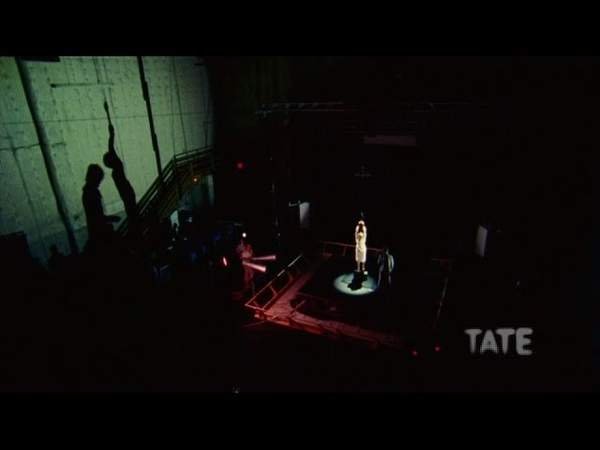
At the end of the choir aisle in St Paul's Cathedral, London, stand four narrow plasma screens, vertical, side by side. Walking past quickly, one might take them for four altar panels. Then the images begin to move.
This is Martyrs (Earth, Air, Fire, Water), a video work of 2014 by Bill Viola and Kira Perov. Tate describes it as the first permanent installation of a video work in a church or cathedral in Britain. It belongs to the Tate collection and stays in St Paul's on long term loan.
Kira Perov worked beside Viola for decades and was also his wife. She produced and shaped much of his video work. Her name next to his on this piece is not courtesy. It is an accurate record of who made it.
Bill Viola died in 2024. The four screens still light up every day in the same place.
Four people, four elements
Each screen holds one person and one element. In water, a man hangs upside down, recalling the legend of Saint Peter's crucifixion. Water pours over him, heavier and heavier, until he breaks through and slowly rises out of the frame.
In air, a woman stands in a wind that keeps growing. She sways, struggles to hold herself, then comes to realise she can stand, and moves through the force.
In earth, a body lies beneath soil. The footage runs backwards: dirt lifts away from each part of the body until the figure rises to the surface. In fire, a person is surrounded by flames. After an inner struggle, light appears and the figure passes beyond the chaos.
No blood. No executioner. No crowd. Only a person and a force of nature, in a frame narrow as a window. Viola said the work was about what people go through inside, not what can be seen from outside.
The witness
Martyr comes from the Greek for witness. In Christian tradition, martyrs kept their faith to the end through suffering. Viola and Perov keep that core and drop the narrative. None of the four has a saint's name. There is no familiar iconography to recognise.
What remains is endurance as an act. Standing in wind. Lying under earth. Waiting in fire. The work is slow enough that the viewer has to stop, and having stopped long enough, sees the moment of change: when the figure is no longer pushed, and begins to move.
Inside St Paul's, the work speaks to the architecture around it. The cathedral has its dome, statues and mosaics, made to last centuries. The screens are far more fragile, dependent on power, software and maintenance. Yet they do what altar paintings always did: hold people for a moment in silence.
Viola spent his life making video about water, fire, birth and death, as in The Crossing, where a man is consumed by fire and water. Martyrs is the quieter version, placed where people come to pray rather than to look at art. Perhaps that is why it belongs there.
Contemporary Art