
Essays · Contemporary Art
Bill Viola. The Crossing.
Through fire, through water, and something else remains.
Solomon R. Guggenheim Museum · Solomon R. Guggenheim Museum
A screen with two sides
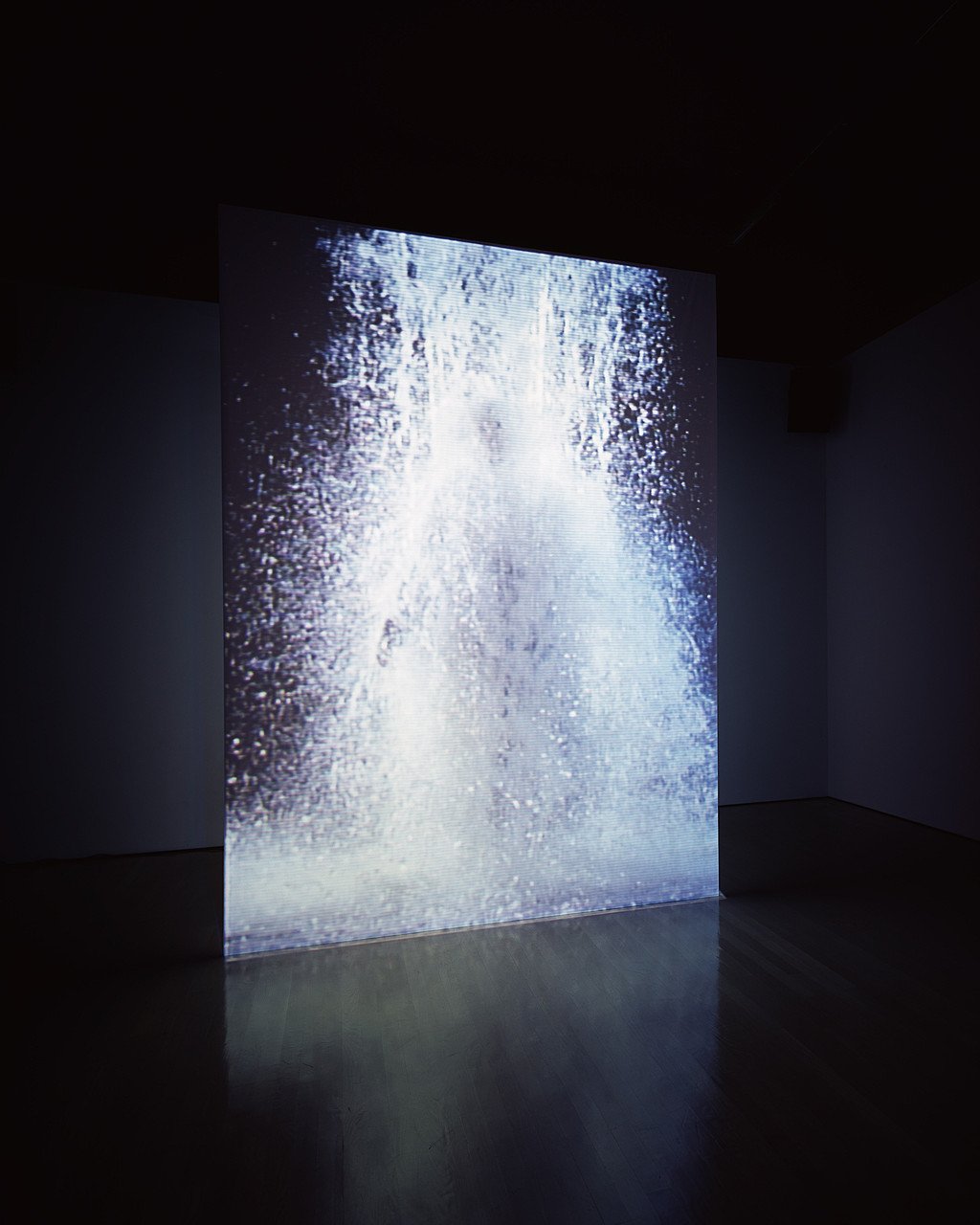
The Crossing is a two channel video installation Bill Viola made in 1996, now in the collection of the Solomon R. Guggenheim Museum in New York, among works given by the Bohen Foundation. At its centre is a freestanding projection screen in a dark room. Both sides of the screen carry an image.
Visitors can walk around it. On one side they see one story. On the other, its parallel. There is no spot from which both can be seen at once. To know the other side, you have to leave this one.
That arrangement is already half of the work's meaning. Two elements, two fates, one body, one screen. The viewer has to make the crossing too.
Water on one side, fire on the other
On one side a man walks out of darkness. He moves very slowly; the image runs many times slower than life. He comes closer until he faces the viewer, larger than life. Then, from above, water begins to drip. Drops become a stream. The stream becomes a torrent. Water crashes down and covers the body until he can no longer be seen.
When the water clears, the screen is empty. Then the scene begins again.
On the reverse, the same man approaches at the same pace. This time flames rise at his feet. They spread and climb until the figure is consumed in fire.
The Guggenheim describes the work as part violent destruction, part peaceful transcendence. The two halves are not separate. The moment the body disappears is also the moment it seems released.
Slow enough to see
Viola worked with video from the 1970s. He believed modern media could bring viewers close to spiritual phenomena. His tools were those of image production: large scale projection, slow motion, precise sound editing, looping.
In The Crossing, slowness does the main work. At normal speed a torrent falling on a man is a shock of a few seconds. At Viola's speed it becomes a process. We see water touch the shoulders, then the head, then cover everything. We see fire lick upward from the feet. Time is stretched until an event becomes a rite.
The loop does the second job. The man does not die once and for all. He walks forward, disappears, walks forward again. That circle is close to the cycles Viola cared about all his life: birth and death, making and unmaking.
Rites without names
Water and fire appear in the rites of many faiths. Water to wash, to initiate. Fire to burn, to purify, to offer. Viola chose no single religion. The museum notes that he drew on nonspecific spiritual processes from many belief systems. Viewers bring to the work whatever they already carry.
Around the same period Viola made The Messenger, first installed in Durham Cathedral in England: a man rises from dark water, takes a breath, sinks again. Years later he and Kira Perov brought four elements to St Paul's in Martyrs (Earth, Air, Fire, Water). The Crossing stands between them, with two elements and one screen.
Perhaps that is why it still carries weight. It does not preach. It shows a body entering something larger than itself, very slowly, again and again, until the viewer begins to wonder which side of the screen they are standing on.
Contemporary Art